

How to Buy Remy Hair Extensions At A Fair Price
Remy hair extensions use real human hair with all the cuticles facing the same way, from root to tip. That alignment keeps the strands from tangling, so remy hair outlasts non-remy hair and costs more. Inexpensive real hair extensions exist. You keep the remy grade and cut cost through length and weight, or by buying wefts instead of ready-made sets.
Two clip-in sets can carry the same “100% remy human hair” label and sit far apart on price. The label won’t tell you whether the cuticle survived processing, or how many grams sit in the box. Four home checks and one sum, price divided by grams, will.
Plenty of sellers compete for that sale. SNS Insider valued the global hair extension market at $3.01 billion in 2025, with $810 million of it in the United States, and put human hair at about 47% of the market. The firm expects remy hair to grow faster than the market as a whole, at about 7.4% a year.
What are remy hair extensions?
Remy hair extensions use human hair that the collector gathers with all the roots together, so the cuticles on each strand point toward the tips. The factory keeps that order through washing, wefting and packing. Remy describes how the collector gathered and lined up the hair, and it says nothing about dye: colored hair can be remy.
The cuticle is the reason alignment matters. Each hair has a coat of flat, overlapping cells that protect the cortex inside, as George E. Rogers sets out in a 2019 review in the journal Cosmetics. The cells overlap like roof tiles, with their free edges toward the tip. Keep the strands facing one way and those edges slide past each other; mix roots with tips and they catch, which is how hair mats.
Remy vs non-remy: two grades of human hair for extensions
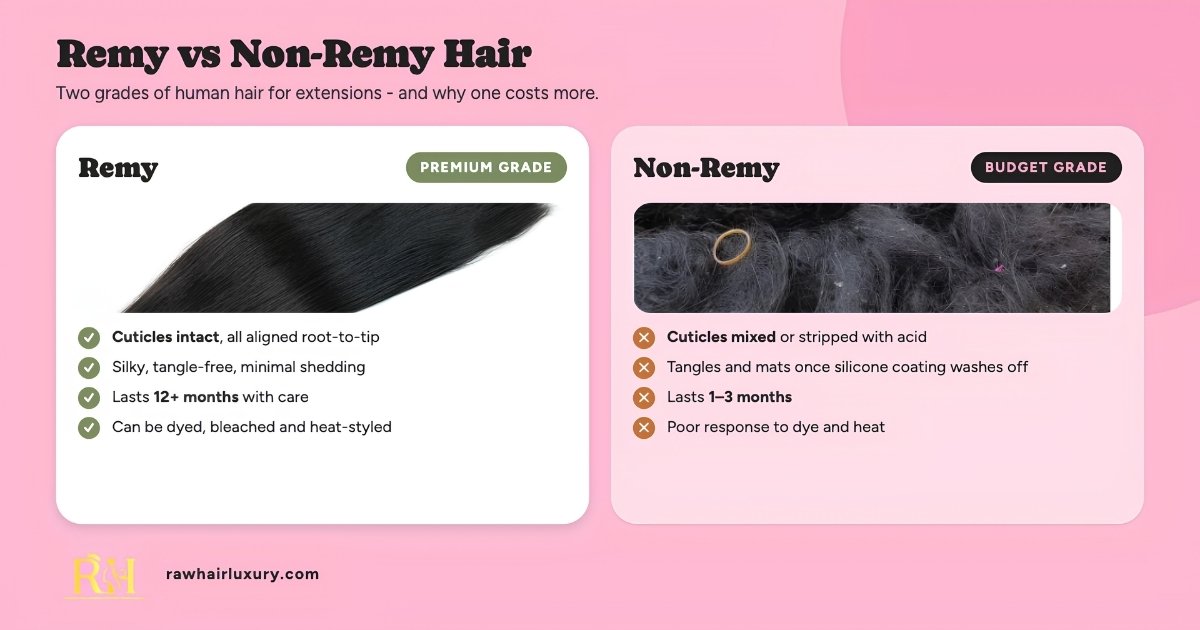
Non-remy hair comes from mixed sources, with roots and tips facing both ways in the same batch. To stop it matting, processors strip the cuticle in an acid bath and coat the hair in silicone, which gives it shine in the pack. Our virgin vs Remy hair guide covers that process step by step.
Both grades are real human hair, and both can look alike on day one. You find the difference in the wash. Once the silicone rinses out, non-remy extensions can tangle near the weft or bond, the spot you can’t reach with a brush while they’re in.
Human hair for extensions comes in more grades than those two. Labels such as machine remy and new remy add to the confusion, and sellers use them in different ways. Treat any grade on a label as the seller’s claim until the hair passes the checks below.
Where virgin and raw hair fit
Virgin hair has had no chemical processing, so no dye or bleach. Raw hair adds two conditions: one donor, and no steam styling, so it keeps the texture it grew with. Our Raw Sea extensions are raw hair: single-donor, unprocessed, with the cuticles aligned. Our story explains why we manufacture our own.
How can you tell real hair extensions from fakes?
You can tell with four checks: read the label, run a slide test, wash one weft and burn a few shed strands. Run them in that order, because the last two change the hair.
- Read the label for grade and grams. A listing for real hair states “100% human hair,” the grade and the weight in grams. A pack with no weight gives you nothing to compare on price.
- Run the slide test. Pinch a few strands near the weft and slide your fingers down to the tips, then back up. Aligned cuticles feel smooth going down and grip on the way up. If both directions feel the same, the cuticle may be gone.
- Wash one weft before you judge the set. Use a clarifying shampoo, skip the conditioner and let the weft air dry. Silicone-coated non-remy hair turns dry and rough once the coating rinses out, while remy hair stays soft.
- Burn a few shed strands. Take two or three strands that come loose when you comb the set, hold them in tweezers over a sink and touch them to a flame. Human hair smells like burning hair and leaves a dull bead you can crush. Synthetic fiber melts into a hard bead with a chemical smell, the same results textile fiber guides list for animal and synthetic fibers.
Check the seller’s return terms before step 3. Some sellers refuse washed hair, and our warranty card asks for an unboxing video with any return or exchange.
Which type of remy hair extensions suits you?
Pick the method first, then the hair. Clip-ins suit occasional wear and first-time buyers, because you put them in and take them out yourself. Salon methods stay in for weeks or months, and a stylist fits and refits them.
| Type | Who installs it | One application lasts | Good fit for |
|---|---|---|---|
| Clip-in | You, in minutes | A day; take them out at night | Occasional wear, first-timers |
| Tape-in | A stylist | 6 to 8 weeks, then re-taped | Daily wear without braids |
| Sew-in weft | A stylist | 6 to 8 weeks | Braided installs, thick or textured hair |
| I-tip (micro-link) | A stylist | 2 to 3 months | Salon wear without glue |
| Keratin bond (fusion) | A stylist | 3 to 6 months | The longest time between visits |
Stylist estimates from The Knot (2025): Vicki Casciola, artistic director at hairtalk, and Tabitha Osman, hairstylist and holistic trichologist.
Where remy hair matters most
Remy matters most for methods you wear for weeks. You wash tape-ins, sew-ins and bonds while they sit in your hair, and you can’t detangle near the attachment the way you can a clip-in laid on a table. If a non-remy set loses its coating there, the tangles form where your brush can’t reach. Clip-ins come out each night and dry flat after washing, so tangles have fewer places to hide.
How do you match remy hair extensions to your hair?
Match texture first and color second, and check both against your own hair in daylight.
Texture. Choose the texture you wear most days. Our straight raw hair has a low luster that blends with relaxed and silk-pressed hair, and our wavy sets suit hair with a loose bend. If you wear coily hair natural, a sew-in with a closure or frontal keeps your own hair braided under the install, so the front needs no texture match.
Color. Match the extensions to the ends of your hair, where color runs lightest, and hold a weft against them by a window instead of under bathroom light. Raw hair keeps the donor’s shade, in the natural black to dark brown range. For a lighter shade, a colorist lifts the extensions to match, and our raw hair lifts as far as 613 blonde.
How much do real hair extensions cost?
Price follows two numbers: length and weight. Longer hair costs more because fewer donors grow it, and a heavier set holds more hair. Grade sets the base price, with raw and remy hair above non-remy. Salon methods add a stylist’s fee on top.
Our own price list shows the length effect. A 100-gram Raw Sea Straight bundle runs from $80 at 12 inches to $179 at 34 inches, adding $9 for each two inches. Our Raw Sea Straight clip-in sets run from $130 at 14 inches to $225 at 24 inches.
Where to find inexpensive real hair extensions
Keep the remy grade and cut cost around it:
- Buy the length you’ll wear. Each two inches adds $9 to a Raw Sea bundle, so a 16-inch bundle costs $81 less than a 34-inch one.
- Buy the grams you need. A few wefts at the crown add volume for less than a full-length set.
- Buy from the manufacturer. We make our hair in our own factory and sell it direct, so no middleman adds a markup.
- Buy the set, not the singles. Our bundle-and-closure combos cost less than the same four pieces bought one at a time: $394.70 against $461 at 18 inches.
Watch for one trap. If a seller prices a remy set like non-remy hair, you’re trusting the label, so run the four checks the day it arrives, inside the return window.
How long do remy hair extensions last?
With care, remy hair lasts six months to a year in the common formats. Vicki Casciola gives clip-in hair six months to a year, tape-in hair up to eight to 10 months and sewn-in weft hair up to a year. You decide where in that range you land through the way you wash and heat the hair.
A care routine that protects the cuticle
- Brush from the ends up with a loop brush or wide-tooth comb, holding the weft or bond still.
- Wash when product builds up, with a sulfate-free shampoo. Condition from mid-length to the ends and keep conditioner off tapes and bonds.
- Air dry on a towel and skip wringing.
- Keep heat under 400°F and use a heat protectant.
- Store clip-ins flat or hanging in a dust-free bag, and take them out before you sleep.
- Book a colorist for color changes after you know you’re keeping the hair, because bleaching or dyeing voids our warranty card.
Choosing remy hair extensions
Remy hair extensions cost more because the hair keeps its cuticle in order, and that order keeps it soft through washing and heat. Check the label, run the slide test, wash one weft and burn a few shed strands before you trust a pack. Save on length and grams, and keep the grade.
Browse our Raw Sea clip-ins, made from single-donor raw hair in our own factory, and pick your length.
==========
- RAW HAIR LUXURY — MORE THAN JUST HAIR, IT’S CONFIDENCE
- Website: rawhairsglobal.com
- Instagram: @rawhairluxury
- WhatsApp: +1 604 841 9668