

What Is Virgin Hair? How to Choose Virgin Hair Bundles
Virgin hair is human hair that was never dyed, bleached, permed or relaxed before it was cut from the donor. The word describes the hair’s chemical history up to the day of collection, and nothing after it. Raw virgin hair goes one step further: no chemicals, no steam and no coating in the factory either. This guide follows one bundle from scalp to pack, so you can read every word on the label and choose bundles that last.
What does virgin hair mean?
Virgin hair means hair that has never had a chemical treatment: no permanent or semi-permanent color, no bleach, no perm, no relaxer and no keratin straightening, from the day it started growing to the day it was cut. The boundary is the cut. Everything a collector or factory does after that is a separate claim, and the word virgin does not cover it.
Some packs stretch it to “virgin unprocessed human hair,” which only repeats the claim. No certifying body inspects hair for the word. A farm has to pass an inspection under the USDA’s National Organic Program before it can print “organic” on a carton; nothing like that exists for a pack of virgin human hair. The seller writes the word, and the buyer checks it. That gap explains why so many packs carry it. Hair that was steamed into a wave, washed in an acid bath or coated in silicone can still be called virgin by a seller who reads the word narrowly, because none of those steps is a dye or a perm.
So when you search “virgin hair what is” or “whats virgin hair”, the short answer is a chemical history, and the useful answer is a question back to the seller: what happened to this hair after the cut?
Virgin human hair vs 100% human hair: what the word adds
“100% human hair” is a claim about fiber. It says the pack holds no synthetic strands, and nothing more. A bundle can be 100% human hair and bleached, dyed back to black and coated to shine. “Virgin human hair” stacks a second claim on top of the first: the fiber is human, and nobody put chemicals on it while it was growing. Our virgin hair vs Remy hair guide adds the third word, Remy, which covers cuticle direction, and shows you how to test all three on your kitchen table.
Where does virgin hair come from?
Virgin hair comes from people who never colored or chemically straightened their hair, which in practice means long hair from a small number of collecting regions in South and Southeast Asia. Collectors buy hair from women who grow it to sell, and temples in South India shave the heads of pilgrims and auction the hair. The South China Morning Post reports that the trust running the temple at Tirupati says about 12 million devotees shave their heads there each year, and that Indian companies clean and sort the hair before export.
The raw material moves across borders before it becomes a bundle. In February 2025 India’s Directorate General of Foreign Trade set a minimum export price of US$65 per kilogram on raw human hair, after reports of hair being smuggled into Myanmar and China. Vietnam sits in the same flow. UN Comtrade figures published by TrendEconomy show that in 2022 Vietnam exported about $0.9 million of unworked human hair and imported about $5 million, with roughly half of those imports coming from China and a third from Myanmar.
[IMAGE: A simple map-style diagram of the raw hair trade with arrows from India and Myanmar into Vietnam and China, then onward to North America. Alt text: “Where raw virgin hair travels before it becomes a bundle”]
That is the fact behind every origin word. A country name on a pack tells you, at best, where the factory sits. It cannot tell you where the donor lived, because the factory may have bought the hair from a trader two borders away.
Virgin Vietnamese hair, Brazilian virgin hair bundles and other origin words
Each origin word is worth reading on its own terms:
- Virgin Vietnamese hair. Northern Vietnam has collectors and factories, and virgin Vietnam hair extensions have a reputation for a straight, low-luster finish. The trade data above also shows Vietnam as an importer of raw hair, so “Vietnamese” on a pack may describe the factory, the donor, or both. Ask which.
- Brazilian virgin hair bundles. In the extensions trade, Brazilian mostly names a finish: fuller, a little coarser, and able to hold a wave. Much hair sold as Brazilian virgin human hair was collected in Asia and processed to that finish. Treat the word as a texture, not a passport.
We leave the country off our packs for that reason. Our Raw Sea hair comes from single donors in Asian collecting regions, and we sew it in our own factory, so one company answers for the donor and the weft. Our hair extension vendors guide lists the origin questions worth asking any seller, including us.
What is raw virgin hair, and how is it different?
Raw virgin hair is hair the factory also left alone: one donor per bundle, cuticles kept running root to tip, and no steam, acid bath, dye or silicone after the cut. Virgin describes the donor. Raw describes the factory. A pack of raw virgin hair bundles carries both claims, and you can test each one separately.
The difference shows up in what a factory is allowed to do under each word. Three steps are common, and only the last one takes the word virgin off the pack:
- Steam texturing. The hair is wrapped on rods and steamed into a wave or curl. No chemical touches it, so many sellers keep calling the result virgin. The set relaxes over washes, and a steamed “virgin curly” bundle drifts toward its natural straight.
- Acid bath and silicone. Hair swept up with roots and tips mixed will tangle, so processors strip the cuticle in an acid bath and coat the strands in silicone. Dermatologist Maria Fernanda Reis Gavazzoni Dias notes that silicone can re-cement lifted cuticle scales, which is why a coated bundle feels smooth in the pack and turns rough after a few washes.
- Bleach and dye. This is the one that breaks the word. In a 2018 study in the International Journal of Cosmetic Science, Grosvenor and colleagues found that peroxide reaches the cortex quickly and oxidizes the fiber throughout, converting cystine bonds into cysteic acid, leaching cuticle and cortex proteins, and degrading melanin even at the mildest bleach they tested. Hair that has been through that and dyed back to black can sit in a pack marked virgin, but it cannot behave like virgin human hair at the flat iron or the sink.
| Stage of the hair’s life | Virgin hair | Raw virgin hair | Steam-processed “virgin” | Processed (non-virgin) |
|---|---|---|---|---|
| Dye, bleach or perm before the cut | None | None | None | Often |
| One donor per bundle | Not required | Yes | Not required | No |
| Cuticle direction | Not guaranteed | Root to tip | Usually root to tip | Stripped |
| Steam to set a texture | Allowed by many sellers | No | Yes | Yes |
| Acid bath or silicone coating | No | No | No | Yes |
| Shade varies between bundles | Yes | Yes | Yes | No, dyed to one shade |
| How it ages | Holds up if cuticles are intact | Holds up across reinstalls | Wave relaxes, hair stays sound | Rough after the coating washes off |
Why the cuticle decides how virgin hair extensions age
Each strand wears a coat of flat, overlapping cells with their free edges pointing toward the tip, as hair scientist George E. Rogers describes in a 2019 review in Cosmetics. An intact, aligned cuticle lets strands slide past each other, reflects light evenly and keeps water out of the cortex. Every factory step in the table above either leaves that coat alone or damages it. That is why high quality virgin hair is a question about the cuticle, and the word on the pack is only where the question starts.
How can you tell good virgin hair before you test it?
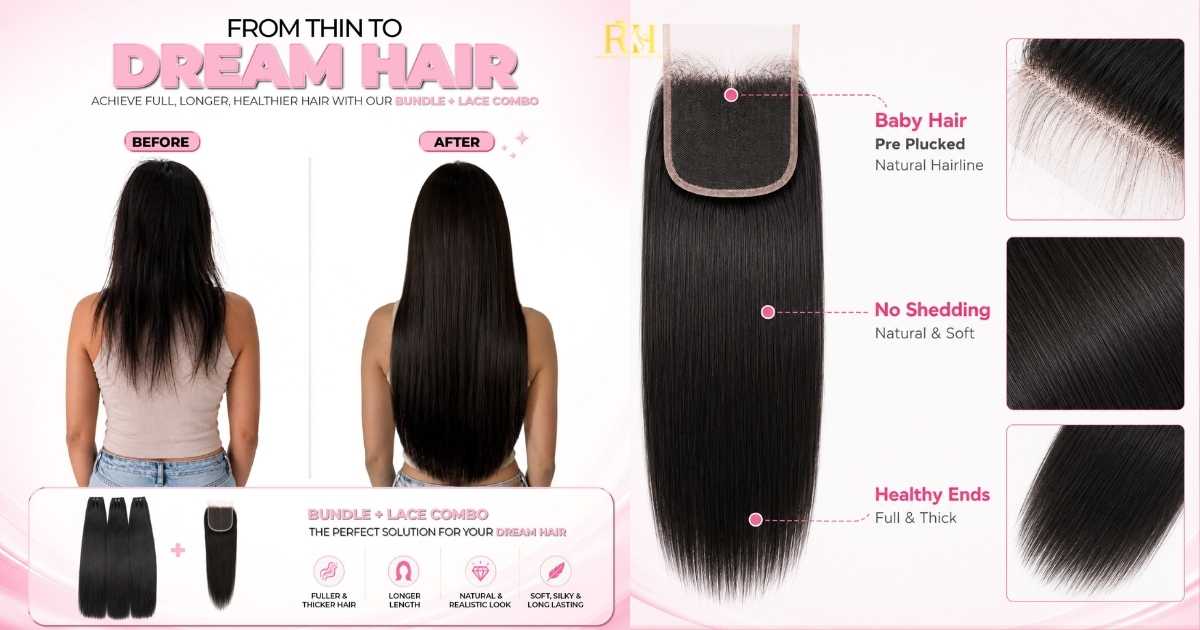
You can rule out most processed packs before a single strand burns, by reading what the seller printed and what the bundle shows in daylight. The burn test, slide test and wash test are in our virgin vs Remy guide; these four checks come first.
- Compare shades across bundles. Raw hair keeps each donor’s own color, in the natural black to dark brown range, so three bundles laid side by side in daylight rarely match exactly. Three bundles in one flat jet black usually mean dye, and dye means the pack is not virgin.
- Look at the ends. A donor’s hair tapers toward the ends. Raw bundles show that taper unless the factory removed the shorter strands (double drawing), which a seller should state. Ask whether the bundle is single or double drawn, and why the ends look the way they do.
- Find the grams. Good virgin hair is sold by weight. Divide the price by the grams and you can compare any two packs in one line, and decide whether a premium virgin hair price is buying you grams or a word. A pack with no weight printed on it gives you nothing to divide.
- Ask three factory questions. Did you steam it? Did it go through an acid bath? Is each bundle one donor? A seller who owns the factory answers all three in a sentence. A reseller has to ask someone else.
Choosing virgin hair extensions: bundles, wefts and skin wefts
Choose the format by the install you want, then hold that format to the virgin claim. Virgin human hair extensions come on a machine weft for a sew-in, on a skin weft for tape-ins, on clips for daily wear, and tied into lace for closures and frontals. The hair can be identical across all four; what changes is how long it sits on your head between washes and how much of it your stylist can reach with a comb.
| Format | What it is | Install | Why virgin matters here |
|---|---|---|---|
| Virgin human hair bundles (machine weft) | A virgin human hair weft: hair stitched along a thread seam, cut to fit each track | Sew-in (a virgin human hair weave), quick weave | The weave stays in for weeks and gets washed in place; coated hair mats at the track where a comb can’t reach |
| Virgin hair skin weft (tape-in) | Hair bonded into a thin polyurethane strip, worn with tape | Tape-in, re-taped every six to eight weeks | The same hair is reused for months of re-tapes; a coating washes off long before the bond gives up |
| Virgin clip-ins | A machine weft with clips sewn along the seam | Clipped in and out daily | Least exposed, because you detangle it flat on a towel |
| Closures and frontals | Hair hand-tied into HD lace | Sewn at the front of a weave | The lace piece takes the most heat and parting; damaged cuticles show first at the part |
Our Raw Sea line runs through the first, third and fourth rows: virgin human hair bundles and clip-ins on a double machine weft, and closures and frontals on HD Swiss lace, all from the same single-donor hair, sold as raw virgin hair bundles at every length from 12 to 34 inches. A double machine weft carries two rows of stitching, so the bundle holds together through a take-down and goes back in for the next install.
How many virgin hair bundles do you need?
Two 100-gram bundles cover a 12- to 14-inch install or light volume. Three cover a full sew-in from 16 to 22 inches, our most popular set with a closure. Four cover 24 inches and longer, because a longer bundle at the same weight holds fewer strands. Our human hair bundles guide turns that into a full install cost. At October 2026 sale prices, a 100-gram Raw Sea Straight bundle runs from $62 at 12 inches to $185 at 34 inches.
Frequently asked questions
What is virgin hair? Virgin hair is human hair that was never dyed, bleached, permed or relaxed before it was cut from the donor. The word covers the hair’s chemical history up to the cut and nothing after it. A factory can still steam, coat or mix it, so the label is a starting claim to test rather than a guarantee of quality.
Is virgin hair the same as raw hair? No. Virgin describes the donor: no chemicals while the hair was growing. Raw describes the factory: one donor per bundle, cuticles kept root to tip, and no steam, acid bath or silicone after the cut. Raw virgin hair carries both claims. A bundle can be virgin and steamed into a wave, but it cannot be raw and steamed.
Is virgin hair better than Remy hair? They answer different questions. Remy means the cuticles on every strand run the same way, root to tip. Virgin means no chemical treatment. Dyed hair can be Remy, and virgin strands can be non-Remy if roots and tips were mixed at collection. The combination you want is virgin Remy, and raw hair adds a single donor and no steam on top.
What is Brazilian virgin hair? In the extensions trade, Brazilian mostly names a finish rather than a country: fuller, slightly coarse, and able to hold a wave. A lot of hair sold under that name was collected in Asia and processed to that look. Read the word as a texture description and ask the seller where the donor lived and what the factory did after the cut.
Can you bleach or dye virgin human hair? Yes, and it takes color well because the cuticle is intact and nothing blocks the dye. A 2018 study in the International Journal of Cosmetic Science found that peroxide damages the cuticle and cortex even at mild strengths, so book a colorist for the first lift. Our Raw Sea bundles lift to 613 blonde; coloring voids our warranty card, so color only hair you have decided to keep.
How long do virgin hair bundles last? It depends on the factory stage more than the virgin stage. A steamed or coated bundle fades as its finish washes out. Raw virgin hair with intact, aligned cuticles survives a take-down, a wash and a reinstall; you set the limit with heat under 400°F, a heat protectant and a satin bonnet at night. We build our Raw Sea bundles for more than one install.
Reading the label in one pass
Virgin hair is a claim about the donor. Raw virgin hair adds a claim about the factory. An origin word is a claim about geography that the hair itself cannot prove. Read the three in that order, check the shade, the ends and the grams, and ask what happened after the cut. The hair that passes all of that is the hair worth paying bundle prices for.
Start with one Raw Sea bundle at your length before you commit to a full set. Lay it beside your own hair in daylight, run the four checks above, and order the rest once you have seen it.
==========
- RAW HAIR LUXURY — MORE THAN JUST HAIR, IT’S CONFIDENCE
- Website: rawhairsglobal.com
- Instagram: @rawhairluxury
- WhatsApp: +1 604 841 9668