

What Is Yaki Hair? Meaning, Texture and Yaki Straight Explained
Yaki hair is extension or wig hair with a fine grain that copies the look of relaxed or pressed Afro-textured hair. Factories make yaki from human hair or synthetic fiber. The word names a texture, so it tells you how the hair looks and nothing about its quality. Yaki straight, the most common version, blends with a relaxer or a silk press.
Yaki hair meaning: where does the name come from?
Yaki is a trade name, not a technical one – no hair science text defines it, and no standards body regulates it. In a product listing it means hair with a visible grain, processed to match Black hair that has been relaxed, flat-ironed or blown out. The name came from the industry and stuck. That’s all it tells you.
What actually affects your order is which yaki you’re buying. Three show up in listings:
- Yaki straight – smooth with a faint grain. Reads like freshly silk-pressed hair. Blends with relaxed and pressed clients.
- Yaki – more grain, slightly coarser to the hand. The default “relaxed look” texture most wholesalers mean when they write yaki with no qualifier.
- Kinky yaki – coarsest of the three, closer to blown-out natural hair. Blends with transitioning and natural clients who wear their hair stretched.
The grade names are not consistent between suppliers. One factory’s “yaki” is another’s “yaki straight,” so the word on the invoice is not a spec.
Yaki hair texture: why does silky straight hair fail to blend?
Silky straight hair shines and slides in a way relaxed Afro-textured hair doesn’t, so the join between your hair and the extensions shows. Yaki hair texture adds grain to close that gap.
The difference starts in the strand. A team at L’Oréal Recherche led by A. Franbourg compared hair from African, Asian and Caucasian donors and found that fiber geometry and mechanical behavior differ by ethnic origin (Journal of the American Academy of Dermatology, 2003). The International Society of Hair Restoration Surgery sums up the geometry: Asian hair has a round cross-section and the largest diameter, and African hair has an oval cross-section that varies from strand to strand.
A relaxer straightens the curl. It leaves the oval shape and the grain. Run your fingers down relaxed hair and you feel a slight crimp; look at it in daylight and you see a matte finish. A round, smooth strand of silky Asian hair reflects light as one sheet. Put the two side by side at your leave-out and the extensions look brighter and slicker than the hair growing from your scalp.
Yaki hair closes that gap. You feel it as a fine bend along the strand, and you see it as lower shine.
Yaki straight, light yaki and kinky straight: which is which?
Sellers sort yaki hair by how much grain it carries. No industry standard sets the names, and one brand’s light yaki can match another brand’s yaki straight, so judge by photos and video instead of labels.
| Texture | Looks like | Feel | Blends with |
|---|---|---|---|
| Silky straight | Fine hair after a flat iron | Smooth, high shine | Fine straight hair, with no relaxer or press |
| Light yaki (silky yaki) | A fresh silk press | Smooth with a faint grain | A silk press or a relaxer in its first week |
| Yaki straight (regular yaki) | Relaxed hair a week or two after styling | Visible grain, low shine | Most relaxed and pressed leave-outs |
| Kinky straight | A blowout on natural hair | Coarse and full, with frizz on the surface | A blowout, or a relaxer with weeks of new growth |
| Kinky curly | Natural 4-type coils | Coily, springy | Natural hair worn in its curl pattern |
Yaki straight hair sits in the middle of the range, and most buyers start there.
Match yaki to the middle of your cycle
Relaxed hair changes between touch-ups. In the first week it looks closest to light yaki. By week six, the new growth at your roots gives your leave-out more texture near the scalp. A silk press drifts the same way: humidity and sweat pull it back toward your natural pattern within days.
Pick the yaki that matches your leave-out halfway between appointments. Take a daylight photo of your hair on that day and hold it next to the seller’s photos. If you land between two textures, choose the coarser one. You can smooth yaki with a flat iron on a low setting, and you can’t add the grain back at home.
Is yaki hair human hair?
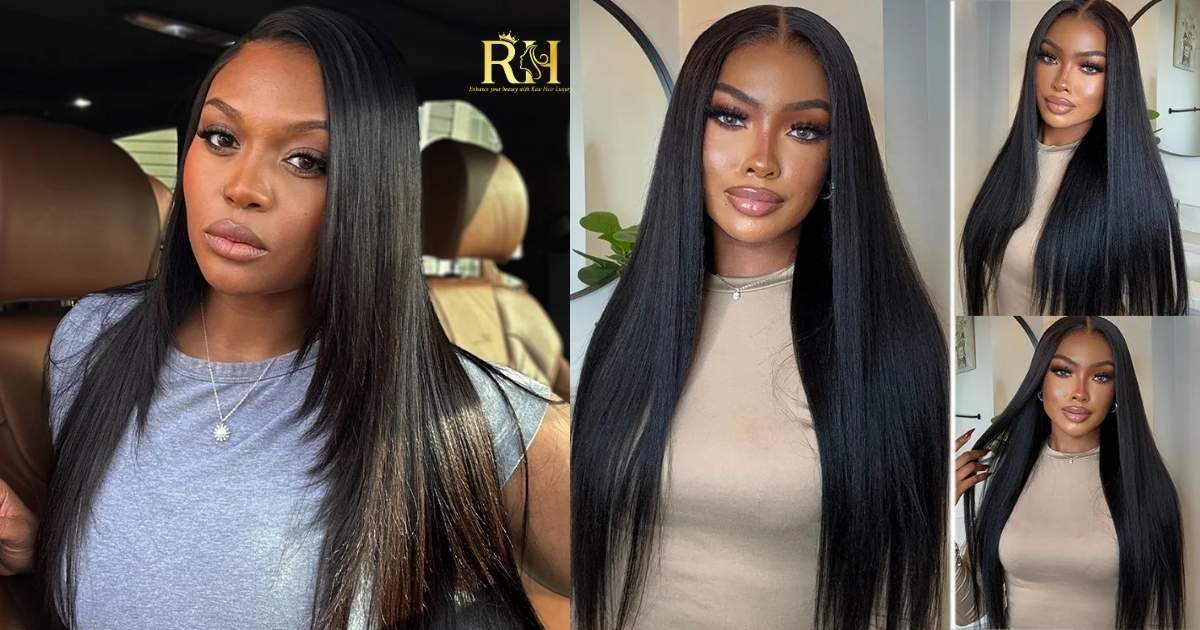
Yaki hair can be human hair, synthetic fiber or a blend of the two. Yaki describes the texture, so all three sell under the same word. Read the label for “100% human hair,” then test a few strands.
| Human hair yaki | Synthetic yaki | Blend | |
|---|---|---|---|
| Heat | Takes a flat iron or curler with heat protectant | Standard fiber melts; heat-friendly fiber handles low settings | Depends on the synthetic share |
| Color | A colorist can dye or lift it | Hair dye doesn’t take | Uneven results |
| Reuse | Goes back in for more installs | Wears out faster | Depends on the synthetic share |
| Price | Highest | Lowest | In between |
Burn a few loose strands to settle the question. Human hair smells like burning hair and leaves a soft bead that crumbles, and synthetic fiber melts into a hard bead with a chemical smell. Our guide to buying human hair bundles that match your hair walks through the burn test step by step.
Yaki also says nothing about grade. Human hair yaki can be virgin, Remy, non-Remy or raw, and you check each claim on its own. Our post on virgin hair vs Remy hair explains the difference.
How do factories make human hair yaki?
Factories start with straight human hair and set the grain into it. Ask every seller how they set it, because the method decides what you’re buying.
Steam and heat set the bend without changing the hair’s chemistry, and the cuticle stays in place. A chemical step changes the hair itself. Once a factory puts hair through chemical processing, the hair no longer counts as virgin or raw, whatever the pack says.
The source hair matters as much as the set. Yaki set on hair from a single donor, with the cuticles facing one direction, holds up through more washes. Hair with mixed cuticles tangles once the coating from processing washes out. Our Remy extensions buying guide lists four checks for coated hair.
Can yaki hair replace a relaxer?
It can give you the relaxed look while your own hair stays natural underneath. You wear human hair yaki as a sew-in, a wig or clip-ins, and your leave-out, if you keep one, is the only part of your hair you need to straighten. With a closure or a wig, you leave none out.
Some women choose this route for health reasons. In the NIH Sister Study, researchers followed 33,497 U.S. women for almost 11 years. They estimated that 4.05% of women who used chemical straighteners more than four times in the previous year would develop uterine cancer by age 70, against 1.64% of women who never used them. The study measured straightener use, not wigs or extensions, and it found an association, not proof of cause. Talk to your doctor about your own risk.
Yaki brings its own trade-off: you match a texture by eye instead of growing it, so the advice in the section above on matching mid-cycle matters more.
How do you care for yaki straight hair?
Protect the grain. Heat and rough handling flatten yaki hair faster than washing does.
- Wash every week or two with a sulfate-free shampoo. On a sew-in, press it into your scalp between the tracks instead of scrubbing.
- Condition from mid-length to the ends and detangle with a wide-tooth comb, starting at the ends and working up.
- Air dry when you have the time. A blow dryer on a low setting works when you don’t.
- Keep heat low. Use a heat protectant, start the flat iron on a low setting and test on a weft at your nape first, because high heat presses the grain flat.
- Book a colorist for any dye or lift. Human hair yaki takes color, and a professional keeps the lift even.
- Sleep in a satin or silk bonnet, and store a yaki wig on a stand between wears.
Film yourself opening the package and hold off on cutting or coloring until you know you’re keeping the hair. Most sellers ask for an unboxing video before they accept a claim, and most void returns on cut or colored hair.
How to choose yaki hair before you buy
Run through these six checks before you pay:
- Photograph your leave-out in daylight, halfway between appointments.
- Ask for unedited photos or video of the yaki in daylight. Studio light and filters hide grain and shine.
- Confirm the fiber: human hair, synthetic or blend.
- Ask how the factory set the texture: steam and heat, or chemicals.
- Choose the format. Yaki comes as bundles, clip-ins and wigs.
- Check the return terms before you open the package, and film the unboxing.
For what a human hair unit should cost at each length, see our breakdown of human hair wig prices.
Frequently asked questions
Is yaki hair human hair? Yaki hair can be human hair, synthetic fiber or a blend. “Yaki” names the texture, a straight or kinky grain that copies relaxed or pressed Black hair, so the word doesn’t tell you the fiber. Look for “100% human hair” on the label, then burn a few loose strands. Human hair leaves a soft bead; synthetic melts into a hard one.
What is the difference between yaki straight and kinky straight? Yaki straight copies relaxed or pressed hair: straight, with a visible grain and low shine. Kinky straight copies natural hair after a blowout: coarser, fuller and frizzier at the surface. Choose yaki straight for a relaxed or silk-pressed leave-out, and kinky straight for a blown-out leave-out or a relaxer with several weeks of new growth.
Can you straighten or curl yaki hair? You can heat style human hair yaki with a heat protectant. A flat iron on a low setting smooths the grain toward a silk-press look, and high heat can press it flat for good, so test on a hidden weft first. Standard synthetic yaki melts under a flat iron. Heat-friendly synthetic yaki handles low settings.
Can you dye yaki hair? You can dye human hair yaki, and a colorist should handle any lift toward blonde. Synthetic yaki won’t take hair dye, so buy it in the shade you want. Hold off on color until you know you’re keeping the hair, since most sellers void returns and warranties on dyed hair.
What is yaki hair made of? Factories make yaki hair from human hair, synthetic fiber or a blend. Human hair yaki starts as straight hair, and the factory sets a fine grain into it with steam and heat or with chemicals. Synthetic yaki comes from wig fibers such as Kaneka’s Kanekalon. Ask the seller which fiber you’re buying and how they set the texture.
Does yaki hair work with natural hair? Yes. Under a wig or a sew-in with a closure, your natural hair stays braided and hidden, so any yaki texture works. With a leave-out, match the texture you wear it in: yaki straight for a silk press, kinky straight for a blowout, and kinky curly for your natural curl pattern.
Want straight hair with no texture set at all? Our raw human hair bundles come from single donors with no chemical processing, and our Raw Sea Straight has a low-luster finish. Send a daylight photo of your hair to us on WhatsApp and ask which length and set fit you.
==========
- RAW HAIR LUXURY – MORE THAN JUST HAIR, IT’S CONFIDENCE
- Website: rawhairsglobal.com
- Instagram: @rawhairluxury
- WhatsApp: +1 604 841 9668