

Tape-in Hair Extensions: Straight, Wavy and Curly Options
Tape-in hair extensions are thin wefts of human hair with a strip of adhesive along the top, pressed together in pairs around a thin slice of your own hair. One install stays in for six to eight weeks. Then your stylist removes the wefts, cleans off the old tape, re-tapes them and puts the same hair back in, often two or three times over. So the set you buy has to survive three installs, three removals and dozens of washes, and that one fact should drive every choice you make: the hair grade, the texture and the person who installs it.
What are tape-in hair extensions made of?
Tape-in hair extensions are hair bonded into a flat weft, usually about 1.5 inches (4 cm) wide, with a strip of double-sided tape along the top edge. Celebrity stylist Takisha Sturdivant-Drew describes the install to Refinery29: you peel the clear backing off the weft and press it onto the hair. Salon owner Nunzio Saviano explains in the same piece that the wefts go in as a sandwich, your hair between two taped pieces, and that the whole install takes about an hour.
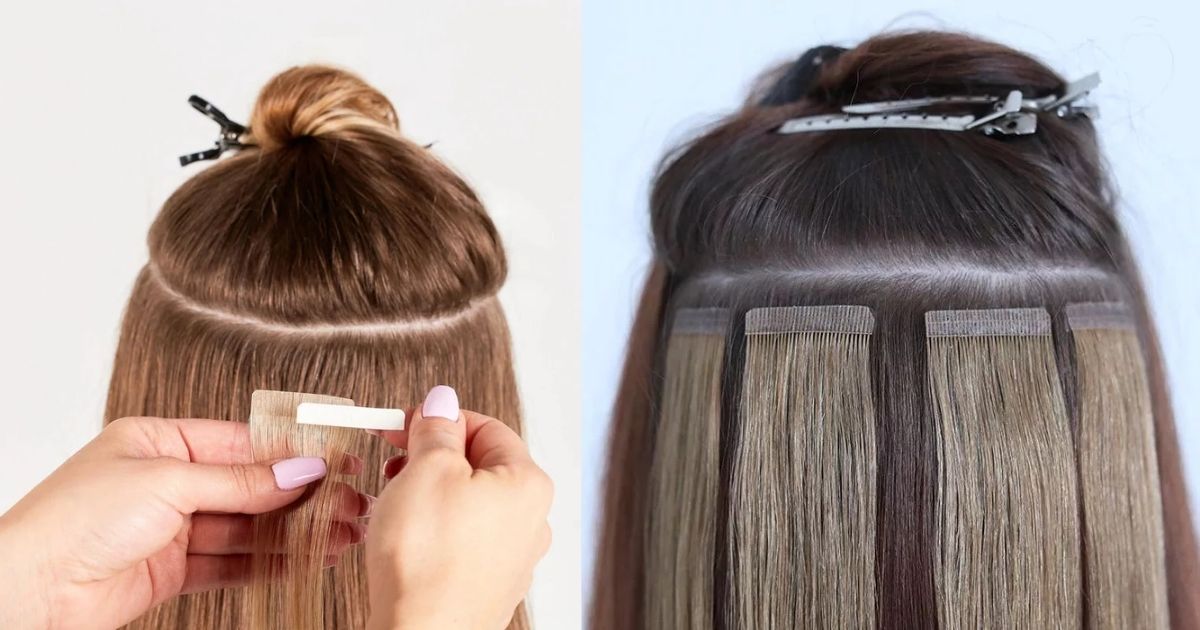
Each tape-in has three parts, and each one wears out on its own schedule:
- The hair. It’s the only part you keep from one install to the next, so it’s where your money goes.
- The tab. A thin polyurethane base holds the hair in a straight line. Thinner tabs lie flatter and hide better, and they tear more easily when someone peels them in a hurry.
- The adhesive. Tape-in tape is a pressure-sensitive adhesive, the same family as medical tape. It’s the part you replace at every install.
Tape-in hair extensions: human hair or synthetic?
Choose human hair if you plan to re-use the set. Human hair can be washed, heat styled, colored and re-taped. Synthetic fiber melts under a flat iron and frizzes after a few washes, which is why most stylists won’t re-tape it. A synthetic set is a one-install product, and it should be priced like one.
Can you be allergic to tape-in adhesive?
Some people can. Acrylate adhesives are a known cause of allergic contact dermatitis, and a case published in the journal Contact Dermatitis traced one reaction to an acrylate in wig-fixing tape. Tape makers publish their own patch test instructions for this reason. Ask your stylist which tape they use and test it on a small patch of skin before the first install. If you’ve ever reacted to a plaster or bandage, tell them before they start.
The tape-in calendar: why one set has to last three installs
Your own hair sets the clock on tape-in hair extensions. Scalp hair grows about half an inch a month, according to the Canadian Dermatology Association. After six weeks, every tab sits roughly three-quarters of an inch lower than the day it went in. The longer that gap gets, the more your new growth twists and tangles above the tab, and the more the weight swings on a longer lever. That’s when the tape-ins come out and go back in higher, a visit stylists call a move-up.
The tape wears out on a similar clock. Walker Tape, one of the larger makers of extension tape, says its tape should hold for four to six weeks and should be replaced by six weeks at the latest, because older tape gets harder to remove. It also notes that a client with fast-growing hair may need a move-up after about three weeks.
| Stage | When | What happens to the hair |
|---|---|---|
| Install | Day 0 | Fresh tape pressed onto clean, product-free hair. Wait about 48 hours before the first wash so the bond sets |
| Wear | Weeks 1 to 6 | Washing, brushing, heat styling, sleep. The ends take the wear; the tab takes the pull |
| Move-up | Weeks 6 to 8 | Remover dissolves the bond. Old tape is scraped off each tab, then the hair is washed and dried |
| Re-tape | Same visit | New tape strips go on each weft, and the hair goes back in close to the scalp |
| Repeat | Install 2, 3 and beyond | The same hair goes through the whole cycle again |
How many rounds a tape-in set lasts depends on the hair, not the tape. Walker Tape says there is no set number: a set can go back in for as long as it still has hair in it and still looks good. Sellers’ own care guides range from a single re-use for budget grades to several rounds for higher grades. Most people plan on two or three.
What tape-in extensions really cost per install
The sticker price hides the real cost. A Byrdie guide puts tape-in hair at about $300 to $600 on average, before the stylist’s fee. Divide the price of a tape-in set by the installs you’ll get from it:
| Set A | Set B | |
|---|---|---|
| Price of the hair | $250 | $450 |
| Installs before it tangles or thins | 1 | 3 |
| Hair cost per install | $250 | $150 |
| Hair cost per week (7-week installs) | About $36 | About $21 |
Illustrative prices, not quotes. The stylist’s fee for each install and move-up comes on top in both columns.
The set that costs nearly twice as much comes out about 40% cheaper per week, as long as it really does last three rounds. The rest of this guide is about telling, before you pay, which set you’re holding.
Remy human hair tape-in extensions: why the grade sets the install count
Remy human hair tape-in extensions are made from hair collected with every cuticle facing the same way, root to tip. The cuticle is the outer layer of overlapping scales on each strand. When the scales all point down, strands slide past each other. When some strands are flipped, their scales catch on their neighbors and the hair knots.
That matters more on tape-ins than on most methods, because tape-in hair goes through a rough routine between installs. The remover soaks the top of the weft. The stylist scrapes old adhesive off the tab, then washes and dries the hair before new tape goes on. Hair that started with flipped cuticles, or had its cuticle stripped in an acid bath and a silicone coat added to hide it, gets through the first install looking fine. The coating thins with every wash and every pass of remover, and by the second install the tangling starts at the ends and climbs.
Remy tape-in hair with an intact cuticle has no coating to lose. It looks on install three much as it did on install one, minus the hair any set sheds over time. Our guide to buying remy hair extensions covers the full set of quality tests. Three of them matter most for tape-ins.
Remy hair tape-in extensions: three checks before the first install
- Slide your fingers both ways. Pinch a few strands near the tab and slide down to the ends, then back up. Remy hair feels smooth going down and slightly rough going up, the same on every strand. Rough both ways, or rough in patches, points to mixed directions or a stripped cuticle.
- Wash one strand before you wear it. Pull two or three hairs from the weft, wash them with your own shampoo and let them air dry. Hair that arrived glossy and dries dull or frizzy was coated, and the coating is what you paid for.
- Look at the tab edge. Every hair should run from the tab straight down. Hairs folded back over the top of the tab, or short loose ends poking out of it, point to hair that wasn’t kept in order when it was collected.
“Remy” only describes cuticle direction. It says nothing about whether the hair was bleached, steamed or chemically processed afterward. Our post on virgin hair vs remy hair explains the difference, and why raw hair from a single donor holds up longest through repeated washing.
Curly tape-in hair extensions: does tape work on curly hair?
Curly tape-in hair extensions work best on waves and loose curls, and get harder the tighter the curl. Stylists genuinely disagree here. Sturdivant-Drew told Refinery29 she doesn’t recommend tape-ins for textured hair, because curls can get caught in the adhesive and tape-ins blend better with fine, straight or wavy hair. Celebrity stylist Cliff Vmir told Byrdie the method suits straighter, smoother textures and is less ideal for coarse, highly textured hair. Plenty of salons still install curly tape-ins every week.
The texture isn’t the whole problem. The routine is. Cosmetologist Stanley Nolan, in the same Byrdie guide, advises against oil-based products with tape-ins because oils weaken the adhesive. Most curly routines are built on oils, butters, leave-ins and generous conditioner, which is exactly what loosens the bond. If your curls need heavy conditioner at every wash, the tabs will slip early whatever your curl pattern.
| Your hair | Tape-ins? | What decides it |
|---|---|---|
| Wavy (2A to 2C) | Usually a good fit | Matching the wave pattern |
| Loose curls (3A to 3B) | Workable | Keeping oils and conditioner off the tabs |
| Tight curls (3C) | Case by case | Your stylist’s experience and how often you deep condition |
| Coils (4A to 4C) | Usually not the first choice | Detangling around tabs and heavy product use; a sew-in or clip-ins tend to suit better |
For coily hair, the American Academy of Dermatology’s advice on hairstyles that pull points the same way: for weaves, it recommends sewn-in styles over ones attached with bonding glue.
Tape-in hair extensions for curly hair: wash-day rules
If your curls fall in the first three rows of that table, tape-in hair extensions for curly hair can last a full cycle with a few changes to your routine:
- Keep products off the top inch. Apply conditioner, leave-in and oils from the mid-lengths down, at least an inch below the tabs. Walker Tape gives its stylists’ clients the same advice.
- Wait 48 hours after an install before the first wash.
- Detangle with the tab held. Hold the hair at the tab with one hand and work through the curls below it with your fingers or a wide-tooth comb, starting at the ends.
- Dry the roots fully. A diffuser on low heat dries the tape-in tabs. Damp tape loosens faster.
- Sleep in a loose braid or pineapple, never with wet roots.
Curly tape-in human hair extensions: match the curl and the length
Curly tape-in human hair extensions are sold by stretched length, so they hang shorter than the label once the curl springs back. Hold one of your own curls stretched straight, then let it go, and compare the two lengths. A matching curl will shrink by about the same ratio. Pick a curl within one size of yours, and if you fall between two, choose the looser one. You can tighten a curl for a day with a wand, but you can’t loosen a tight curl without stretching it straight.
Then think about install three. A curl that grew in the donor’s hair comes back after every wash, remover soak and re-tape. A curl set with steam or a perm on straighter hair can relax a little each round, so a curly set that matched you in March may not match by June. Ask the seller how the curl was made. If they can’t tell you, wash a strand three times and see whether the curl comes back each time.
Wavy tape-in hair extensions: the texture that forgives the most
Wavy tape-in hair extensions match more people than any other texture, because a wave dries close to straight under a blow-dryer and comes back with water. They also hide tape-in tabs well. Waves stand slightly away from the head, while straight hair lies flat and can show a tab line when your part shifts.
Wavy tape-ins come labeled body wave, loose wave or natural wave, and the label says more about how the wave was made than what it looks like. A body wave is usually set in the factory: an even S repeated down every strand. A natural or raw wave is the donor’s own, uneven from strand to strand the way most wavy hair is. On day one both look good. By the third re-tape, after the remover and a few dozen washes, a factory wave may have loosened while a donor wave hasn’t moved.
You can test that before a stylist spends an hour or more on an install. Clip a wavy weft under your top layer for a week and check the join after a wash and on a humid day. Our Raw Sea Wavy clip-ins are made from the same donor-wave hair as our wavy bundles, so they show you whether that wave holds up against yours before you commit to wavy tape-ins, and you keep them for days you want extra length. The hair by texture collection shows the other wave patterns side by side.
How many tape-in pieces do you need?
Fewer than most people expect. Saviano told Refinery29 that a half head usually takes 10 to 12 pieces and a full head 20 or more, and that you don’t need many for length and volume. Where you land depends on your own density and what you want the extensions to do.
| Goal | Typical pieces | Notes |
|---|---|---|
| Face-framing or a little volume | 4 to 8 | Usually placed at the crown and sides |
| Half head, added fullness | 10 to 12 | Works at your current length |
| Full head, length and volume | 20 or more | Needs enough of your own hair to cover every row |
| Fine or thinning hair | Fewer, lighter pieces | Each tab needs a slice of hair strong enough to carry it |
Weight is the rule that protects your hair. Each tab hangs from a thin slice of your own hair, and the AAD lists hair extensions among the styles that can cause traction alopecia, hair loss from steady pulling. It advises removing a style right away if it causes pain or stinging, or if you see crusts on your scalp. If your tape-in tabs pull or ache after the first few days, they’re too heavy or too tight. Go back to your stylist rather than waiting for the move-up.
Questions to ask before you book a tape-in install
A good tape-in stylist will answer all of these without hesitation:
- Which tape do you use, and can I patch test it first? Get the brand name, so you can buy the same tape again if you move salons.
- What remover do you use? Removers come alcohol-based or oil-based, and Walker Tape sells both kinds. Either works if the stylist lets it soak in before lifting the tab. Byrdie’s Nolan notes that breakage often happens when tape-ins come out before the adhesive is ready to let go.
- How many curly or wavy installs have you done? Ask for photos of their tape-ins at a move-up, not on install day.
- What does a move-up cost, and is re-taping included? That fee, times the installs you plan, is most of your real cost.
- Will you cut the extensions into my hair? Tape-in hair extensions that aren’t layered into your cut look like a separate piece of hair.
- Can I bring my own hair? Many stylists will install hair you buy yourself, which lets you choose the grade and texture. Our guide to hair extension vendors explains how to tell a factory from a reseller.
Tape-ins, clip-ins or a sew-in: which suits your hair?
| Tape-ins | Clip-ins | Sew-in | |
|---|---|---|---|
| Who installs | A stylist | You, in minutes | A stylist |
| How long it stays in | 6 to 8 weeks per install | One day at a time | 2 to 3 months, per Byrdie |
| Textures it suits best | Straight, wavy, loose curls | All textures | Curly, coily and coarse hair |
| Upkeep | Move-up every 6 to 8 weeks | None between wears | Scalp cleansing, careful drying |
| Hair reused | Yes, re-taped | Yes, every wear | Yes, re-sewn |
| Biggest risk | Breakage at removal, slipping tabs | Tugging on fine hair | Tension from tight braids |
If your curls sit at the tight end of the range, or you don’t want a salon visit every two months, a sew-in with human hair bundles that match your hair or a set of clip-ins gets you the length without tape. If you want hair that sits flat to the head and asks nothing of you between visits, tape-ins are hard to beat on straight and wavy hair.
Frequently asked questions
Can you get tape-in extensions with curly hair? Yes, on waves and loose curls. Match the curl within one size of yours, keep oils and conditioner an inch below the tabs, and find a stylist who installs curly tape-ins often. On tight curls and coils, stylists are split, and many suggest a sew-in or clip-ins, which don’t depend on an adhesive holding up against curly-hair products.
How long do tape-in hair extensions last? One install lasts about six to eight weeks, until your hair grows the tabs too far from the scalp. The hair itself lasts as many installs as it survives. Budget grades may manage one re-use, while remy human hair tape-in extensions with an intact cuticle often go back in two or three times, sometimes more.
How many times can you reuse tape-in extensions? There’s no fixed number. Each reuse means removal, cleaning off old tape, washing and fresh tape. The hair can go back in for as long as it still looks full and doesn’t tangle. Most people plan on two or three installs from a remy set, and replace it when the ends thin or knots form near the tabs.
Do tape-in extensions damage your hair? They can if the pieces are too heavy, sit on too thin a slice of hair, or come out before the adhesive has dissolved. Removal is the riskiest moment. Choose a stylist who uses a remover and waits for it to work, keep the pieces light, and tell your stylist right away about pain, stinging or crusting on your scalp.
Can you heat style and color tape-in hair extensions? Human hair tape-ins take heat the way your own hair does. Keep tools under 400°F, use a heat protectant, and keep the iron off the tabs, since heat softens the adhesive. Have the hair colored before the install or between installs, because dye and developer near the tabs can loosen them.
Are remy hair tape-in extensions worth the extra cost? Usually, because tape-ins are made to be reused. A cheaper set that tangles after one removal costs more per week than a remy set that lasts three installs. Compare the price per install, not the price per pack.
Choosing tape-in hair extensions that last
Tape-in hair extensions are a re-use method, so judge them on install three. Choose remy human hair with an intact cuticle, because it survives the remover, the re-tape and the washing in between. Choose a tape-in texture that matches yours and grew that way, if you want it to stay matched. With curly hair, decide whether your wash-day routine can live with tape before you choose a curl. And ask your stylist for a patch test and a proper remover, never a peel.
Not sure tape-ins suit your hair? Send us a photo of your hair, dry and unstyled, next to a ruler on WhatsApp, with a line about your wash routine. We’ll tell you which texture in our raw range is closest to yours, and whether tape-ins, clip-ins or a sew-in would serve you better.
==========
- RAW HAIR LUXURY — MORE THAN JUST HAIR, IT’S CONFIDENCE
- Website: rawhairsglobal.com
- Instagram: @rawhairluxury
- WhatsApp: +1 604 841 9668