
Natural-looking Wigs for White Women
Human hair wigs for white women look natural when four things match the wearer: density, color depth, the lace at the part and the wave. Most wigs miss on the first one. They are built thicker and shinier than the fine, soft hair many women of European descent grow, so they read as a wig before anyone gets close enough to see the hairline.
That is why a wig can look perfect on a model and wrong on you. The model photo was shot under studio light, styled by a pro and often worn by someone with a darker scalp and fuller hair. Your bathroom mirror, your office lights and your own pale part are less forgiving.
This guide starts with your hair, not with a catalog. You’ll learn how Caucasian hair differs from the hair most wigs are made of, which cap and lace suit fair skin, how to pick a blonde or brunette that doesn’t look flat, and where you can spend less without it showing.
A note on words. People search for white womens wigs, white people wigs or human hair wigs for caucasian women, and they usually mean the same thing: a wig for straight to wavy hair, a light scalp and lighter hair colors. Hair varies a lot inside any group, so treat everything here as a starting point and match the wig to your own head, not to a label.
Why human hair wigs for Caucasian women look more natural than synthetic
Human hair moves, catches light and takes heat the way your own hair does, and on fine, straight to wavy hair those details show. Fine hair swings and separates at the ends. It lies flat at the root and lifts with a brush. Synthetic fiber tends to sit in a fixed shape, and most of it carries a smooth, even shine that looks glassy under daylight or a phone flash.
The American Cancer Society puts the trade-off plainly. Synthetic wigs cost less and need less upkeep. Human hair wigs cost more and need more care, but you can style and color them like your own hair. The ACS also says no wig type is better than another, and that holds: the right choice depends on how you’ll wear it.
For human hair wigs for white women, the case gets stronger in three situations:
- You wear it most days. Human hair handles daily brushing, washing and heat for longer, so the price spreads over more wears.
- You want blonde, a rooted shade or highlights. Human hair can be lifted and toned by a colorist to match your brows and skin. A synthetic shade is fixed when you buy it.
- You style with heat. A flat iron or round brush gives you the soft bend at the ends that fine hair has. Most synthetic fiber can’t take that heat.
If you want a wig for a few events, a costume or a short trial of a new color, a good synthetic is fine. If you want natural wigs for white women that pass up close, day after day, human hair earns its price.
Natural wigs for white women: match strand, density and part first
Even good human hair wigs for white women give themselves away at three points on fair skin: too much hair, too much shine and a part that doesn’t look like scalp. Each one traces back to how Caucasian hair differs from the hair in most wigs.
Strand thickness: why many wigs look heavy
Hair strands differ in thickness across the world. The International Society of Hair Restoration Surgery notes that Asian hair is round and larger in diameter than other types, while Caucasian hair sits between Asian and African hair in cross-section. A 2016 study of 2,249 young adults from 24 ethnic groups found the same pattern from the other side: Asian hair was thicker, and Caucasian hair had a high total density, meaning more strands per square centimeter.
So many white women grow lots of fairly fine strands. Most human hair on the market, ours included, comes from Asian donors, with a thicker strand. Put the same number of thicker strands on a cap and the wig looks fuller and more solid than the hair it is meant to copy. The fix is not a different country of origin. It is less hair.
Density: the setting most buyers get wrong
Wig sellers state density as a percentage. Labels vary by seller, but most use a scale like this: 100 to 120% reads light, 130% reads like a natural head of hair, 150% reads full, and 180% or more is glam volume. Photos online are usually 150% or higher, because fuller hair photographs better.
For fine hair, start at 120 to 130%. Ask whether the wig is lighter at the part and hairline, where your own hair would be thinnest. A wig that gets denser toward the back looks grown in. A wig that starts at full volume right at the part looks bought. Ask for the density in writing before you order.
The part and lace on fair skin
The part is where light scalp makes things harder. On a pale or pink-toned scalp, brown lace looks like a stripe and dark knots look like dots. Choose HD or transparent lace, and tint it with a powder in your exact scalp shade. If you go brunette or darker, ask for bleached knots. If you go blonde, the knots are pale already, which is one reason blonde units often pass at the part more easily.
Keep the part narrow and a little uneven. A part that runs ruler-straight with skin showing all the way down is the classic wig tell. A stylist can thin the hair along the first inch so it fans out the way your own part does.
| Your own hair | Density to ask for | Lace and cap | Why |
|---|---|---|---|
| Fine and thin, scalp shows at the part | 100 to 120% | HD lace closure, tinted to your scalp | Matches the see-through look of your own part |
| Fine but plenty of it | 120 to 130% | HD or transparent lace closure | Full enough, without a solid helmet look |
| Medium to thick, holds volume | 130 to 150% | 5×5 closure or frontal | You can carry more hair without it reading heavy |
| Thinning at the crown or part | 120 to 130% | Closure wig with a lace part, glueless | Covers the thinning without adding weight on top |
=>> Read more: Natural hair wigs: what gives a wig away, how density, lace and fit look across a room and up close
Glueless wigs for white women: choosing the cap
For daily wear, the best human hair wigs for white women are glueless. Fine hair breaks more easily under clips, combs and adhesive, and fair skin shows any redness from glue along the hairline. A glueless cap holds with an adjustable band, sometimes with small combs, so you can put it on in a few minutes and take it off at night.
The cap decides where the wig looks real and how it feels after eight hours. These are the builds you’ll see most:
| Cap build | What it is | Glue needed? | Best for |
|---|---|---|---|
| Glueless lace closure wig | A 2×6 or 5×5 inch lace panel at the part, wefts on the rest, adjustable band | No | Daily wear, a first wig, fine or thinning hair |
| Glueless lace front | Lace along the front hairline, band and combs inside | Usually no, some wearers add a grip band | Wearing hair off the face, side-swept bangs |
| Monofilament top | A thin mesh at the crown, each hair tied by hand | No | Very fair or sensitive scalps, women who part anywhere on top |
| Hand-tied cap | Every hair tied into a soft, stretchy base | No | Comfort all day, hair loss, chemo |
| Full lace or 13×6 frontal | Lace across the whole cap or ear to ear | Most units, yes | Ponytails and updos, done by a stylist |
A glueless closure wig gives most women the best mix of a natural part, a quick routine and a fair price. The lace size decides where you can part, so check where you part your own hair before you choose.
=>> Read more: Closure Wigs: Types, Sizes and How to Choose Your Fit, how to pick a 2×6, 5×5 or 6×6 lace for the way you part
Get the fit right before anything else
A glueless wig only works if the cap fits. Measure three things, the way the American Cancer Society suggests: around your head along the hairline, front hairline to nape, and ear to ear over the top. Flatten your hair first. The ACS lists 21.5 inches around as an average size, and many women with fine hair sit at or below it. If you fall between sizes, go with the larger measurement and tighten the band.
A well-fitted glueless wig stays put when you shake your head and leaves no red line when you take it off. If it presses at the temples or behind the ears by lunchtime, it’s too tight, and that pressure lands on the hair you’re trying to protect.
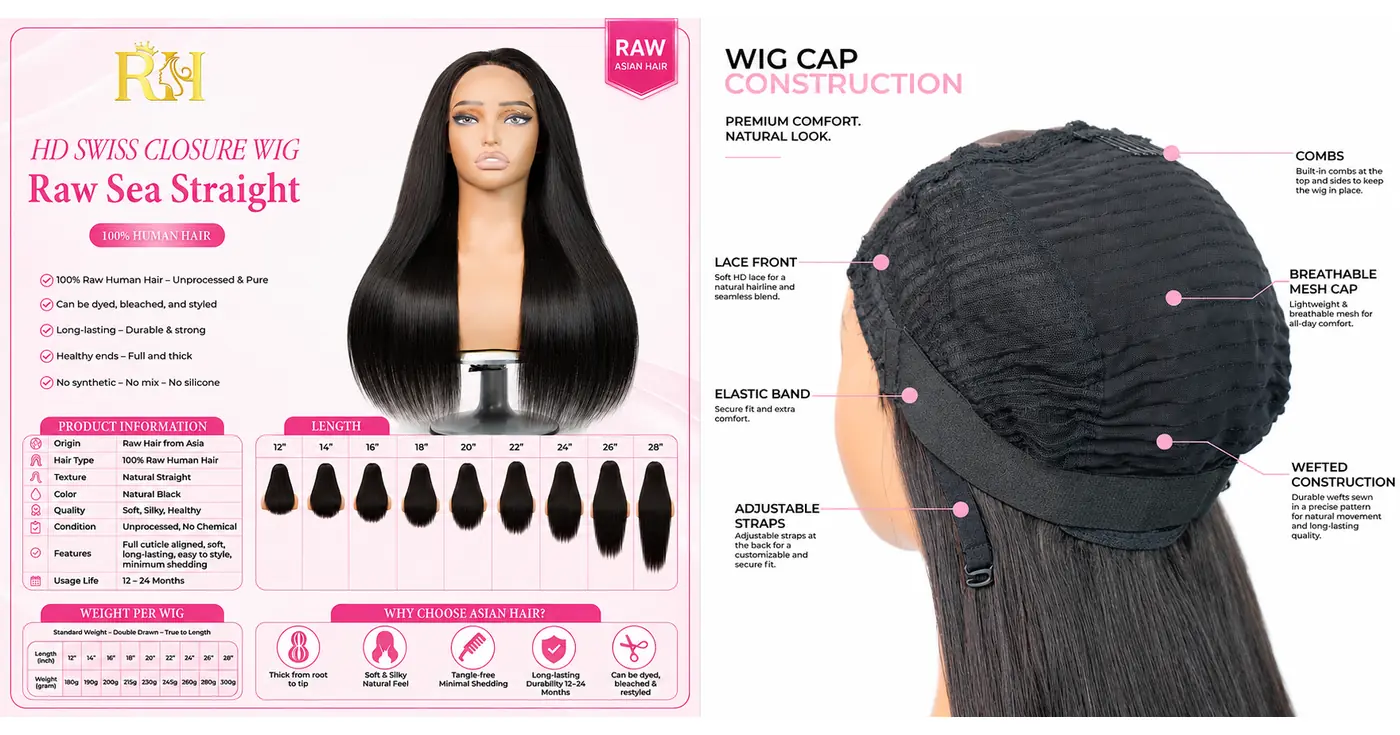
=>> Shop now: Straight HD Closure Wig, raw human hair on a 2×6 or 5×5 HD lace closure, glueless with an adjustable band
White womens wigs in blonde, brunette and gray: choosing a color that isn’t flat
Natural hair is never one color. It sits a little darker at the root, lighter at the ends and lighter again around the face, where the sun hits it. A wig dyed one even shade from root to tip looks flat next to fair skin, and that flatness reads as fake faster than almost anything else.
Start with the American Cancer Society’s method, which works for anyone. Save a lock from the top front of your head, where your hair is lightest, and compare wig colors against it in natural light, outdoors or by a window. Then check the shade against your eyebrows. A wig much lighter or darker than your brows pulls attention to the hairline.
Common color codes help you read listings, though shades shift a little between sellers:
| Code | Shade | Often suits |
|---|---|---|
| #1B | Off-black | Dark brows, olive or deeper skin |
| #2 to #4 | Dark to medium brown | Most brunettes with fair skin |
| #6 to #8 | Light brown, dark blonde | “Mousy” natural shades, soft fair skin |
| #27 | Honey or strawberry blonde | Warm, golden or freckled skin |
| #613 | Light, pale blonde | Very fair skin, and the base for toning any blonde |
Blonde human hair wigs
Blonde is where human hair pulls furthest ahead. A raw hair wig lifted to 613 can be toned by a colorist to ash, beige, honey or platinum, and toned again later as your taste or the season changes. Ask for a rooted finish, with a slightly darker shade in the first inch at the part. It hides the lace, softens the hairline and looks like color you’d get at a salon.
Match the undertone to your skin. Cool, pink-toned skin usually suits ash, beige and platinum. Warm, golden skin usually suits honey and butter tones. With a made-to-order wig, you can ask for the tone before the wig is built.
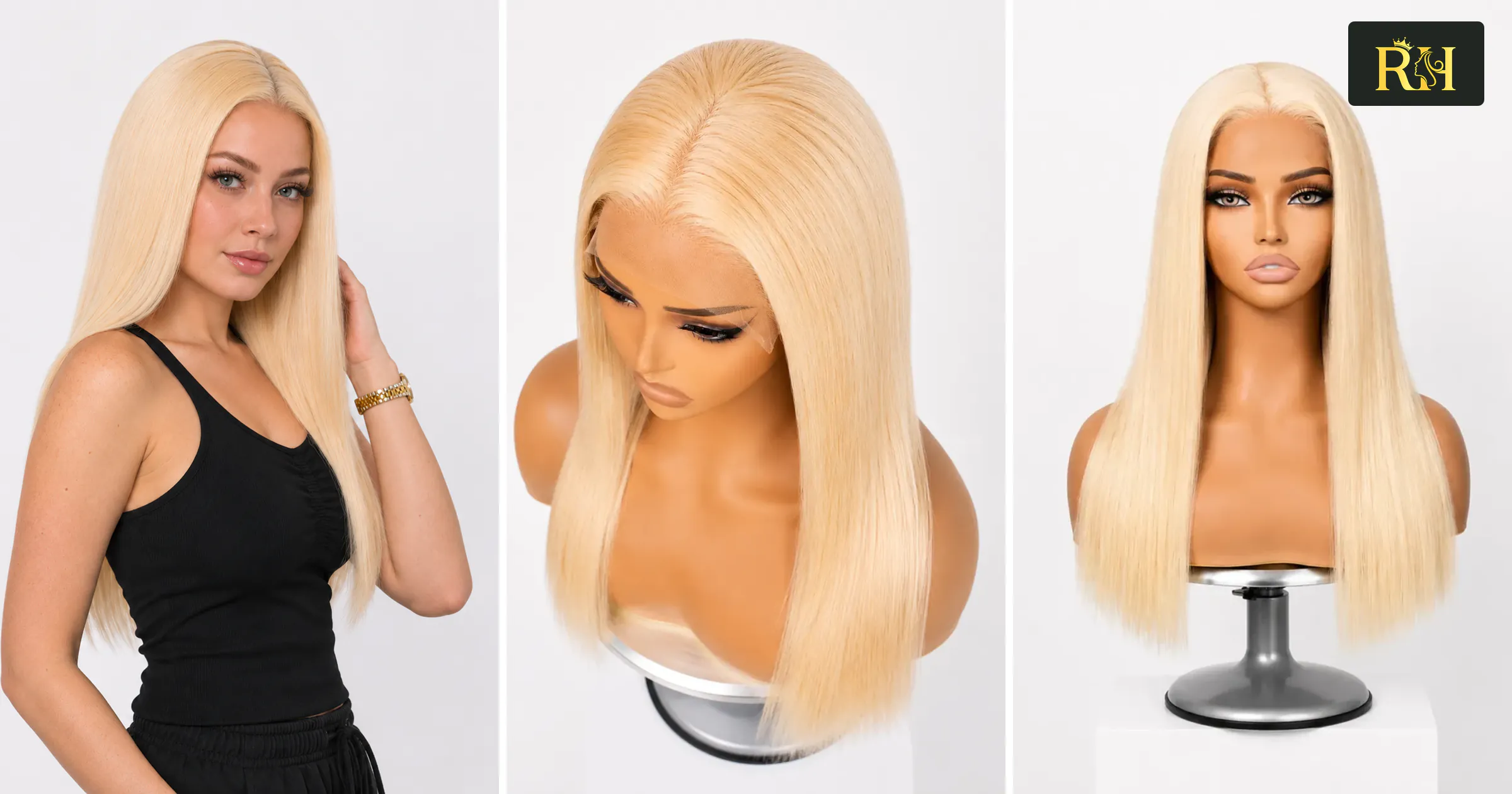
=>> Shop now: Blonde Collection, 613, ash blonde and platinum highlight HD lace wigs made to order
Brunette wigs on fair skin
On fair skin, very dark wigs are hard to wear. Jet black and off-black can look painted on unless your brows and lashes are naturally dark. A soft medium brown with a few lighter strands around the face looks more like grown hair. During cancer treatment the ACS notes that skin can look paler, and some women go a shade softer than their usual color for that reason.
Gray and silver wigs
Natural gray human hair is rare, so most gray human hair wigs are lifted and toned. Ask how the color was made and how often it needs toning. Salt-and-pepper blends, with some darker strands mixed in, often look more real than a solid silver.
Curly Caucasian wigs: matching a wave you could actually grow
The most natural curly Caucasian wigs copy a loose wave, not a tight curl. The ISHRS describes Caucasian hair as generally straight with few irregularities along the strand, and most women of European descent grow something between straight and loosely wavy. Some have true ringlets, and those women should match them. But a wig that is curlier than anything you’ve grown will look like a wig, however good the hair.
The hair’s origin doesn’t decide its wave. L’Oréal researchers who measured hair from 2,449 people in 22 countries sorted it into eight types by shape alone. The authors note that a straight hair type stays the same type whether it grew on a Caucasian or an Asian head. What matters on your head is the curve, the size of the loop and how evenly it repeats.
Find your own wave in five minutes
Wash your hair, skip all product and let a section dry on its own. Then look at one strand from the side.
- A gentle S-bend, no closed loops: choose body wave or loose wave.
- Loose loops about as wide as a marker pen: choose loose curl or a soft water wave.
- Tight loops about as wide as a pencil: choose a defined curly texture, and ask to see the curl stretched and relaxed.
- Straight at the root, bend only at the ends: choose straight hair and add the bend with a curling iron.
The last group is bigger than most people think. Many women with fine hair wear it blow-dried, with a soft bend at the ends. A straight human hair wig styled the same way often looks more like them than any factory wave would.
What to check on a curly unit
- Mixed pattern. Real curly hair is looser on top and tighter underneath. A wig with the same perfect spiral everywhere looks set, not grown.
- Length after shrinkage. Sellers measure curly hair stretched. A 16-inch curly wig hangs several inches shorter than a 16-inch straight one.
- Volume at the root. Curly units carry more bulk, so ask for a lighter density than you would for straight hair.
For water wave or loose body wave, ask us for a made-to-order unit.
=>> Shop now: Wavy HD Closure Wig, a loose wave in raw human hair, the range most women in this guide grow
Human hair wigs for Caucasian women: European, raw, virgin or Remy?
The label on the hair matters less than what was done to it. For fair skin and fine hair, the finish is the giveaway: hair that has been stripped and coated shines like plastic in daylight, however good it looks in the box.
Here is what each label should mean, and how it tends to read on a fair-skinned wearer:
| Label | What it should mean | How it reads on fair skin | Price |
|---|---|---|---|
| European hair | Hair from European donors, often fine and light | Very natural when genuine, but supply is small and the label is hard to check | Highest |
| Raw hair | Unprocessed hair, cuticle intact and running one way, often from one donor | Soft, low luster, moves like grown hair, takes color well | High |
| Virgin hair | Never colored or permed; may still be steamed for texture | Natural if the cuticle is kept, varies by seller | Mid to high |
| Remy hair | Cuticles kept and aligned root to tip; may be processed | Fine if lightly processed, can carry a coated shine | Mid |
| Non-Remy, processed | Cuticle stripped in acid, coated in silicone | Glassy shine, tangles after a few washes | Lowest |
Wigs sold as “European hair” cost the most, and many buyers assume that makes them the natural pick among human hair wigs for white women. Sometimes it does. But you can’t verify origin from a box, and a raw Asian hair wig set at a lower density often looks just as natural on fine hair, with more hair for the money. Raw hair also lifts to 613 and takes toner evenly, which matters if you want blonde.

=>> Read more: Virgin Hair vs Remy Hair, simple tests to check what the label really means
=>> Read more: How to Buy the Best Quality Human Hair Wigs, what to check on day one, after the first wash and at month six
Affordable human hair wigs for Caucasian women: where to spend and where to save
Here is the good news on price: the most natural build among human hair wigs for white women is also one of the cheaper ones. Lower density means less hair. A shoulder-length cut means shorter hair. A closure means less lace than a frontal. Each of those lowers the price and makes the wig look more like your own hair.
Price tracks a few things, roughly in this order:
- Length. Every extra inch adds hair, and long human hair is scarce. It moves the price more than anything else on a listing.
- Density. 180% uses far more hair than 120%.
- Lace size and cap. A 13×6 frontal or a full hand-tied cap costs more than a 5×5 closure on wefts.
- Hair grade. Raw and genuine European hair cost more than processed hair.
- Color work. Lifting hair to blonde and toning it takes time and skill, so light shades cost more.
Spend on these, save on those
| Spend here | Save here |
|---|---|
| Hair that keeps its cuticle, so it lasts and looks soft | Length: 12 to 18 inches suits most fine-haired women |
| A good HD lace part, tinted to your scalp | Density: 120 to 130% instead of 150 to 180% |
| A cap that fits and a band that adjusts | Lace size: a 5×5 or 2×6 closure instead of a frontal |
| A stylist’s cut around the face | Extra wigs: one good unit beats three cheap ones |
Think in cost per wear
A human hair wig costs more on day one, so compare by how often you’ll wear it. Say you pay $450 and wear it four days a week for a year. That’s about 208 wears, or roughly $2.16 each, and a well-kept human hair unit can go on past that first year. If a $120 synthetic wig needs replacing every few months at the same pace, the yearly cost lands closer than the price tags suggest. Run the same sum with your own numbers.
=>> Read more: How Much Does a Human Hair Wig Cost?, how each inch and each lace size changes the price
When cheap is a red flag
- A long, full “100% human hair” wig priced like a synthetic. That much hair at that price is usually processed and coated.
- Photos taken only under studio light, with no daylight shot of the part.
- No density, lace size or cap size stated in writing.
- A return policy you can’t find. The ACS warns that some wig sellers charge restocking fees or don’t take returns, so read it before you pay.
A wig for white women with thinning hair or hair loss
Many women start looking at wigs because their own hair has changed. The American Academy of Dermatology calls female pattern hair loss the most common cause of hair loss in women, affecting millions. The part gets wider, hair near the temples may recede, and without treatment some women go on to thin all over. On a light scalp under brown hair, that wider part often shows early.
See a board-certified dermatologist before you buy. Some hair loss can be slowed or treated, and the AAD says treatment works best when it starts at the first sign. Then match the piece to the loss:
- Thinning at the part and crown only: a topper may be enough, though its clips grip the hair you have left. Move them often.
- Thinning that keeps spreading: a glueless closure wig at 120 to 130% density covers the crown without weight on top.
- Patches or total loss: a full wig with a soft cap, worn over a liner.
- Hair loss from cancer treatment: choose the wig before treatment starts if you can, while you can still match your color. The ACS suggests an adjustable cap, since your head size can drop once the hair is gone, and asking your insurer whether it covers a “cranial prosthesis” with a doctor’s prescription.
=>> Read more: Wigs for Bald Women and Thinning Hair, caps for each type of hair loss, gray shades, lighter wigs for older women and insurance claims
How to make human hair wigs for white women look natural: 8 steps
The right wig gets you most of the way. These steps close the gap, and most take a few minutes once you’ve done them twice.
- Wear a cap in your skin tone. A nude or beige wig cap under the lace keeps dark hair or a dark cap from showing through the part. On a sensitive scalp, a thin satin liner is gentler.
- Set the hairline where yours is. A common tell is a wig worn too low on the forehead. Line the front edge up with your own hairline, then check it from the side.
- Tint the lace. Press a little powder or foundation in your exact scalp shade into the lace from inside the cap. On fair, pink-toned skin, a shade slightly too beige stands out.
- Soften the part. Pluck a few hairs from the first inch so the part narrows and wanders a little. Dab the same powder along the part.
- Have it cut on your head. Ask a stylist for face-framing layers and lightly thinned ends. Fine hair tapers at the ends, and a blunt factory cut doesn’t.
- Take down the shine. A light mist of dry shampoo at the roots gives the matte look of real hair. Skip shine sprays and heavy serums near the part.
- Style it imperfectly. Add a little lift at the crown, a soft bend at the ends and a few loose strands around the face. Perfect hair looks set.
- Check it in daylight and on camera. Stand by a window, take a photo with your front camera at arm’s length and look at the part and the sides. That’s how other people will see it.
Caring for a human hair wig so it keeps looking real
A wig doesn’t grow new hair, so every wash and every pass of a hot tool counts. Gentle habits keep the soft, natural finish that made you buy human hair in the first place.
- Wash every 7 to 10 wears, or sooner if it feels heavy or smells of product. Use cool water and a sulfate-free shampoo, and press the hair rather than rubbing it.
- Condition from mid-length to the ends. Keep conditioner and oils off the lace, where they loosen the knots.
- Detangle from the ends up with a wide-tooth comb, holding the hair above the section you’re working on.
- Air dry on a wig stand. Keep heat tools under 400°F and use a heat protectant every time.
- Store it on a stand or in a silk bag, out of direct sun, which fades color, especially blondes.
Blonde wigs need extra moisture. Hair lifted to blonde is more porous, so it dries out and tangles faster. Use a deep conditioner every second wash. Use purple shampoo only when the color turns brassy, since too much leaves a lilac tint on very light shades. When the tone fades, a colorist can refresh it, which is one more advantage of human hair.
Seven mistakes to avoid when buying a wig for white women
- Buying the density in the photo. Listing photos usually show 150% or more. On fine hair, 120 to 130% looks like you.
- Choosing one flat color. A single shade from root to tip looks dyed. Ask for a root, lowlights or face-framing highlights.
- Ignoring your brows. A wig two shades off your brows draws the eye straight to the hairline.
- Going curlier than you grow. Tight curls on a woman whose own hair is wavy look borrowed. Match your loop size.
- Leaving the lace untinted. Even HD lace shows on a pale scalp until you match it with powder.
- Buying too long. Past 22 inches, fine-looking hair gets heavy, tangles at the nape and costs much more.
- Judging it under bathroom light. Check the part and sides in daylight and on camera before you decide it’s right, and before the return window closes.
Frequently asked questions
What are the best human hair wigs for white women? For most women, a glueless lace closure wig in raw or virgin human hair, at 120 to 130% density, 12 to 18 inches long. Choose HD or transparent lace tinted to your scalp, and a color with a soft root that matches your brows. That build looks natural up close and is easy to wear every day.
Are glueless wigs for white women good for fine hair? Yes. Fine hair breaks easily under glue, clips and tight combs, and fair skin often reddens from adhesive. A glueless wig holds with an adjustable band and comes off at night, so your own hair and scalp get a rest.
What density should a wig for white women be? Start at 120 to 130% if your hair is fine, and go to 150% only if your own hair is thick and full. Ask for a lighter density at the part and hairline. Most wigs look too heavy because they ship at 150 to 180%.
Are there affordable human hair wigs for Caucasian women that still look natural? Yes, because the natural build costs less. A shorter length, lower density and a closure instead of a frontal each lower the price. Spend on the hair quality and the lace at the part, and compare cost per wear rather than the price tag.
Are white people wigs different from other wigs? The hair itself can be the same. What changes is the build: lighter density, lace that suits a pale scalp, lighter and multi-tone colors, and looser waves. A wig made for fuller, darker hair can still work after a stylist thins it and tints the lace.
Can human hair wigs for Caucasian women be colored blonde? Raw human hair can be lifted to 613 and toned to ash, beige, honey or platinum. Have a colorist do it, keep heat tools under 400°F and give lifted hair extra conditioning.
Do curly Caucasian wigs look natural? They do when the wave matches yours. Most women of European descent grow straight to loosely wavy hair, so body wave, loose wave or a straight wig with a soft bend usually looks more real than tight curls.
Choosing human hair wigs for white women that look like your own hair
The best human hair wigs for white women copy the hair you grow, not the hair in the ad. Start with less density than the photos show. Pick lace that suits a pale scalp and tint it. Choose a color with depth that sits close to your brows, and a wave no curlier than your own. Go glueless for daily wear, and spend your money on the hair and the part rather than on extra inches.
Get those right and a wig stops being something you hide. It becomes the hair you leave the house in.
Not sure which density, shade or lace fits you? Send us a daylight photo of your part and brows, your head measurement and the length you want on WhatsApp. We’ll suggest a density, lace size and shade, and send the cap details in writing before you order.
=>> Shop now: Human Hair Wigs Collection, straight, wavy and blonde styles in raw human hair
==========
- RAW HAIR LUXURY — MORE THAN JUST HAIR, IT’S CONFIDENCE
- Website: rawhairsglobal.com
- Instagram: @rawhairluxury
- WhatsApp: +1 604 841 9668