
What is a closure wig?
A closure wig combines a lace closure with a wig cap. Individual hairs are knotted into the lace so you can see a scalp-like surface beneath the part. Most of the rest of the wig uses sewn-in rows of hair, called wefts.
The lace covers a limited area around the front and top. It doesn’t usually extend across the temples from ear to ear, so the wig offers less freedom for exposed-hairline styles than a frontal.
A lace closure sold on its own is a component for making a wig or completing a sew-in. A lace closure wig is the finished unit. Check which one a listing includes before comparing prices. If you’re considering a sew-in instead, see the guide to human hair bundles with closure.
Closure wig vs. frontal wig vs. full lace wig
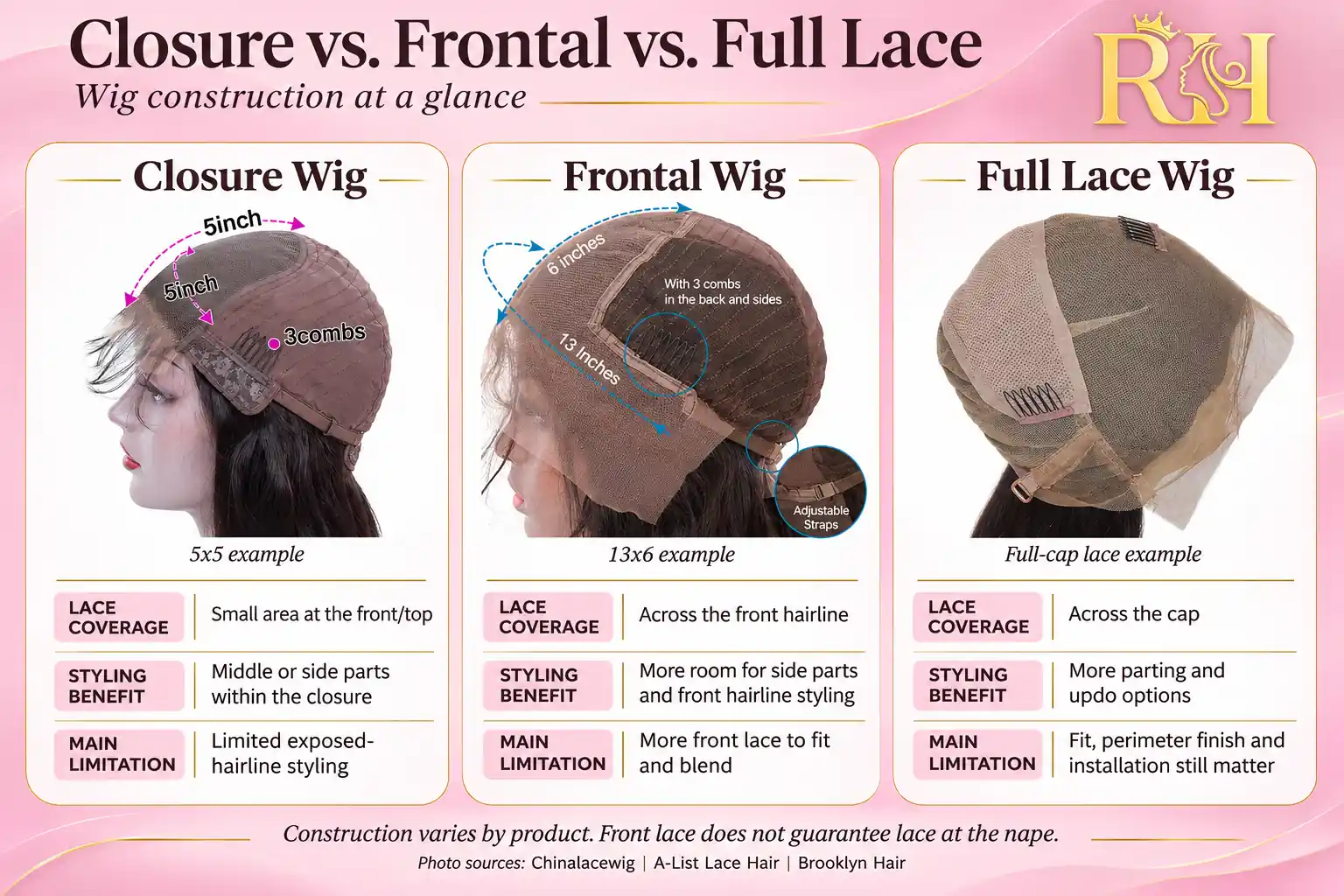
| Construction | Where the lace sits | Main styling benefit | Main limitation |
|---|---|---|---|
| Closure wig | A smaller area at the front/top | Middle or side parts within the closure | Limited exposed-hairline styling |
| Frontal wig | Across the front hairline, commonly in sizes such as 13×4 or 13×6 | More room for side parts and front hairline styling | More front lace to fit and blend |
| Full lace wig | Across the cap | More parting and updo options | Fit, perimeter finish and installation still limit the result |
A frontal adds lace across the front; it doesn’t necessarily add lace at the nape. For a high ponytail, inspect the back of the cap as well as the front.
Listings that use phrases such as “lace front closure” or “lace front wig closures” can be ambiguous. Ask whether the item is a separate closure, a finished closure wig or a frontal wig, and request an inside-cap photo.
“Full closure wig” is also a seller-dependent label. It doesn’t mean full lace. Confirm the construction and whether any of your natural hair needs to be left out.
Wig closure types by lace size
Lace dimensions are commonly listed in inches as width × depth. Width determines how far you can move the part sideways; depth determines how far it can extend back. Confirm the orientation and usable lace area with the seller, especially for rectangular closures.
| Lace size | What it generally allows | What to check |
|---|---|---|
| 2×2 closure wig | A short part in a small area | Whether the part is fixed or adjustable |
| 2×6 closure wig | A long, narrow part, usually in the middle | Whether the lace is 2 inches wide and 6 inches deep |
| 4×4 closure wig | A middle part or modest side-part adjustment | Whether your preferred part stays within the lace |
| 5×5 closure wig | More room for middle and side parts than a 4×4 | Actual free-part space and hairline placement |
| 4×7 closure wig | A deeper part if listed as 4 inches wide × 7 inches deep | Which measurement is width and which is depth |
| 6×6 or 7×7 closure wig | More space to reposition the part across the top | Lace shape and whether it reaches your intended part |
These are construction dimensions, not guaranteed lengths for a finished part. Seams, hairline shape and placement can reduce the usable area.
When a 2×6 lace closure wig makes sense
A 2×6 lace closure wig is a practical option if you prefer a deep middle part and rarely change it. Its long, narrow lace panel offers depth without the width of a larger square closure. UNice’s explanation of 2×6 closures illustrates this construction and its limited sideways parting space.
A 2×6 wig can work well with a sleek bob or long straight style. On a ready-made unit, though, don’t assume you can rotate the closure into a side part. Its position is determined by how the wig was built.
Is more lace always better?
More lace is useful when you need extra parting space. If you wear the same middle part every day, unused width may offer little benefit.
For example, a nominal 2×6 rectangle has 12 square inches of lace, while a 4×4 has 16. The 2×6 is deeper despite having less total area. Compare width and depth separately rather than treating total lace area as a measure of styling freedom.
A 4×7 closure is deeper than a 5×5 if the first number is width, but it is also narrower. Extra depth won’t compensate for insufficient width when you want a far side part.
HD closure wig or transparent lace?
An HD closure wig uses fine lace designed to make the part and front edge less noticeable. Transparent lace is a light, sheer option that can also create a natural-looking finish. How well either blends depends on the lace tone, knots, cap fit and installation.
HD lace is commonly finer and more delicate than standard transparent lace, though thickness varies between products. Both may need tinting or makeup to blend with your skin. If you prefer a sleek, straight style, explore our HD Closure Wig and check its lace size, cap measurements and preparation options before ordering.
Before choosing, look for:
- An unfiltered close-up of the lace against skin in daylight.
- A clear view of the knots and front edge.
- Details on whether the knots are already bleached.
- Instructions for any preparation needed before wearing.
Fine lace won’t hide large dark knots or correct a poorly fitting cap. Avoid repeated bleaching or heavy plucking, especially on a closure that’s already been customized. A wig stylist can assess whether further work is appropriate.
Choose a texture you want to maintain
Texture affects the finished look, detangling routine and styling after washing. Product names aren’t fully consistent between sellers, so compare photos and videos of the hair after washing and drying.
| Texture | Typical appearance | Practical consideration |
|---|---|---|
| Straight closure wig | Smooth, straight lengths | A sleek finish may need restyling after washing |
| Yaki straight closure wig | Straight hair with a textured finish | Ask for a close-up; light yaki and coarser finishes look different |
| Body wave closure wig | Broad, soft waves | Ask how much wave remains after washing |
| Loose wave closure wig | Relaxed, rounded waves | Compare the actual pattern with the seller’s body wave |
| Loose deep wave closure wig | Defined waves between looser and deeper patterns | Request a dry, product-free view |
| Deep wave closure wig | Pronounced, closely spaced waves | Plan for gentle section-by-section detangling |
| Water wave closure wig | A rippled, tousled pattern | The name doesn’t guarantee a wet look when dry |
| Curly closure wig | Curls or spirals in varying sizes | Check curl size, shrinkage and the recommended care method |
Straight and yaki textures
A straight closure wig suits a smooth bob or long, sleek style. Keep in mind that human hair may dry with some movement or frizz and need styling to return to its advertised finish.
If you’re comparing a straight closure wig with HD lace against a standard-lace version, inspect the part in similar lighting. The lace upgrade is useful only if the finished result justifies it for you.
A yaki closure wig has a textured straight finish designed to resemble relaxed or blown-out hair. A yaki straight closure wig can suit that look without requiring you to leave out and blend your own hair. Read more about what yaki hair is to compare textured and silky straight finishes.
Body wave and loose wave textures
A body wave closure wig offers broad waves; a loose wave closure wig has a different, relaxed wave pattern. A loose deep wave closure wig usually has more definition, although the distinction depends on the seller.
Ask whether the pattern is natural or set during processing, and how it changes after washing. If you’re shopping for a loose wave wig with HD lace, check the texture and lace separately: the label doesn’t confirm either one’s quality.
Deep wave, water wave and curly textures
A deep wave closure wig gives a more defined wavy look. Water wave and curly styles offer other patterns, with different amounts of volume and shrinkage.
Follow the supplier’s instructions for detangling. Work in small sections from the ends upward, support the hair above any tangle and avoid pulling at the lace. Refreshing curls between washes is part of the routine to consider alongside wash-day care.
Bob closure wig or longer hair?
A bob closure wig gives you shorter lengths to manage, but the cut still matters. A sharp, straight bob may need regular smoothing; a wavy bob may be easier to wear with movement.
A 2×6 HD lace bob wig combines a narrow, deep parting area with fine lace and a short cut. It can suit a consistent middle-part style, provided the cap fits and the lace blends well.
For any bob, look at the front, sides and back: the ends should fall where you want them, and the cut should sit evenly when the model moves.
Longer wigs offer more length for braids, waves and low ponytails, but also more hair to detangle. Length, density and cap construction all affect weight. The unit’s weight is a more useful comparison for comfort than length alone.
For textured wigs, confirm whether the advertised length is measured with the hair stretched. Curly hair can sit noticeably shorter when worn in its natural pattern.
Human hair, raw hair and color labels
Hair labels describe different things: material, processing claims or color. None replaces a clear product specification.
A raw closure wig is generally marketed as using minimally processed donor hair. Ask what the seller means by “raw,” whether the hair has been colored or texture-set, and whether the closure hair matches the wefted hair. The term alone doesn’t guarantee lifespan, cuticle alignment or bleaching performance.
A black human hair closure wig describes the stated material and color. Ask whether “black” means natural dark hair, an off-black shade such as 1B, or dyed jet black, and request a daylight photo.
If you want a lighter color, ask the supplier to confirm the exact unit’s coloring limits in writing. Have a professional assess it and perform a strand test. Dark hair isn’t guaranteed to lift evenly to blonde, and coloring can affect both the hair’s condition and return eligibility.
How to choose a closure wig before ordering
1. Match the lace to your usual part
Style your current hair or wig into the part you want. Note where it begins, how far back it runs and how far it sits from the center.
Compare that position with the seller’s lace diagram. For a side part, check that the part stays within the lace along its full length. There is no universal “add one inch” rule that works for every cap and hairline.
A fixed middle part points toward a narrow closure such as 2×6. Switching between middle and side parts calls for more width, such as a 5×5 or larger closure, depending on the actual placement.
2. Measure the cap separately
Lace size doesn’t tell you whether the wig will fit your head. Prepare your hair as you intend to wear it underneath, then follow the seller’s measuring instructions.
Check circumference, front-to-back and ear-to-ear measurements where provided. These are separate measurements in Jon Renau’s cap-fitting guide, and they help describe fit beyond a single circumference number.
Compare your measurements with the specific product’s chart. Don’t assume “medium” is the same across brands.
3. Confirm how the wig stays on
“Glueless” describes the intended wearing method, not the size of the closure. Ask whether the wig has an adjustable band, straps, combs or another securing feature, and whether the lace arrives pre-cut.
The fit should feel secure without painful pressure or pulling. Glueless construction doesn’t remove the need to check tension around your edges or in the hair underneath. The American Academy of Dermatology advises changing styles that cause pain, stinging or scalp irritation and avoiding repeated pulling on the hair.
4. Check evidence and return terms
Before ordering, request:
- An inside-cap photo showing the lace and wefts.
- A daylight video of the hairline, part and ends.
- A washed-and-dried texture example.
- Confirmation of lace dimensions, cap size, density and hair material.
- Written return terms, including what happens after cutting lace, washing or coloring.
If two wigs look similar, compare what is included in the price: customization, shipping, possible duties and any professional fitting or styling you will need. The guide to human hair wig costs covers the factors to compare.
Closure wig styling and care
Keep exposed parts within the lace. Middle parts, suitable side parts, bangs and face-framing styles can work well. Low ponytails may work if the sides and nape stay covered; slicked-back looks and high ponytails depend on lace coverage around the perimeter.
For care:
- Detangle gently, supporting the hair so you don’t pull on the knots.
- Wash according to the supplier’s instructions without scrubbing or twisting the closure.
- Keep conditioner and heavy styling products away from the knotted base unless the manufacturer directs otherwise.
- Let the cap dry fully before storing the wig.
- Use heat only when the hair material permits it, following the unit’s care instructions.
There is no single damage-free heat setting for every human hair wig. Use the lowest effective setting and a suitable heat protectant, and avoid repeated passes. As a manufacturer-specific example, Jon Renau’s human hair care guide recommends a maximum of 350°F for its human hair products. This isn’t a universal limit for other brands or fibers.
Frequently asked questions
Which closure wig is best for beginners?
Start by comparing a correctly fitted glueless closure wig with a style you already like. A 2×6 can suit a consistent middle part, while a 5×5 offers more room to adjust it. Check how much cutting, tinting or styling the wig needs before buying.
Is a 2×6 or 5×5 closure better?
A 2×6 is narrower and deeper; a 5×5 is wider and offers more sideways parting room. Choose by the position of your preferred part, then confirm that the product’s usable lace area accommodates it.
Can closure wigs be worn without glue?
Yes, when the cap is designed for glueless wear and fits securely. A lace closure alone doesn’t make a wig glueless. Check the band, straps and other securing features in the actual listing.
Is an HD closure wig worth the extra cost?
It can be if fine lace improves the appearance of the part and front edge on your skin. Compare unfiltered close-ups and consider how carefully you’ll need to handle it. The HD label alone doesn’t guarantee a natural finish.
Do closure wigs require leave-out?
A conventional closure wig is designed to cover your natural hair without leave-out. You can choose face-framing styles without exposing your own hair. Confirm this if a listing uses unclear construction terms.
Can I wear a closure wig in a high ponytail?
A standard closure wig usually doesn’t provide the perimeter lace coverage needed for an exposed high ponytail. Check the sides and nape before buying for that style. A frontal alone doesn’t guarantee a natural-looking back hairline either.
How long does a closure wig last?
There isn’t a reliable lifespan based on the closure label alone. Wear frequency, hair processing, heat, knot handling and lace condition all matter. Ask about repair or closure replacement, and inspect the lace for tears or thinning before each installation.
Choose by the part, then check the whole wig
Choose the lace shape that accommodates your preferred part, the texture you want to care for and a cap that matches your measurements. Before paying extra for a larger closure or HD lace, ask to see what the difference looks like on the actual product.
When browsing the wig collection, narrow your options by parting space and cap fit first. For help comparing options, send your preferred style, usual part and cap measurements to the seller. Ask us to confirm the lace dimensions, preparation needed and return terms before you order.
==========
- RAW HAIR LUXURY — MORE THAN JUST HAIR, IT’S CONFIDENCE
- Website: rawhairsglobal.com
- Instagram: @rawhairluxury
- WhatsApp: +1 604 841 9668