
Best Wigs for Black Women: Natural-Looking Guide
The best wigs for Black women look like hair that could have grown from your own scalp. The hairline sits flat against your skin, the texture sits close to yours, and the length suits your face and your week. Choose in that order: your edges first, then texture, then length, and leave color and cut for last.
Most wig guides start with the product. This one starts with your head, because the same 20-inch unit can look real on one woman and borrowed on the next.
Wigs earn their place for a practical reason. In the 2023 CROWN Workplace Research Study from Dove and LinkedIn, 66% of Black women said they changed their hair for a job interview, and 41% of those went from curly to straight. A wig lets you make that switch in the morning and take it off at night, with no relaxer and no daily flat iron on your own hair. Pick the right one and you get the look without paying for it at your hairline.
What makes Black women’s wigs look natural?
Three things give a wig away first: the hairline, a texture that doesn’t match the wearer, and hair that moves wrong for its length. Our natural hair wigs guide shows how each one reads across a room and up close. This guide covers the order to choose in, so Black women’s wigs suit the wearer before anyone styles them.
- Your edges decide how the wig attaches.
- Your own texture decides the wig’s texture.
- Your week decides the length.
- Your skin tone decides the lace and the part.
Start with your edges
Your hairline carries the strain of any wig. The American Academy of Dermatology names the hairline as one of the first places traction alopecia shows, and notes that girls and women of African descent get it more often because tight styles are common. A Johns Hopkins review of 19 studies put the share of African American women with traction alopecia at about one in three. The same review found that wigs held on with clips and adhesives can cause significant breakage.
Check your edges in daylight before you shop. The AAD lists broken hairs along the forehead, a hairline that has moved back, and thin patches where hair gets pulled as early signs. If you see them, pick a wig that needs no glue and no tight combs at the front, and book a board-certified dermatologist. A wig can cover thin edges. Only a doctor can tell you why they thinned.
Glueless or glued?
A glued lace front gives the flattest hairline, and it asks the most of your skin and edges. Each install puts adhesive on skin, and each removal tugs at the baby hairs underneath. A glueless wig holds with an adjustable elastic band, sometimes with small combs, so you can take it off every night and let your scalp breathe.
For daily wear, choose glueless. Keep the glued install for weddings, shoots and big nights, and let a stylist do it. The AAD’s rule for any style holds here too: if it hurts, or your scalp stings, it sits too tight.
Are lace front wigs for Black females worth it?
They are if you wear your hair off your face, in a high ponytail or swept back, because a frontal gives you lace from ear to ear. If you wear a middle or side part with the hair down, a closure wig gives you the same believable part with far less lace to lay each morning. Shops sell four builds under the “lace front” name, and the difference sits in how much lace you get and how it stays on.
| Build | Lace area | Where you can part | How it stays on | Best for |
|---|---|---|---|---|
| 2×6 closure wig | A strip 2 in. wide, 6 in. deep | Deep middle part | Glueless, elastic band | Sleek middle parts, beginners |
| 5×5 closure wig | A 5 in. square at the top | Middle or side, inside the square | Glueless, elastic band | Daily wear, more parting choice |
| 13×4 or 13×6 frontal | 13 in. ear to ear, 4 to 6 in. deep | Anywhere along the front | Glue, tape or gel at the edge on most units | Ponytails, updos, off-face styles |
| Full lace | The whole cap | Anywhere, including high updos | Glue or tape on most units | Experienced wearers, styling range |
More lace gives you a soft hairline in more places, and more hairline to keep laid. A frontal needs its knots bleached, its edge plucked and a firm hold at the front every time you put it on. If you won’t lay that edge each morning, you pay for lace you never show. That trade decides whether lace front wigs for Black females fit your routine.
Our own Straight HD Closure Wig and Wavy HD Closure Wig use 2×6 and 5×5 HD closures for that reason. They go on glueless with an adjustable band, and the part reads as scalp with no front edge to glue. If you want ear-to-ear lace, a stylist can build a custom unit from bundles and a 13×6 HD frontal from our closures and frontals range.
Match the texture to the hair you grow
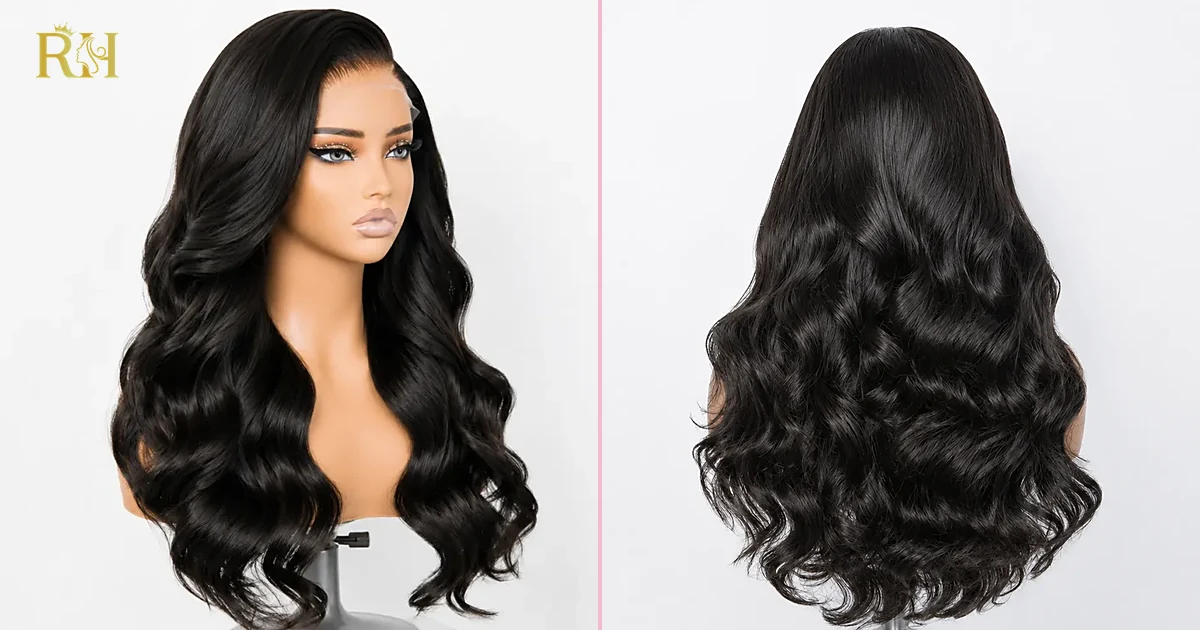
A wig reads as yours when its texture could have come from your scalp. Hold a strand of your own hair, in the state you wear it most, next to the product photos taken in daylight.
- You press or blow out your hair: choose straight hair with a soft, low shine. Raw hair keeps its cuticle and its own luster. Hair stripped in acid and coated in silicone looks glassy under light, and that gloss reads as fiber, not hair.
- You wear twist-outs, wash-and-gos or a curly blowout: choose a wavy, water wave or curly pattern so the bulk and movement match what people see on your off days.
- You want to go from short natural hair to a long, sleek look: you are changing texture and length at once. Many women take it in two steps, a straight bob first and the long unit later.
Color follows the same logic. Match the wig to your roots and eyebrows, not to the label on the box. Most natural black human hair sits at a soft off-black, and a flat jet black can look painted next to brown-black brows. Raw hair takes color, so a colorist can warm it or lift it later. Keep heat tools under 400°F and use a heat protectant every time.
Match the lace and the part to your skin
HD lace is thin, but lace still shows on deep skin when it sits lighter than your scalp. No standards body defines “HD”, so ask the seller for a close-up of the part on a skin tone near yours. A stylist can tint the lace with a powder or foundation in your scalp shade. Bleached knots stop the hairs at the part showing as tiny dark dots, and our closure wigs ship with the knots bleached.
Long black hair wig: what changes past 22 inches
Length adds drama and weight together. Every extra inch adds hair, and the band and the front of the cap carry that hair all day. The AAD tells braid wearers to keep their braids shorter because longer hair weighs more and pulls more, and the same pull lands on the front of a wig.
A long black hair wig at 24 to 30 inches works best when:
- you wear it a few days a week, or rotate it with a shorter unit
- you’ll detangle the nape after each wash, since long ends rub collars, seat belts and pillows
- your edges are healthy enough for a firm band
For everyday wear, 16 to 22 inches gives you hair past the shoulders with less weight at the front. Wavy and curly units also hang shorter than their label: a 22-inch water wave wig falls above a 22-inch straight one, because sellers measure the hair stretched.
Check the ends before you buy. A long unit with thin ends looks fake from behind, even with a perfect hairline. Ask the seller for a photo of the back at your length, in daylight. Length also drives the price more than anything else on the listing, and our guide to what a human hair wig costs shows how much each extra inch adds.
Short black hair wig: when short looks more real
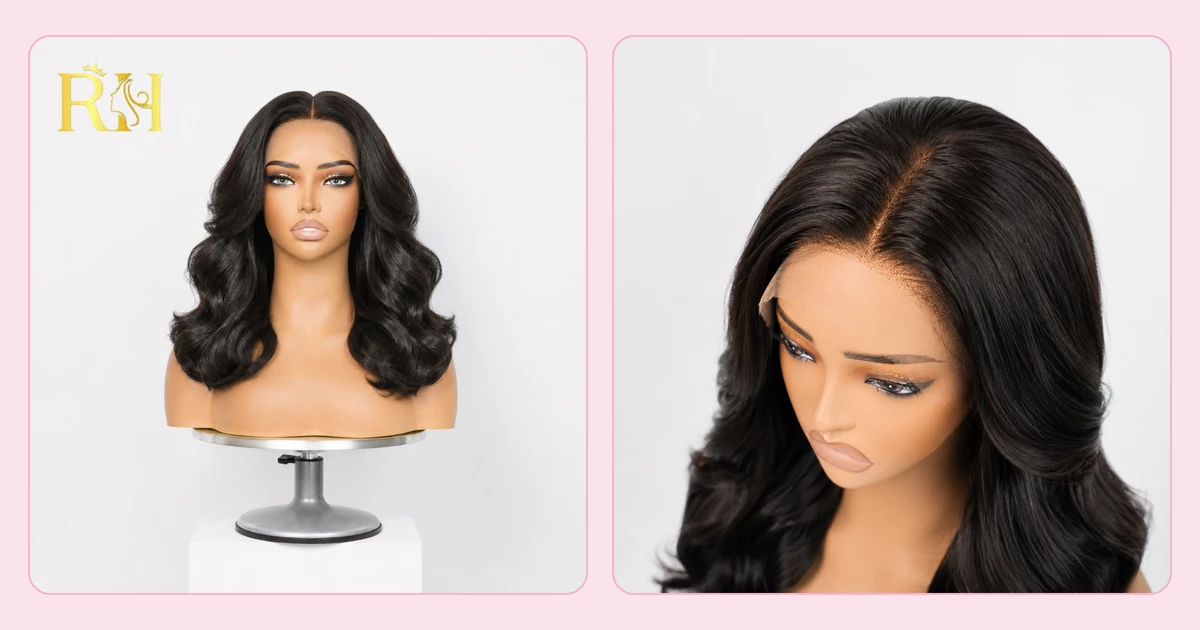
A short black hair wig has less to give it away. It puts less weight on your hairline, leaves fewer ends to tangle, and lands at a length many women grow on their own. A sharp cut also frames your face, so people look at you and not at the hair.
Short cuts ask more of the fit. Long hair hides the edge of the cap at the nape and around the ears, and a bob or a pixie hides nothing. Measure around your head before you order, ask the seller for the cap size, and have a stylist trim the nape once the wig sits right.
- Blunt bob, 10 to 14 inches: chin to shoulder, sleek or with a soft bend. The easiest short cut to wear daily.
- Layered or butterfly bob: more movement, more styling time with a flat iron or rollers.
- Pixie: shortest and lightest, and the one that most needs a close-fitting cap and a stylist’s cut.
Our closure wigs start at 12 inches, which a stylist can cut into a blunt bob. Our pre-order bob and pixie units come in 613 blonde and highlight shades. Message us to ask about a short black hair wig in natural color.
How long should your wig be?
| Length | Where it falls | Weight at the front | Upkeep | Suits |
|---|---|---|---|---|
| 10 to 14 in. | Chin to shoulder | Lightest | Regular trims to keep the shape | A first wig, the gym, thin or recovering edges |
| 16 to 20 in. | Collarbone to shoulder blades | Moderate | Detangle once or twice a week | Daily wear, office, most first-time buyers |
| 22 to 26 in. | Mid-back | Heavy | Nape detangling after each wash | Several days a week, rotation with a shorter unit |
| 28 to 30 in. | Lower back | Heaviest | The most detangling and heat time | Events, photos, occasional wear |
Where a length falls depends on your height and the cap. Use the table as a starting range, then check a seller’s photos on a model close to your build.
Daily habits that protect the hair under your wig
The best wigs for Black women protect the hair underneath them, and that part depends on you. These habits come from dermatologist guidance on wigs, weaves and extensions.
- Wear a satin wig cap. The Johns Hopkins review found that cotton and nylon caps rubbing the hairline may weaken hair shafts, and satin caps are less likely to.
- Take a glueless wig off at night. Sleep in a satin bonnet or on a satin pillowcase, and let your scalp rest.
- Keep braids under the wig loose. If the braids hurt, ask your stylist to redo them. The AAD treats pain, stinging and crusts on the scalp as signs to change the style.
- Care for your edges. The AAD’s advice for weaves and extensions is to use water-based styling gels on the hairline, keep the hair conditioned, and skip heat there.
- Give your hair breaks. The same AAD guidance caps weaves and extensions at two to three months before a break. If you braid down under a wig, plan your breaks the same way.
Human hair wigs need their own routine too, from the first wash to month six. Our best quality human hair wigs guide walks through each checkpoint.
Which wig fits your week?
| Your week | Build | Length | Why it works |
|---|---|---|---|
| Office five days, little time in the morning | Glueless 5×5 closure | 14 to 20 in. | On in minutes, off at night, a part that reads real at desk distance |
| Gym, sport or a long commute | Glueless 2×6 or 5×5 closure, bob cut | 10 to 14 in. | Less weight, less hair at the nape to tangle |
| Events, photos, high ponytails | 13×4 or 13×6 frontal, installed by a stylist | Any | Ear-to-ear lace for swept-back styles |
| Edges thinning or recovering | Glueless closure, no front combs, satin cap | 10 to 16 in. | No glue and low weight while a dermatologist checks the cause |
| Your first wig | Glueless 5×5 closure | 16 to 18 in. | Easiest to learn on, long enough to style |
| You may color it later | Raw human hair closure wig | Any | Raw hair lifts and takes dye; leave the color work to a colorist |
Frequently asked questions
What are the best wigs for Black women who wear one every day? A glueless closure wig in raw or virgin human hair, 14 to 20 inches long, in a texture close to your own. It goes on in minutes and comes off at night, with no adhesive on your hairline. Add a satin cap underneath and breaks every few months.
Are lace front wigs for Black females safe for your edges? The lace itself does little harm. Tension and adhesive do the damage: a Johns Hopkins review found that wigs held on with clips and adhesives can cause significant breakage. Choose glueless for daily wear, let a stylist install and remove any glued unit, and see a dermatologist if your edges thin.
Should my first wig be long or short? Start at 16 to 18 inches. A long black hair wig past 22 inches adds weight at the front and more detangling at the nape. A short black hair wig sits lighter, but the cap has to fit close because there is no length to hide its edges.
Is human hair or synthetic better? Human hair takes heat and color and lasts longer, so it costs less per month of wear if you wear it often. Most synthetic wigs cost less up front, shine more, and can’t take a flat iron. For a wig you’ll wear most days, human hair earns its price.
How do I make a wig look like my own hair? Choose in order: edges, texture, length, then lace. Match the color to your roots and brows, tint the lace to your scalp, and ask for bleached knots. A stylist’s cut around your face finishes what the right choice started. That order makes Black women’s wigs look grown, not bought.
Choosing the best wigs for Black women
The right wig starts at your hairline and works outward. Healthy edges point you to glueless or glued. Your own texture sets the wig’s texture. Your week sets the length, from a short black hair wig for the gym to a long black hair wig for the weekend. Your skin sets the lace and the part.
Tell us how you’ll wear it. Send us your usual part, the length you want and how many days a week you’ll wear it on WhatsApp. We’ll match you to a Straight or Wavy HD Closure Wig at that length and send the lace size and cap details in writing before you order.
==========
- RAW HAIR LUXURY — MORE THAN JUST HAIR, IT’S CONFIDENCE
- Website: rawhairsglobal.com
- Instagram: @rawhairluxury
- WhatsApp: +1 604 841 9668