
Human Hair Bundles with Closure: Choosing a Matching Set
Human hair bundles with closure are the pieces of one sew-in: three or four bundles of wefted hair, plus one closure, a small panel of lace with hair tied into it that covers the top of your head where the tracks end. A set looks like your own hair when all of its pieces agree on six specs: texture, shade and finish, length, density, lace and grade. When one spec is off, it shows at the border where the closure meets the first track. Choose the install first, buy every piece from the same hair, and check the match after water touches it, before your stylist starts sewing.
What are human hair bundles with closure?
Hair bundles with closure are the hair for one weave, sold as a set or piece by piece. Each bundle is a long weft of hair stitched along the top. Your stylist cuts the weft into tracks and sews them onto braided hair in rows, from the nape up. The bundles carry the length and the volume.
The closure finishes the top. A worker ties hair into its lace a few strands per knot, so the part looks like hair growing from scalp. It lies over the last braids and hides the ends of the tracks. A lace frontal does the same job across the whole hairline, from one ear to the other.
Salons name the finished style after the front piece. A closure weave is a sew-in finished with a closure, and a frontal weave is a sew-in finished with a frontal. Shops also sell the set as a hair weave with closure, a bundle deal or hair extension bundles with closure. All of these names describe the same four or five pieces.
Two matches decide how the set looks. The set has to match your own hair and leave-out, which our guide to human hair bundles that match your hair covers. The pieces also have to match each other, and that is what this guide is about.
Closure weave, frontal weave or quick weave: choose the install first
Decide how the set goes in before you choose the pieces. The front piece sets your parting, your upkeep and your bundle count, and most people choose between three installs.
| Closure weave | Frontal weave | Quick weave with closure | |
|---|---|---|---|
| Front piece | Closure: 2×6, 5×5 or 6×6 | Lace frontal: 13×4 or 13×6 | Closure, sometimes a frontal |
| Where you can part | Inside the lace | Anywhere along the hairline | Inside the lace |
| Pulled-back styles | No | Yes | No |
| How it holds | Sewn down with the tracks | Sewn at the back; glue, tape or a band at the hairline | Bonding glue on a protective cap |
| Upkeep during wear | Low | The lace needs re-laying as it lifts | Low until takedown |
| Takedown | Cut the thread | Cut the thread, release the lace | Remove glue from the cap and the wefts |
Closure weave: the simplest install
Your stylist sews the closure down with the tracks, and nothing touches your hairline. You can part your hair only inside the lace. A 2×6 gives you a deep middle part, and a 5×5 or 6×6 gives you room for a side part. For a first install, a closure weave asks the least of your own hair and your schedule.
Frontal weave: the most styling room
A frontal weave lets you part anywhere and wear ponytails that show the hairline. The trade-off sits on your skin. The frontal lace runs along your forehead, so your stylist has to hold it down there with glue, tape or a band, and re-lay it as it lifts.
Dermatologists prefer the sewn options. The American Academy of Dermatology recommends sewn-in weaves over styles held with bonding glue, and advises taking a weave out right away if it hurts or irritates your scalp. A Johns Hopkins review of 19 studies, summarized by ScienceDaily, found that wigs held on with clips and adhesives can cause heavy breakage. Adhesives can also trigger allergies. A case report in the International Journal of Trichology traced a rash along one wearer’s front hairline to an acrylate in the glue that held his wig.
Before you book a frontal weave, ask your stylist how they will secure the lace and whether a glueless method works for your hairline.
Quick weave: faster, harder to reuse
A quick weave bonds the wefts to a protective cap with glue instead of sewing them onto braids. It takes less time in the chair and costs less. Quick weave bundles with closure come out of the takedown with glue along every weft, which makes the hair harder to clean and reuse. If you plan to wear the same raw hair more than once, a sewn install protects the wefts as well as your own hair.
The best hair bundles with closure match on six specs
The best hair bundles with closure are the sets whose pieces still look like one head of hair after a month of wear. Check these six specs on every piece, in this order. A mismatch in texture or shade shows from across a room. A mismatch in lace or grade shows after a few weeks.
1. Texture: straight, wave and bundle with closure curls
Texture mismatch shows first at the border between the closure and the top track, where hair from both pieces falls together. Straight sets have the fewest variables. Wave and curl sets have more, because a factory can make the same pattern name two ways: from the wave the donor grew, or by setting the hair around rods with steam.
A steam-set pattern loosens with washing. If the bundles and the closure were set on different days or different rods, they can loosen at different speeds, and a body wave set that matched in the pack can drift apart by the third wash. Shoppers who search for closure body hair bundles or a bundle with closure curls should ask the seller two things: how the pattern was made, and whether the closure came from the same batch as the bundles. For curls, ask for a photo of the closure and one bundle side by side, both wet.
2. Shade and finish: why glossy hair bundles with closure stop matching
Raw hair keeps the donor’s own shade, somewhere between natural black and dark brown, and two donors can sit a shade apart. Small differences between bundles are normal, and your stylist can spread a lighter bundle through the back. The closure has no such hiding place. It sits at your part, in full view, so its shade has to match the hair right behind it.
Finish matters as much as shade. On human hair, a mirror-like gloss tends to come from a coating such as silicone, added after acid processing strips the cuticle. Glossy hair bundles with closure look matched in the pack because the coating gives every piece the same shine. The coating washes out over the first weeks of wear, and the hair underneath decides the match. If the closure and the bundles came from different lots, the closure can end up duller or lighter than the tracks around it. Hair that keeps its own cuticle and carries no coating keeps the luster it arrived with, so the match you see on day one is the match you keep.
Planning to color? Color the closure and all the bundles together, in one session, so every piece takes the same lift. Read your seller’s warranty first. Our warranty card, like many, no longer applies once the hair is bleached or dyed.
3. Length: match the closure to your shortest or longest bundle
The closure hair is your top layer, and it starts higher on your head than any track. Paired with the shortest bundle in a graduated set, it gives a soft, layered fall. For a blunt, full end, choose a closure as long as your longest bundle, if the seller makes one that long.
Long sets hit a limit here. Closures and frontals tend to stop well short of the longest bundles: ours run 12 to 24 inches, and our bundles run 12 to 34. For 30-inch hair, a graduated 26-28-30 set with a 24-inch closure steps down in 2-inch layers. Three 30-inch bundles under the same closure leave a 6-inch jump between the top layer and the tracks.
4. Density: a full closure for a full set
Bundles sell by weight; ours weigh 100 grams each. A closure sells by density, the amount of hair tied into the lace, which sellers tend to give as a percentage. The two have to agree. A thin closure over four heavy bundles gives a flat crown above a full back. A dense closure over two bundles gives a full top and thin ends.
Match the closure’s density to your bundle count: a four-bundle set needs a fuller closure than a two-bundle bob. If the listing gives no density, ask for it, or ask for a photo of the lace held up to the light, which shows how close together the knots sit.
5. Lace: 2 by 6 closure with bundles, 5×5 and 13×6 lace frontal with bundles
The numbers in a lace size give its width and depth in inches. The size decides where you can part and how much of the top the lace covers. Our guide to buying bundles that match your hair lists what each size covers. The table below shows what each size changes in the rest of the set.
| Lace size | Parting | What it changes in the set |
|---|---|---|
| 2×6 closure | Deep middle part | Tracks run up to both sides of the part and need the closure’s exact texture |
| 5×5 closure | Middle or side part | The most common partner for three bundles |
| 6×6 closure | Middle or wider side part | More hair from the lace, fewer tracks at the top |
| 13×6 frontal | Any part, plus pulled-back styles | Covers the hairline, so at some lengths the set needs one bundle fewer |
A 2 by 6 closure with bundles suits a sleek middle part. A 13×6 lace frontal with bundles suits anyone who wants to wear the hair back. Two more lace details decide the match at your part.
Part style. A free-part closure lets your stylist part anywhere inside the lace. A 3 part closure has three set parting lines, left, middle and right, and you choose one at install. If a deal lists a 3 part closure in bundles packs, you keep those three lines for the life of the closure.
Lace type and knots. HD lace is the thinnest lace and blends into most skin tones. It is also the most delicate, so an HD lace frontal with bundles needs a gentle hand at install and at takedown. Most sellers bleach the knots where hair meets lace, so the part reads as scalp. Bleach weakens hair: in a study in the Journal of Cosmetic Science, wet hair lost about 20% of its breaking strength within the first minute of bleaching. If your closure arrives with bleached knots, as ours do, don’t bleach it again at home. Each extra round loosens the knots, and loose knots shed at the part, the one place everyone sees. The same care applies to all lace weaves and closures.
6. Grade: raw and remy hair bundles with closure
The grade on the label has to hold for every piece in the set. Remy means the cuticles run one way, root to tip. Raw means single-donor hair with no chemical processing. A label on the bundles says nothing about the closure, so remy hair bundles with closure can still pair remy wefts with a closure tied from other stock. Before you buy raw bundles with closure, ask whether the closure is raw too, and whether it came from the same hair as the bundles. Our guide to virgin hair vs remy hair explains the labels and the tests you can run at home.
A factory that makes both pieces can answer those questions for you. In ours, we tie our closures from the same raw hair we use for our wefts, and we select each combo for color, density and texture across all four pieces.
How many bundles with closure? 3 or 4 by lace size and length
Three bundles with closure cover most installs from 16 to 22 inches. Add a fourth bundle from 24 inches, or when you want extra fullness. A lace frontal and bundles count differently: the frontal covers more of your head than a closure, so at 16 and 24 inches the set needs one bundle fewer. Our guide for 100-gram bundles:
| Bundle length | With a closure (2×6, 5×5, 6×6) | With a 13×6 frontal |
|---|---|---|
| 10 to 14 inches | 2 bundles | 2 bundles |
| 16 inches | 3 bundles | 2 bundles |
| 18 to 22 inches | 3 bundles | 3 bundles |
| 24 inches | 4 bundles | 3 bundles |
| 26 inches and longer | 4 bundles | 4 bundles |
Count a graduated set by its longest bundle. Every bundle weighs the same at every length, so a 28-inch bundle holds fewer strands than a 16-inch one, and long sets need the extra bundle to keep the ends full.
A closure with three bundles is the standard set, and most combos are built on it, ours included. When you need 4 bundles and a closure, order the fourth bundle with the set, from the same seller. Whether you buy 3 or 4 bundles with closure, every piece should come from one lot. A bundle bought months later may come from a different lot.
Hair bundles with closure deals: what the set price should include
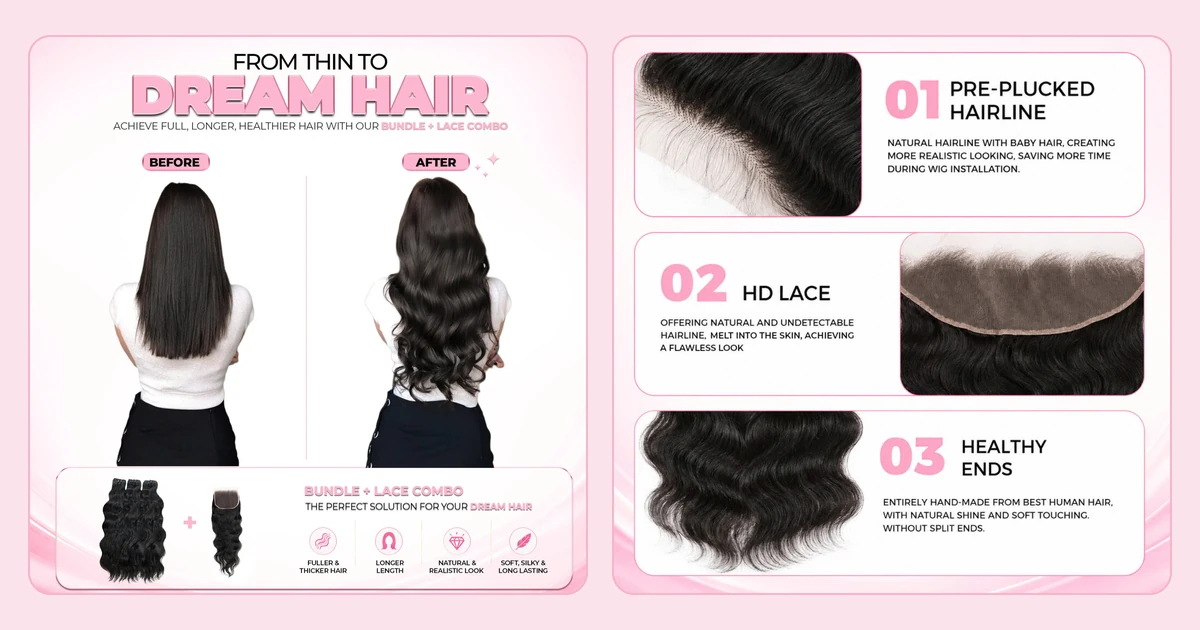
A bundle deal prices three or four weave hair bundles with closure as one set, below what the pieces cost on their own. It saves money only when the pieces in the deal are the ones you would have chosen anyway. Before you compare two 3 bundles with closure deals, line them up on these points.
| Check | What to look for |
|---|---|
| Grams per bundle | Two deals at the same price can hold different amounts of hair |
| Closure size and lace | Which size comes in the deal, and whether HD lace costs extra |
| Closure length | Whether you pick it, or the deal fixes it |
| Bundle lengths | Same-length and graduated sets, and whether you can choose |
| One source | Whether the closure and the bundles come from the same hair |
| Returns | Whether you can exchange one piece, or have to return the whole set |
| Delivery | Shipping, plus duty if the set crosses a border |
The last row can undo a good price. Our guide on where to buy human hair bundles in Canada shows what duty and cross-border shipping add to a set.
Cheap human hair bundles with closure: where the savings come from
Cheap human hair bundles with closure save money in a few places: lighter bundles, hair pooled from many donors, acid processing with a coating, or a closure tied from other stock. Each saving comes back later, as a weaker match after the first washes and as a set you replace after one install.
Compare the cost per install instead of the price per set. In an illustrative example, a $300 bundle pack with closure that lasts one install costs $300 per install. A $600 set of raw hair worn for three installs costs $200 per install, plus a new closure if the lace wears out first. Your numbers will change with your stylist, your care routine and the hair itself. Our guide to hair extension vendors lists the questions that tell you which kind of set a seller makes.
Check the match before install day
Run these checks the day your set arrives, so you have time to swap a piece before your appointment.
- Film the unboxing. Many sellers ask for an unboxing video before they accept a claim, and our warranty card requires one.
- Lay the closure on a bundle in daylight. Put the closure’s lace edge beside the bundle’s weft. Compare the shade at the roots, the sheen along the length and the texture at the ends. Indoor light hides warm and cool undertones.
- Measure every piece. Stretch each bundle and the closure straight, measure from the weft or the lace to the tip, and check each length against your order.
- Wet a test section. Spray one section of the closure and one section of a bundle with water, and let them air dry side by side. A coating dulls, and a steam-set wave relaxes or frizzes, faster than hair with its own pattern. Read the return terms first: some sellers won’t take back hair that has been washed, and a little water on one section is the gentlest test.
- Part the closure. Part it where you will wear it, and look at the knots and the lace against your skin. Our guide on how to buy remy hair extensions covers the home tests for the hair itself.
- Comb the closure. Run a wide-tooth comb through it, from the ends up. A few loose hairs are normal. Clumps coming out at the knots point to weak knots.
Keep weave bundles with closure matched across installs
Raw weave bundles with closure can go back in for more than one install, but the pieces age at different speeds. The closure carries the most wear. Your stylist lifts it, lays it and sometimes plucks it at each install, and you wash it at the part every week. The wefts hang from braids under the rest of your hair. In most sets, the lace gives out before the wefts do.
A few habits keep the set matched:
- Take it down on time. The Johns Hopkins review advised taking weaves and extensions out after six to eight weeks, so your own hair can recover between installs.
- Wash the pieces together. Use the same shampoo and conditioner on the closure and the wefts, so they age at the same rate.
- Keep oil off the lace. Heavy oils at the part loosen the knots and lift the lace.
- Store the set as a set. Between installs, wash the wefts and the closure, dry them flat and keep them together.
- Replace the closure from the same source. When the lace tears or the part thins, order a new closure from the seller who made your bundles, in the same texture and length. If you color your hair, color the new closure with the bundles.
Frequently asked questions
How many bundles do I need with a closure? Three bundles with a closure cover most installs from 16 to 22 inches. Use two bundles for 10 to 14 inches, and four from 24 inches up or when you want extra fullness. A 13×6 frontal covers more of your head, so at 16 and 24 inches it needs one bundle fewer than a closure.
Should the closure be the same length as the bundles? Match the closure to your shortest bundle for a soft, layered fall, or to your longest bundle for a blunt, full end. Many sellers stop their closures at about 24 inches. For longer hair, a graduated set such as 26-28-30 with a 24-inch closure hides the step between the top layer and the tracks.
Is a closure weave or a frontal weave better? A closure weave suits most first installs. Your stylist sews it down with the tracks, it needs no adhesive, and it asks for little upkeep. A frontal weave lets you part anywhere and wear the hair back, but the lace sits on your hairline and needs re-laying. Dermatologists recommend sewn-in styles over bonding glue.
Can I buy the closure and the bundles from different sellers? You can, but the match gets harder. Two sellers seldom use the same donors, processing or wave setting, so the pieces can differ in shade, sheen and texture, and drift further apart with each wash. If you mix sellers, compare the pieces wet and dry, in daylight, before install day.
What is a 3 part closure? A 3 part closure has three set parting lines: one on the left, one in the middle and one on the right. You choose one of them when you install it. A free-part closure lets you part anywhere inside the lace. Choose free part if you like to change your part from one install to the next.
How long do human hair bundles with closure last? One install lasts about six to eight weeks, the point at which dermatology researchers advise taking a weave out. The hair itself can last much longer. Raw bundles go back in for several installs with good care, while the closure lace tends to wear out first, so plan for a replacement closure.
Choosing human hair bundles with closure that match
Choose the install first, then the set. A closure weave asks the least of your hairline, and a frontal weave gives you the most styling room. Buy the bundles and the closure from the same hair, and check texture, shade, length, density, lace and grade on every piece, wet as well as dry. Count your bundles by lace size and length, judge any deal by what it holds, and budget for the closure to wear out before the wefts.
Ready to build your set? Our straight bundle with closure combo and wavy bundle with closure combo put three Raw Sea bundles and a closure or frontal in one order, and you choose the bundle lengths, the lace size and the closure length. Not sure which to pick? Send a photo of your hair, dry and unstyled, on WhatsApp with the length you want, and we’ll suggest a set.
==========
- RAW HAIR LUXURY — MORE THAN JUST HAIR, IT’S CONFIDENCE
- Website: rawhairsglobal.com
- Instagram: @rawhairluxury
- WhatsApp: +1 604 841 9668