Hand-Tied Weft Hair Extensions: How to Match Straight, Wavy and Curly Texture
Hand-tied weft hair extensions blend when their texture matches the hair that falls over your rows, so measure that hair before you choose straight, wavy or curly. Three dry strands, a ruler and a few circles drawn on paper give you two numbers: how tight your curl bends and how much it shrinks. Those two numbers pick the texture and tell you how long a curly weft will hang once it’s in.
What does texture change on a hand-tied hair weft?
A hand-tied hair weft is a thin seam of hair knotted by hand onto a thread. Your stylist clamps a line of small beads onto your own hair, sews two or three wefts to that line, and lets the hair above the row fall over it. That last step makes texture your first decision. Your own top layer hides the row. If it bends one way and the hand-tied extension bends another, you’ll see the change a few inches below the row, where the two hairs meet.
Texture changes three more things on hand-tied weft hair extensions:
- How much the row shows. Curls and waves stand away from the head and cover a seam. Straight hair lies flat, so a straight row needs your own hair to fall over it cleanly, and a part in the wrong place shows the beads.
- How long the hair looks. A curly hand-tied weft hangs shorter than the number on the pack, because the seller measured it stretched.
- How full it looks per gram. Curly hair takes up more space than straight hair of the same weight, so the same grams look fuller in a curl.
You also can’t trim your way out of a texture mismatch on hand-tied weft hair extensions. You can’t cut a hand-tied hair weft to size, since the knots sit on a single thread and a cut end unravels. Your stylist plans each weft’s width before ordering, and a wrong texture stays in until the next move-up. Get the texture right on paper first. Our remy hair extensions guide covers the quality checks to run on whatever texture you pick.
How do you measure your texture before buying hand-tied extensions?
Before you buy hand-tied weft hair extensions, measure three strands from your crown, dry and free of product, for curve size and shrinkage. A research team led by Roland De La Mettrie measured hair from 1,442 people in 18 countries and sorted it into eight shape groups using three numbers: curve diameter, curl index and the count of waves along a strand. They built the system so nobody had to guess curl type from where a person’s family came from.
A later test of that system in PLOS ONE by Mkentane and colleagues found raters agreed more often when the curliest groups were merged into six groups. It also found that one self-declared group, labeled African, spread across the four curliest groups. The same holds for shop labels. “Brazilian curl” or “Indian wave” on a pack tells you nothing about how tight the curl is. Your own measurements do.
You’ll need three shed strands, a ruler, a pen and a sheet of white paper.
- Take strands from the crown. Beaded rows sit under your top layer, so match the hair that falls over them, not the nape. Pick shed strands from your comb after a wash day and let them air dry with no product.
- Draw four circles. Use a cup, a coin or a compass to draw circles about 1 cm, 2 cm, 4 cm and 8 cm across, and check each with the ruler.
- Find the curve size. Lay a strand on the paper without stretching it. Find the circle whose edge follows its tightest bend. Researchers use a ring just under 1 cm across as a cutoff: if a 6 cm piece of hair coils inside it, the hair belongs to the two tightest groups.
- Work out the curl index. Measure the strand lying loose. Then hold both ends and stretch it straight without pulling hard, and measure again. Divide the stretched length by the loose length. Straight hair scores about 1.0. The higher the number, the more your curl shrinks.
- Feel the thickness. Roll the strand between your thumb and finger. If you can barely feel it, it’s fine; if it feels like sewing thread, it’s coarse.
Write down the circle and the ratio for each strand, and take the notes to your hand-tied extension stylist. If the three disagree, go with the crown strand, since it covers the most rows.
| Tightest bend on paper | Curl index | Usually reads as | Hand-tied texture to look at |
|---|---|---|---|
| Wider than the 8 cm circle, or none | About 1.0 | Straight | Straight |
| Follows the 4 to 8 cm circles, one or two waves | A little above 1.0 | Wavy | Natural wave, loose wave or body wave |
| Follows the 2 to 4 cm circles | Clearly above 1.0 | Loose curl | Curly, in a loose curl size |
| Follows the 1 to 2 cm circles | Higher again | Curly | Curly |
| Coils inside the 1 cm circle | Highest | Tight curl or coil | Tight curly rows, or a sew-in |
The circle sizes are a rough shopping guide built on the research method. They are not the study’s published cut-offs.
Why strand thickness matters for curly hand-tied extensions
Thickness tells you how much load your hair can take. A 2009 study in the Journal of Cosmetic Science measured 12,050 fibers and found thinner hairs tended to be curlier, while less curly hair needed higher loads to break. If your strands came out fine and tightly curled, ask your stylist for lighter hand-tied wefts per row and fewer rows. The American Academy of Dermatology advises choosing extensions light enough that they don’t pull, and getting them done at a salon that specializes in them.
Match the hair you wear most days
The measurements describe your hair at rest. Hand-tied weft hair extensions have to match the hair you show the world. If you flat iron your top layer five days a week, a curly hand-tied weft fights your routine, and you end up ironing the extensions too. Choose straight or wavy hand-tied extensions with a soft wave. If you wear your curls out, match the curls. If you switch between the two, wavy covers both, because a wave dries close to straight under a blow-dryer and comes back with water.
Wavy hand-tied extensions: which wave matches your hair?
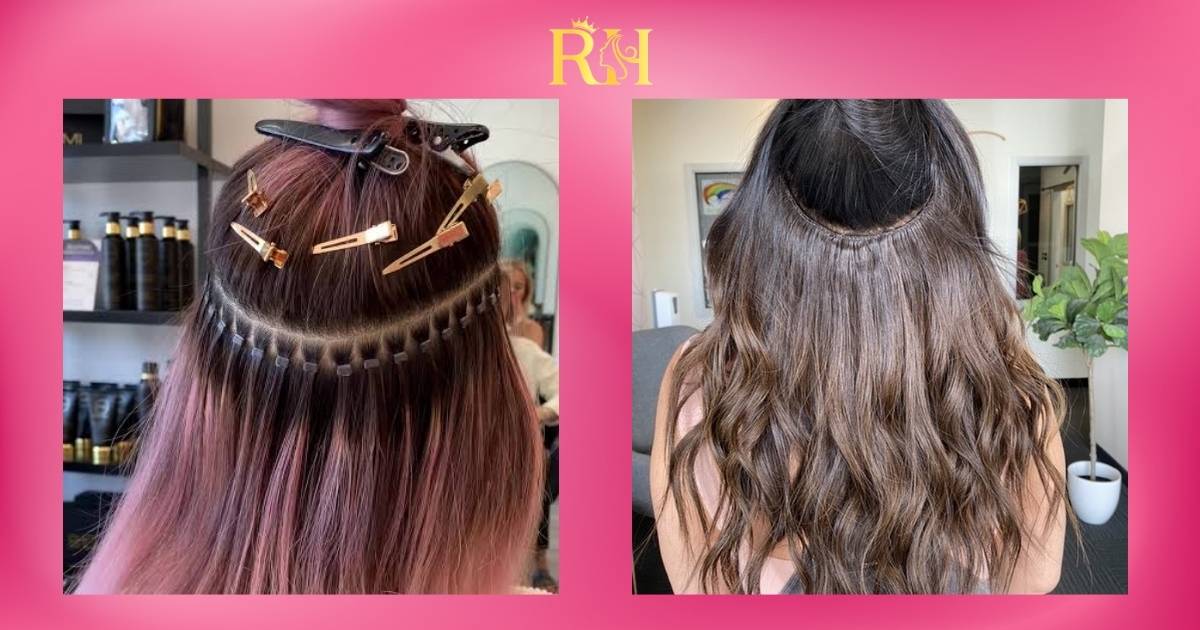
Wavy hand-tied extensions match the widest range of hair because a wave passes for straight after a blow-dry and for texture after an air-dry. Three labels cover most packs of wavy hand-tied extensions, and they describe how the wave got there as much as what it looks like.
| Wave label | How the hair gets its wave | How it looks | Blends with | After a flat iron and a wash |
|---|---|---|---|---|
| Body wave | A factory sets a large, even S-shape | Polished, like a fresh blowout with rollers | Blown-out or relaxed hair; straight hair you curl | Depends on how the factory set it; test a strand |
| Loose wave | A factory or the donor; a tighter, less even S | Beachy, with more frizz at the ends | Air-dried wavy hair | Depends on the factory; test a strand |
| Natural or raw wave | The donor’s own growth pattern | Uneven, strand to strand, like most wavy hair | Air-dried hair that waves in some places and not others | Returns, because the wave grew in the hair |
The last row matters if your own hair waves unevenly, and most wavy hair does. A factory wave repeats the same S down every strand. Your hair bends more at the ends than at the root and bends differently over each ear. A donor wave varies the same way, so the join below a hand-tied row disappears faster.
Hair stylists often describe wave with a number and letter system, from 1 for straight to 4 for coily, and the AAD notes you will see those labels on hair products. Your circle test gives you the same information with a measurement behind it. Our hair by texture collection groups each pack by its wave, so you can match your number to a pack instead of a name.
Test the wave before you book the rows
A beaded-row install costs hours of stylist time, and you can’t cut the wefts afterward. Test the texture of a hand-tied hair weft against your own hair first, on something you can take out. Clip a wavy weft under your top layer for a few days and check the join in daylight, after a wash, and on a humid day. We make our Raw Sea Wavy clip-ins from the same donor-wave hair as our Raw Sea Wavy bundles, which makes them an affordable way to find out if the wave matches yours before you commit to a full set of wavy hand-tied extensions.
Curly hair hand-tied extensions: what to check first
Curly hair hand-tied extensions work when the curl size and the shrinkage match yours, and when your rows stay light. Check them in that order.
Curl size: match within one circle
Pick curly hand-tied extensions within one circle of your own curl. A curl two sizes tighter than yours reads as a separate piece of hair. A curl two sizes looser looks limp beside your curls by the end of the day. If your strands landed between two circles, choose the looser curl. You can tighten a curl for the day with a wand, and a hand-tied weft takes heat the same way your hair does, but you can’t loosen a tight curl without stretching it straight.
The length math for curly hand-tied extensions
Most sellers measure wavy and curly hand-tied weft hair extensions pulled straight, so the length on the pack is the stretched length. To find where curly hand-tied extensions will hang, divide the pack length by your curl index.
| Pack length (stretched) | Curl index 1.2 | Curl index 1.5 | Curl index 2.0 |
|---|---|---|---|
| 18 inches | About 15 in | About 12 in | About 9 in |
| 20 inches | About 17 in | About 13 in | About 10 in |
| 22 inches | About 18 in | About 15 in | About 11 in |
Your own hair shrinks by the same ratio, which is the hidden benefit of a matched curl index. When the extension and your hair share a ratio, they shrink together on wash day and stretch together when you blow them out, and the ends stay lined up. A mismatched ratio leaves a step at the ends that changes with the weather. Humidity tightens curls because water from the air breaks and re-forms the weak bonds that hold the shape, as chemist Michelle Wong explains in her guide to hair and hydrogen bonds.
Are hand-tied rows right for tight curls?
They can be, with a stylist who installs curly hair hand-tied extensions on coily hair. Tight coils wrap around beads, and you can’t get a comb between beads to detangle, so hair that mats near a row has nowhere to go. That same 2009 study showed curlier hair breaking at lower loads. If your strands coiled inside the 1 cm circle, ask your stylist about two options side by side: tight curly hand-tied rows, and a sew-in on flat braids, where your own curl pattern doesn’t touch the install. Our guide to bundles that match your hair covers the sew-in route.
Natural texture or factory texture: which lasts on hand-tied wefts?
Natural texture lasts longer, because the curl grew in the hair. Curly hair grows from a curved follicle, and a review in Experimental Dermatology by Gillian Westgate and colleagues at the University of Bradford traces how that follicle shape and uneven cell growth inside it coil the fiber. Donor hair keeps that shape after cutting. A factory starting with straighter hair has to add a curl afterward, with steam or a chemical perm.
The difference sits in which bonds hold the shape. Michelle Wong describes the split: disulfide bonds only change under chemical treatments such as perms and relaxers, while water and heat break hydrogen bonds, which re-form in a new shape as hair dries or cools. Your flat iron and your wash day move hydrogen bonds. A chemical perm rewrites disulfide bonds, which lasts, but it opens the cuticle on the way. Steam sets vary by factory, and one seller’s steam curl can hold through a year while another’s softens after a few washes.
You can’t see the method from a pack of hand-tied weft hair extensions, so test it:
- Ask the seller for a few loose strands, or keep the shed strands from your first comb-through.
- Wash them with your usual shampoo and let them air dry. Compare the curl with the pack.
- Flat iron the same strands at the heat you use, under 400°F with a heat protectant.
- Wash and air dry again. If the wave or curl comes back close to the original, it will survive your routine. If it comes back looser after each round, expect your hand-tied rows to relax between move-ups.
Run the same test on your own hair as a control. If your curl comes back and the extension’s doesn’t, the texture won’t match by month two, however close it looked on day one. Our virgin vs remy hair guide explains how to tell chemically processed hair from raw hair before it reaches the wash test.
How does texture change care for hand-tied weft hair extensions?
Curlier hand-tied weft hair extensions need more moisture and gentler detangling than straight ones, because the hair gets no oil from a scalp and curls tangle around the beads. The AAD advises conditioning dry or curly hair along its full length, and detangling wet hair with a wide-tooth comb rather than a brush.
| Straight | Wavy | Curly | |
|---|---|---|---|
| Wash | Most often of the three, when the roots look oily | Less often than straight | Least often; let the curl rest between washes |
| Condition | Mid-length to ends | Mid-length to ends; leave-in after | Full length; leave-in every wash |
| Detangle | Brush when dry, holding the row | Wide-tooth comb, damp | Fingers and wide-tooth comb, wet with conditioner in |
| Dry | Blow-dry on low | Air-dry or diffuse | Air-dry or diffuse; never sleep on wet rows |
| Heat | Under 400°F, with protectant | Under 400°F; test the wave after | Least heat of the three |
Treat these as starting points and adjust to how oily your scalp gets and how often you sweat.
Two habits help every texture of hand-tied hair weft. Hold the hair at the row with one hand while you detangle below it with the other, so the beads don’t take the pull. Sleep with the hand-tied rows in a loose braid or a silk bonnet, so the hair doesn’t knot against the pillow. Most stylists move hand-tied rows up every six to eight weeks as your own hair grows, and a move-up is the time to check if the texture still matches.
Frequently asked questions
Can you get hand-tied extensions with curly hair? Yes. Curly hair hand-tied extensions come in curl sizes from loose spirals to tight coils. Match the curl size within one size of your own and match the shrinkage ratio. Keep the rows light if your strands are fine. For tight coils, compare tight curly rows with a sew-in on braids, since beads are harder to detangle around than braids.
Why do curly hair extensions look shorter than the pack length? Most sellers measure wavy and curly hair stretched straight. A curl shrinks back once it’s released, so a curly weft hangs shorter than its label. Divide the pack length of a curly hand-tied hair weft by your curl index, the ratio of your stretched strand to your relaxed strand. An 18-inch curly weft at a ratio of 1.5 hangs about 12 inches.
Can you straighten wavy hand-tied extensions? Yes. Wavy hand-tied extensions made from human hair take a flat iron the same way your own hair does. Keep the iron under 400°F and use a heat protectant. A natural donor wave comes back after the next wash. A factory wave may come back looser, so test a strand before you iron the whole set.
Which hand-tied texture is easiest to match? Wavy. A wave passes for straight hair after a blow-dry and for textured hair after an air-dry, so it matches the widest range of routines. A natural donor wave blends best with wavy hair because it varies along each strand the way your own wave does.
Can you mix two textures in one hand-tied install? Yes, if your own hair changes texture between areas. Some people have a straighter crown and curlier hair underneath. Your stylist can put a wavy hand-tied weft in the top row and a curlier hair weft in the lower rows. Measure strands from each area and order wefts for each row by its own measurements.
How long does the texture last on hand-tied wefts? A natural donor curl or wave lasts as long as the hair, because the shape grew in. A factory texture lasts as long as the method used to set it, and that varies by seller. Run the wash-and-iron test on a few strands to see how a texture holds up to your routine.
Choosing the texture for your hand-tied weft hair extensions
Hand-tied weft hair extensions look like your hair when they bend like your hair. Measure three crown strands for curve size and shrinkage, match the hair you wear most days, and choose the looser texture when you land between two. Do the length math before you order curly hand-tied extensions, and wash a few strands to see whether a texture will last. When the numbers point to wavy, a natural donor wave gives you the most room: straight on Monday, waves by Thursday.
Send us a photo of three dry strands next to a ruler on WhatsApp, with your relaxed and stretched lengths. We’ll reply with the texture in our raw range closest to yours, and tell you when a custom texture would match better.
==========
- RAW HAIR LUXURY — MORE THAN JUST HAIR, IT’S CONFIDENCE
- Website: rawhairsglobal.com
- Instagram: @rawhairluxury
- WhatsApp: +1 604 841 9668