Types of Hair Extensions: Which Method Is Right for Your Hair?
The main types of hair extensions are clip-ins, sew-ins, tape-ins, beaded extensions (micro-links, I-tips and beaded wefts) and keratin bonds, with wigs, closures and frontals for full coverage. They differ in two ways: how the extension holds on to your hair, and how often you pay to put it back in. No single type of hair extensions is best for everyone. The best one for you is the type your own hair can carry, worn as often as you plan to wear it, made from hair good enough to survive being reused.
What are the different types of hair extensions?
Salons use dozens of names: K-tips, I-tips, nano rings, halos, hand-tied wefts, invisible wefts. Stephanie Angelone, master stylist at RPZL Extensions Bar, told Bustle that hundreds of variations exist, and that clip-ins, tape-ins, keratin bonds and hand-tied wefts are the most popular. Almost every other name on a salon menu is a variation on five ways to hold extra hair on your head, plus a sixth option that covers your hair instead of adding to it.
| What holds it | Types of hair extensions | Who puts it in | Stays in |
|---|---|---|---|
| Clips or a wire | Clip-ins, halo, ponytail pieces | You | One day at a time |
| Thread | Sew-in weave, beaded wefts, hand-tied wefts | A stylist | About 6 to 10 weeks between visits |
| Tape | Tape-ins | A stylist | About 6 to 8 weeks |
| Beads | Micro-links, I-tips, nano rings | A stylist | Up to about 12 weeks before a move-up |
| Keratin bond | Fusion, K-tips | A stylist | About 3 to 4 months |
| Full cover | Wigs, closures, frontals | You or a stylist | Varies |
Once you know the hold, most of the trade-offs follow from it. A clip only holds while you wear it. Thread, tape and beads sit close to your scalp and drift down as your hair grows, which the Canadian Dermatology Association puts at about half an inch a month. That growth is why every semi-permanent method has a move-up date. A keratin bond holds until a stylist dissolves it.
Kinds of hair extensions, one by one
The six types of hair extensions below run from the least commitment to the most, ending with the option for when extensions won’t work.
Clip-in and halo extensions: the no-commitment type
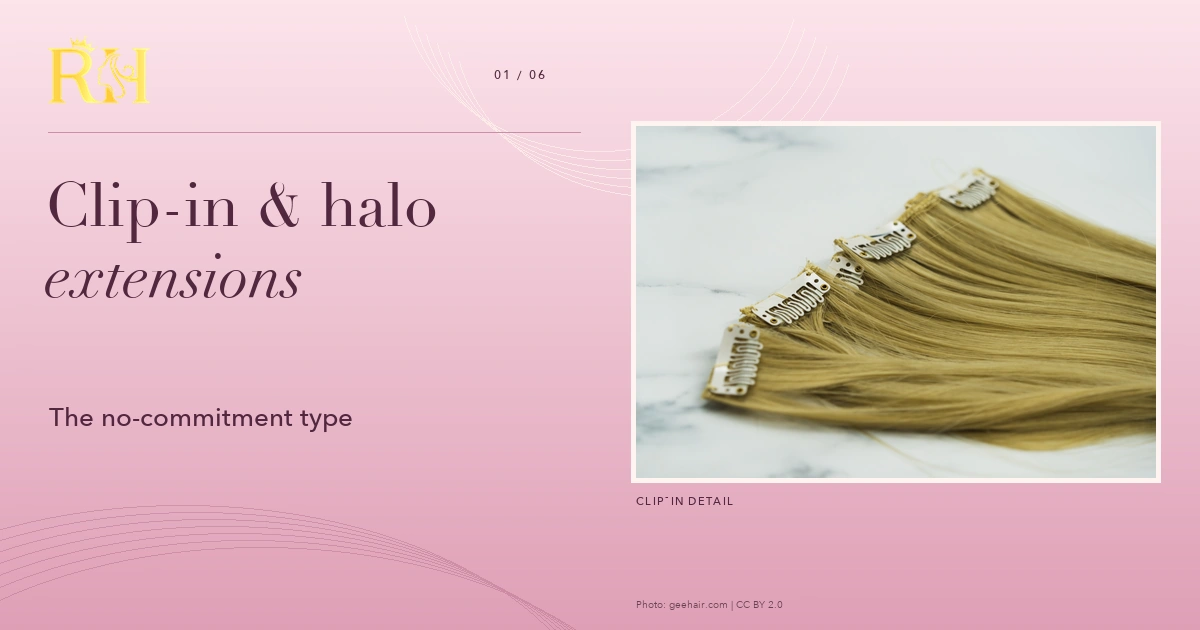
Clip-ins are wefts of hair with small pressure clips sewn along the top. You open each clip, slide it into your hair close to the root and snap it shut. A full set runs from one wide piece across the back of the head to a few narrow pieces at the sides. A halo does the same job with a clear wire in place of clips: the wire sits around your crown and your own hair falls over it.
Angelone calls clip-ins the only type of hair extensions that is truly damage-free, as long as you never sleep in them. That rule is also the drawback. You add them each morning you want them and take them out before bed. A writer for Reviewed who wore clip-ins for five years found they added at least half an hour to her morning, so she moved to a sew-in once she wanted length every day.
How long a set lasts depends on the hair more than the clips. Hairstylist Paul Rus told PureWow to expect 15 to 20 wears before clip-ins show wear, while Angelone told Bustle a well-kept set can last years. Both can be right about the sets they’ve handled. We come back to why in the section on hair grade.
Best for: events, part-time wear, testing a color or length before you commit, and anyone who doesn’t want a salon schedule.
Sew-in (weave) extensions: the type built for textured hair
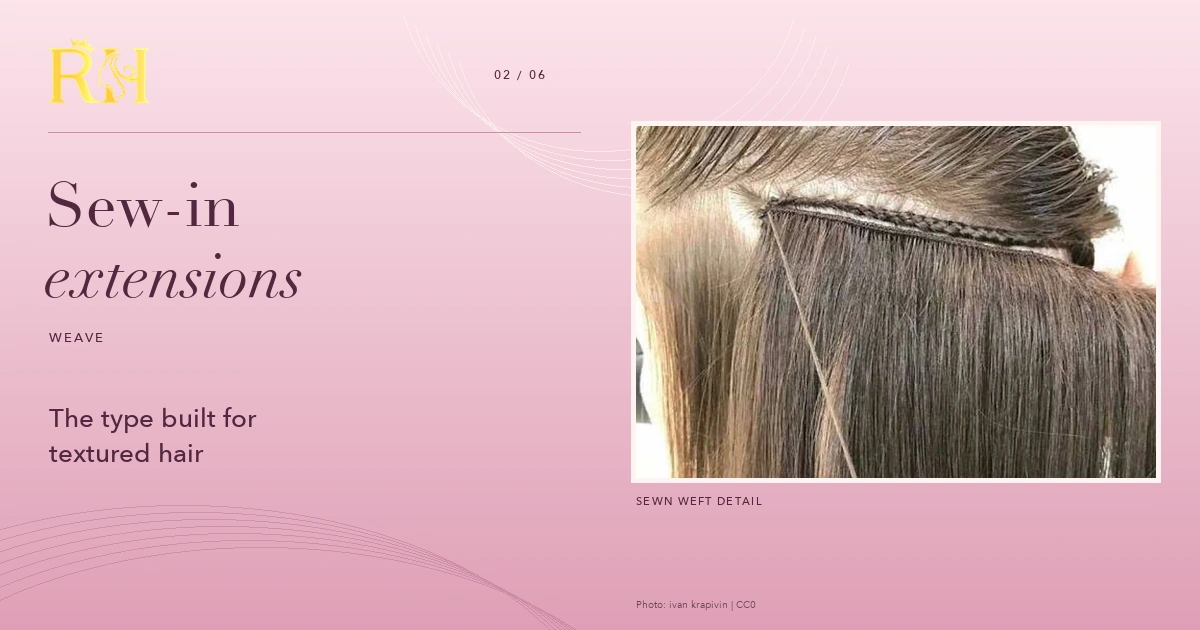
A traditional sew-in starts with your own hair braided flat into cornrows. Your stylist then sews wefts of hair onto the braids with a curved needle and thread. PureWow puts the install at two hours or more and the wear at eight to ten weeks. Most human hair bundles end up in a sew-in, often with a closure or frontal on top to hide the braids at the part.
A newer version skips the braids. Extension specialist Kaileigh Henninger, quoted by Reviewed, sets a row of small beads along the scalp and sews the weft to the beads, then tightens and moves it up every six to eight weeks. Hand-tied wefts use the same bead row with a thinner, lighter weft. Dafina Smith, founder of Covet & Mane, told Bustle that taking hand-tied wefts out means opening the beads, with no glue, acetone or alcohol involved.
A sew-in carries more hair than any other method and spreads the weight over a whole braid or bead row, which suits thick, curly and coily hair. The American Academy of Dermatology (AAD) recommends sewn-in weaves over ones attached with bonding glue. The risk is tension. Braids or beads set too tight pull on the hairline, and the weight keeps pulling for weeks.
Best for: daily wear, full-head length and volume, curly and coily textures, and reusing one set of hair across several installs.
Tape-in extensions: the fast semi-permanent type
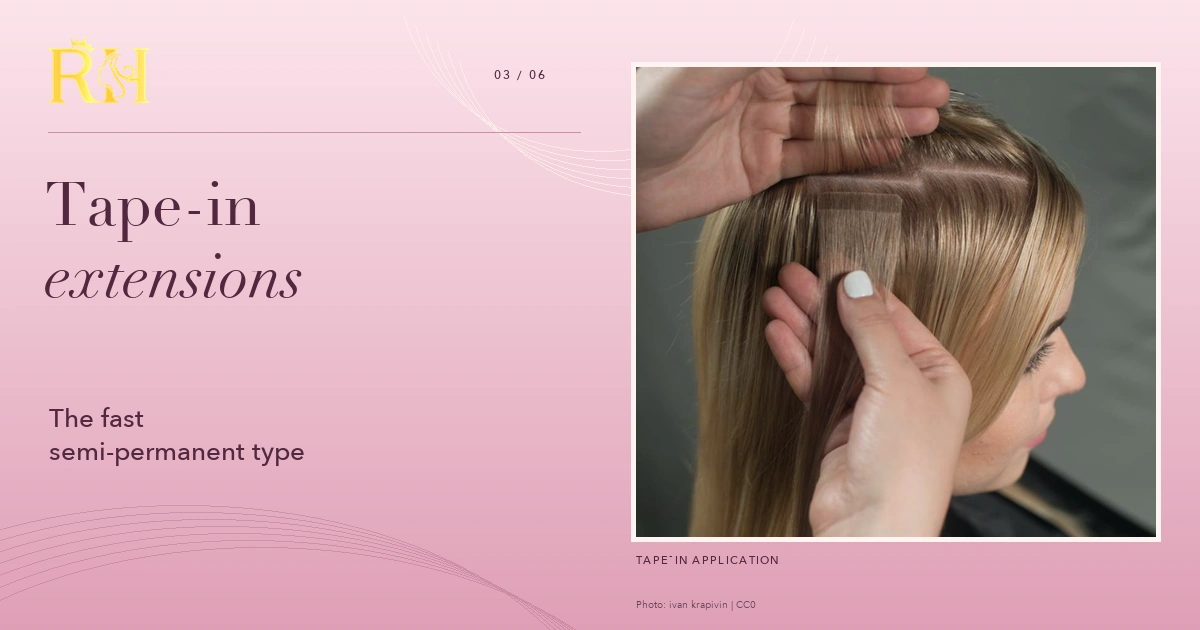
Tape-ins are thin wefts with a strip of adhesive along the top. Your stylist presses a thin slice of your hair between two of them, like a sandwich. Celebrity stylist Justine Marjan told Bustle the install takes about 90 minutes and lasts six to eight weeks. Angelone added that the same set can go back in two or three times, as long as you wash, dry and brush the hair between installs.
Tape-ins lie flat against the head and suit straight and wavy hair. Oils and heavy conditioner near the tabs loosen the adhesive, and a high ponytail can show them. Henninger told Reviewed that tape-ins work best on thick, healthy hair, because the adhesive can be rough on fine strands.
Best for: straight or wavy hair of medium to thick density, worn every day, by people who want nothing to do between salon visits.
Micro-link, I-tip and beaded extensions: no heat, no glue
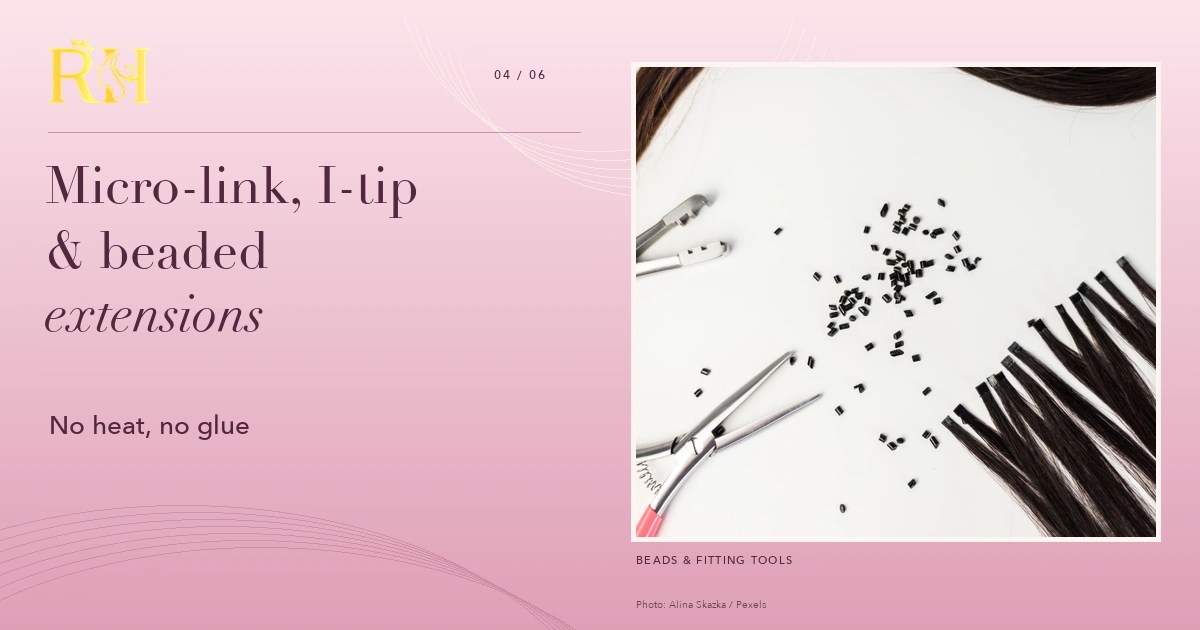
Micro-links, also sold as I-tips, micro-beads or nano rings, join a small strand of extension hair to a small strand of yours with a tiny bead. Your stylist closes each bead with pliers. No heat or adhesive touches your hair. PureWow puts the install at two to four hours. Henninger told Reviewed the links can stay in for up to 12 weeks before they need adjusting, and she sends clients with fine hair toward beads instead of tape.
The cost is time and skill. A full head takes a lot of beads, and every one has to sit at the right distance from the scalp. A bead closed too tight, or on too few hairs, breaks your hair at that point. Each move-up means opening every bead, sliding it up and closing it again.
Best for: fine to medium hair that can’t carry tape, and anyone who wants strand-by-strand placement without heat.
Keratin bond (fusion, K-tip) extensions: the longest wear per install
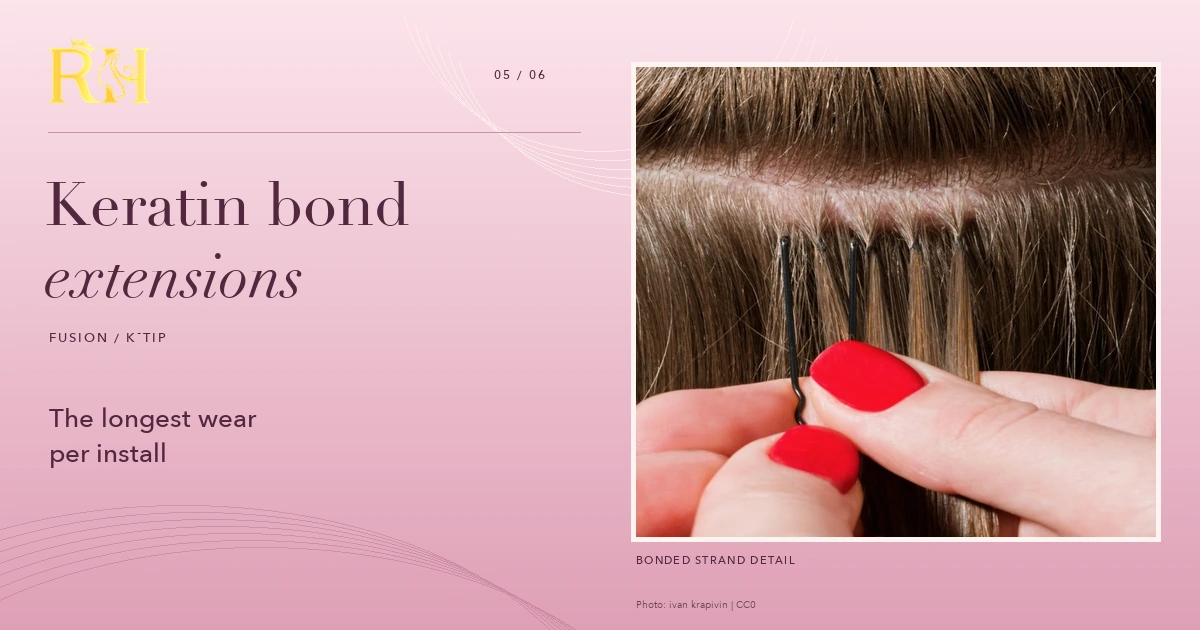
Keratin bond extensions are small strands of hair with a tip of keratin-based glue. Your stylist melts each tip around a small section of your hair with a heat tool. Celebrity stylist Marc Mena told Bustle the bonds last about three to four months, and warned against stretching them to six, because the weight starts to damage the hair. Mena also explained that removal means breaking each bond with acetone or alcohol and pulling it apart with pliers.
The bonds move with your hair and hide in updos, which is why many stylists rate them highest for a natural finish. The catch is cost. Bustle puts a full set at $1,500 to $5,000, the install takes three to six hours, and the hair can’t be reused, so every new install means buying new hair. LilyBeth Vargas, a stylist at The Parlor in New York, told Bustle that bonds can lead to breakage and bald spots over time as the attached strands shed.
Best for: people who want three to four months without a salon visit, can sit through a long install, and accept the highest cost per year.
Wigs, closures and frontals: when extensions aren’t the answer
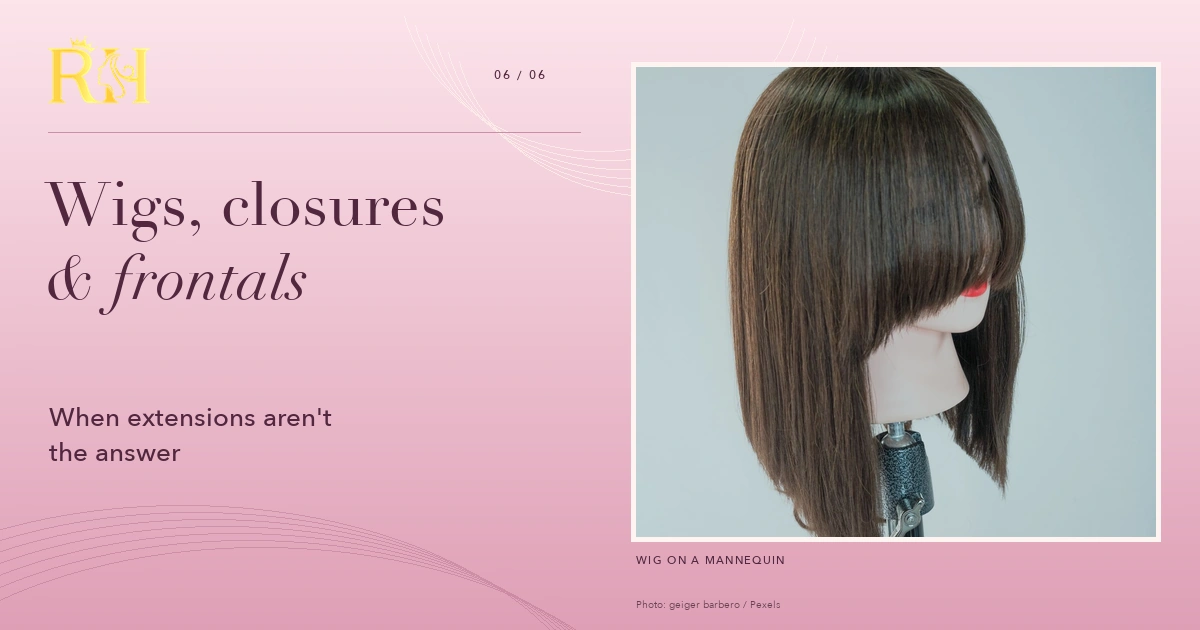
Every type of hair extension needs enough of your own hair to anchor to. Once the scalp shows at the part or crown, Henninger told Reviewed, the anchor points of clip-ins, tape-ins and even sew-ins can show too, and she suggests a wig instead. A wig covers the whole head and sits on your hair rather than hanging from it. A closure or frontal covers a smaller patch, usually the part line on top of a sew-in. Our guide to buying a quality human hair wig covers lace, cap and density choices, and our wig price guide explains what drives the cost.
Best for: thinning hair, a break from tension on your own hair, and big changes in color or texture.
Different hair extensions side by side
The table lines up the five attached types of hair extensions on the points that decide most choices: time in the chair, time between visits, and whether you can reuse the hair.
| Clip-ins | Sew-in | Tape-ins | Micro-links / I-tips | Keratin bonds | |
|---|---|---|---|---|---|
| Install time | Minutes, at home | 2 hours or more | About 90 minutes | 2 to 4 hours | 3 to 6 hours |
| Wear before a salon visit | One day | 8 to 10 weeks | 6 to 8 weeks | Up to 12 weeks | 3 to 4 months |
| Same hair reused? | Yes, every wear | Yes, re-sewn | Yes, 2 to 3 times | Yes, moved up | No |
| Heat or glue on your hair? | No | No | Adhesive | No | Heat and keratin glue |
| Removal | Unclip | Cut the thread, take out braids or open beads | Adhesive remover | Open each bead | Acetone or alcohol, then pliers |
| Suits | All textures, part-time | Thick, curly and coily hair | Straight and wavy, medium to thick | Fine to medium | Fine to thick, with a skilled stylist |
| Typical price | $100 to $400 | $200 to $1,500 | $200 to $800 | $300 to $2,500 | $1,500 to $5,000 |
Install and wear times come from the stylists quoted by Bustle, PureWow and Reviewed. Price ranges come from StyleSeat, and from Bustle for keratin bonds. Your salon’s prices will differ.
What is the best type of hair extensions for you? Four questions
Ask a stylist what is the best type of hair extensions and you’ll often hear their favorite method. Answer these four questions in order and you’ll find yours.
1. How many days a week will you wear them?
If the answer is two days or fewer, start with clip-ins. You pay once, wear them when you want, and leave your own hair free the rest of the week. If the answer is every day, the clip-in routine gets old, and a semi-permanent method gives you your mornings back.
2. How much of your own hair is there to hold them?
Every method except a wig hangs from your own hair, so your density sets the limit. Two quick checks give you a rough answer. Look at your part in daylight: a wide, clear line of scalp means fine or thin hair. Then pull your hair into a ponytail and count how many times an ordinary elastic wraps around it. Three or more wraps usually means fine hair, two means medium and one tight wrap means thick.
| Your hair | Usually suits | Go easy on |
|---|---|---|
| Thick | Sew-ins, tape-ins, any method | Very little |
| Medium | Most methods, in moderate amounts | Heavy wefts packed into one section |
| Fine | Micro-links, small bonds, a light set of clip-ins | Strong adhesives and heavy wefts |
| Thinning, with scalp showing | A wig or topper | Any method that anchors to weak hair |
Weight matters more than the method. The AAD lists hair extensions among the styles that can cause traction alopecia, hair loss from steady pulling on the hair. A light set on fine hair puts less strain on it than a heavy set of any type.
3. What is your texture?
Match the extensions to the hair they will sit next to. Straight hair blends with straight extensions, and wavy hair needs a wave that dries close to yours. Curly and coily hair blends with sew-ins or clip-ins in a matching curl, or with a sew-in and closure if you’d rather wear it straight. Smith told Bustle that when someone with curly hair wants straight extensions, a wig or a full sew-in serves them better than strand-by-strand methods.
If you sit between straight and wavy, test before you book a salon. A week of wearing wavy clip-ins under your top layer shows you whether the wave holds up next to yours through a wash and a humid day.
4. What will they cost you per month?
The price of one install hides the real cost. Add up a year: the hair, every install, every move-up and every set you replace. Then divide by twelve.
| 12 months, illustrative | Hair | Salon visits | Year total | Per month |
|---|---|---|---|---|
| Clip-ins, worn 2 days a week | One $250 set | None | $250 | About $21 |
| Sew-in, same hair re-sewn | One $400 set | 5 installs at $250 | $1,650 | About $138 |
| Tape-ins, each set used 2 to 3 times | Two $450 sets | 7 visits at $150 | $1,950 | About $163 |
| Keratin bonds | Included in each set | 3 full sets at $1,500 | $4,500 | $375 |
Illustrative numbers, not quotes. Your stylist’s fees, how fast your hair grows and how long your extension hair lasts will change every line.
Two lines open the gap: how often you buy hair, and how often you pay a stylist. The keratin row buys hair three times in a year. The sew-in row buys it once, and that only works if the hair survives a year of being unpicked, washed and sewn back in. Clip-ins stay the cheapest type of hair extensions to keep up, as long as part-time wear is enough for you.
Different styles of hair extensions, one deciding factor: the hair
Each of these types of hair extensions is a way to attach hair. The hair itself decides how long a set looks good, how many installs it survives and whether it blends with yours at all.
Synthetic or human hair?
Synthetic fiber costs less and holds a preset style. PureWow notes that you can’t use heat or chemicals on most synthetic extensions without damaging them, so a flat iron, a curling wand or a box of dye is off the table. Human hair takes heat, color and washing the way your own hair does. For any method where you plan to reuse the hair, human hair is the realistic choice.
Remy, virgin and raw: the words that decide reuse
Human hair is sold in grades. Remy hair keeps every cuticle facing the same way, root to tip, so the strands slide past each other instead of knotting. Virgin hair has never been dyed, bleached, permed or relaxed. Raw hair goes one step further: it comes from a single donor and gets no chemical processing or coating at the factory. Our guide to virgin hair vs remy hair explains the differences, and how to buy remy hair extensions walks you through checks you can do at home.
The grade matters most on the methods that reuse hair. Tape-ins go through remover, re-taping and dozens of washes. Sew-in bundles get unpicked and sewn back in. Clip-ins go in and out of your hair hundreds of times. Hair that was stripped in an acid bath and coated in silicone to fake its shine looks good on day one, then dulls and tangles as the coating washes out. Hair that still has its own cuticle has no coating to lose. That gap explains Rus’s 15 to 20 wears and Angelone’s years.
Keratin bonds flip the logic. You throw the hair away after one install, so the top grade buys you less there than on any other method.
Before you buy, ask the seller three things: where the hair was collected, whether each bundle comes from one donor or a blend, and how the wave or curl was made. A seller who runs their own factory can answer all three. Our guide to hair extension vendors explains how to tell a factory from a reseller.
Which type of hair extensions is gentlest on your hair?
Clip-ins worn part-time put the least strain on your hair, because they come out every night. Among the semi-permanent types of hair extensions, the way they are put in matters more than which one you pick: how much they weigh, how tight they sit and how long they stay in.
A Johns Hopkins review of 19 studies, published in the Journal of the American Academy of Dermatology and summarized by ScienceDaily, placed weaves and extensions among the highest-risk styles for traction alopecia, especially on chemically straightened hair. The authors advised taking weaves and extensions out for a period after six to eight weeks, and warned about glue applied straight to the scalp. They also found that untreated, unprocessed natural hair tolerates more pulling than relaxed hair.
In practice, that review and the AAD’s advice come down to five habits:
- Keep the weight in proportion. Add what your own hair can carry, not the most volume the method allows.
- Book the move-up on time. Extensions that hang lower every week pull on a longer lever.
- Give your hair a break. Leave a gap between installs, or switch to clip-ins for a few weeks.
- Keep glue off your scalp. Ask your stylist where any adhesive goes before the install starts.
- Take pain seriously. The AAD advises removing a style right away if it causes pain or stinging, or if you see crusts on your scalp. If you notice thinning at your hairline, see a dermatologist.
Frequently asked questions
What is the best type of hair extensions for beginners? Clip-ins. You can put them in at home in a few minutes, take them out the same night, and learn which length, color and texture blend with your hair before you pay for a salon install. If you move to a sew-in or tape-ins later, you’ll already know what to ask your stylist for.
What type of hair extensions looks the most natural? The type that matches your texture and color, placed by a skilled stylist. Stylists often name keratin bonds and hand-tied wefts as the hardest to spot, because the attachment points are small and flat. On curly and coily hair, a well-matched sew-in with a closure looks just as natural.
Which kinds of hair extensions last the longest? Per install, keratin bonds last about three to four months and micro-links up to twelve weeks. Over a year, the hair matters more than the method. A raw human hair set on a sew-in or tape-ins can go back in several times, while keratin bond hair is replaced at every install.
What are the best hair extensions for fine or thin hair? Methods with small, light attachment points: micro-links, small keratin bonds or a light set of clip-ins. Stylists steer fine hair away from strong adhesives and heavy wefts. If you can see your scalp at the part or crown, a wig or topper puts less strain on your hair than any extension.
Can you reuse hair extensions? Clip-ins, sew-in wefts, tape-ins and micro-links can all be reused if the hair holds up. Tape-ins usually go back in two or three times. Keratin bond hair can’t be reused after removal. Human hair with an intact cuticle survives reuse far better than processed hair with a silicone coating.
Are hair extensions bad for your hair? They can be if they’re too heavy, too tight or left in too long. Dermatologists link extensions to traction alopecia, hair loss from steady pulling. Keep the weight light, book move-ups on time, leave a break between installs, and take them out if your scalp hurts or stings.
Choosing between the types of hair extensions
The different types of hair extensions come down to one choice of hold and one choice of hair. Clip-ins suit part-time wear and every texture. Sew-ins carry the most hair and suit curly and coily textures. Tape-ins and micro-links fit daily wear on straight to wavy hair, with beads the gentler pick when your hair is fine. Keratin bonds give the longest wear per install and cost the most over a year. Whichever hold you choose, buy hair that can survive being reused, and keep the weight in proportion to your own.
Not sure which type of hair extensions suits you? Send us a photo of your hair, dry and unstyled, on WhatsApp, with a line about how often you’d wear extensions. We’ll tell you which of our raw textures sits closest to yours, and whether clip-ins, a sew-in or a wig would serve you better. If you’d rather start at home, try a set of Raw Sea Straight clip-ins. For a full sew-in, our straight bundle and closure combo puts the bundles and closure in one order.
==========
- RAW HAIR LUXURY — MORE THAN JUST HAIR, IT’S CONFIDENCE
- Website: rawhairsglobal.com
- Instagram: @rawhairluxury
- WhatsApp: +1 604 841 9668