
Curly Wigs: Choosing Curls and Lace Options
A curly wig is the easiest wig to wear and the hardest to buy from a photo. Curls lift off the head, so they cover a lace edge, soften a part and hide the wefts at the back of the cap better than straight hair can. Those same curls bend every number on the listing. An 18-inch curly hair wig can stop at your collarbone. A density that looks natural in straight hair can look twice as big in a tight curl. And the ringlets in the product photo may be one wash away from a loose wave.
Most guides list curl names and stop. This one works through the two choices that decide how the wig looks on you in month three: the curl and the lace.
For the curl, you’ll see what the names on a listing mean, where the curl in curly human hair wigs comes from, and how to adjust length, density and color for it. For the lace, you’ll see what closures, curly lace front wigs and full lace units each let you do, and which one fits the way you part and refresh your hair. After that come the styles, a care routine and a seven-day test to run before your return window closes.
Key takeaways
- Curl names aren’t standardized. Ask for the curl’s width and for photos of the same hair dry, wet and air-dried.
- Sellers measure curly hair pulled straight. A curly wig hangs about a tenth shorter than its listed length in a loose curl and a third or more shorter in a tight one.
- Curls add volume, so most people need less density than they’d pick in straight hair. 150% is a full look in most curl patterns.
- Curls hide lace. A glueless 5×5 closure covers a middle part for most wearers, and a frontal earns its upkeep only if you wear your curls pulled back or parted deep.
- Curls are refreshed with water, and water is hard on glue and knots. Choose the lace for the way you plan to care for the hair.
- Never brush a curly wig dry. Detangle it wet, with conditioner in, from the ends up.
What is a curly wig? Straight, wavy and curly hair wigs compared
A curly wig is a wig whose hair turns in full loops or spirals. That is the line between wavy and curly. A wave bends from side to side in an S and lies fairly flat. A curl travels around a center, the way ribbon wraps a finger, and stands away from the head.
Hair scientists measure that difference instead of naming it. A team led by Roland De La Mettrie measured hair from 1,442 people in 18 countries and sorted it into eight shape types with three measurements: the width of the curve, how much the strand shortens when it curls, and how many waves it carries. Wig listings use names in place of measurements, and nobody polices the names. One shop’s “deep curly” is another shop’s “jerry curl”.
Here is how the three broad families behave once they are on a wig cap:
| Straight | Wavy | Curly | |
|---|---|---|---|
| Shape of the strand | A line | An S that lies flat | A spiral that stands off the head |
| Hangs at | Its listed length | An inch or two shorter | A tenth to more than a third shorter |
| Volume at the same density | Least | Medium | Most |
| Hides lace, knots and wefts | Least | Some | Most |
| Shows poor hair | Slowly | Sooner | Soonest, as matting at the nape |
| Wash-day work | Low | Low to medium | Medium to high |
Some shops sell “straight wavy curly hair wigs” as if one unit could be all three. With human hair that is half true. You can flat iron a curly wig for a day or set a straight one on rods. But every wig has a resting pattern it goes back to after a wash, and the farther you push it from that pattern, the more heat it takes each time. Buy the texture you’ll wear most days and treat the other two as occasional looks.
Curly wig names decoded: from wavy curls to kinky curly
The names below run from loosest to tightest. The widths are rough guides, because each factory sets its own pattern.
| Name on the listing | What you usually get | Curl about as wide as | Closest natural hair type | Upkeep |
|---|---|---|---|---|
| Loose wave | S-waves that turn into a curl at the ends. Sometimes sold as a “wavy curls wig” | A wine cork, at the ends only | 2B to 2C | Low |
| Water wave | Small, uneven ripples that clump into curls when wet | A cork down to a thick marker | 2C to 3A | Medium |
| Loose curly, bouncy curl | Open spirals from near the root to the tip | A stick of sidewalk chalk | 3A | Medium |
| Deep wave | Tight, even ridges that spiral at the ends | A thick marker | 3A to 3B | Medium to high |
| Deep curly, spiral curl, jerry curl | Defined corkscrews from root to tip | A marker down to a pencil | 3B to 3C | High |
| Kinky curly | Small, springy coils with a matte, fluffy finish | A pencil down to a drinking straw | 3C to 4A | Highest |
The hair type column uses the 1 to 4 chart many stylists and product labels follow, where 2 is wavy, 3 is curly and 4 is coily.
Read the last column first. A loose curls wig, meaning anything in the top three rows, is forgiving. It detangles quickly, holds its shape for days and suits a first purchase. Loose curly wigs also pass for straight hair that has been curled with a wand, so they sit well next to relaxed or blown-out hair. The bottom two rows look the most like natural type 3C and 4A hair, and they take the most water, product and patience.
Country names in front of the curl, such as Brazilian curly, Malaysian curly or Mongolian kinky curly, are pattern nicknames. They don’t tell you where the hair grew or how tight the curl is. Ask the seller for two things instead: the curl laid next to a ruler, and a photo of the same hair soaking wet.
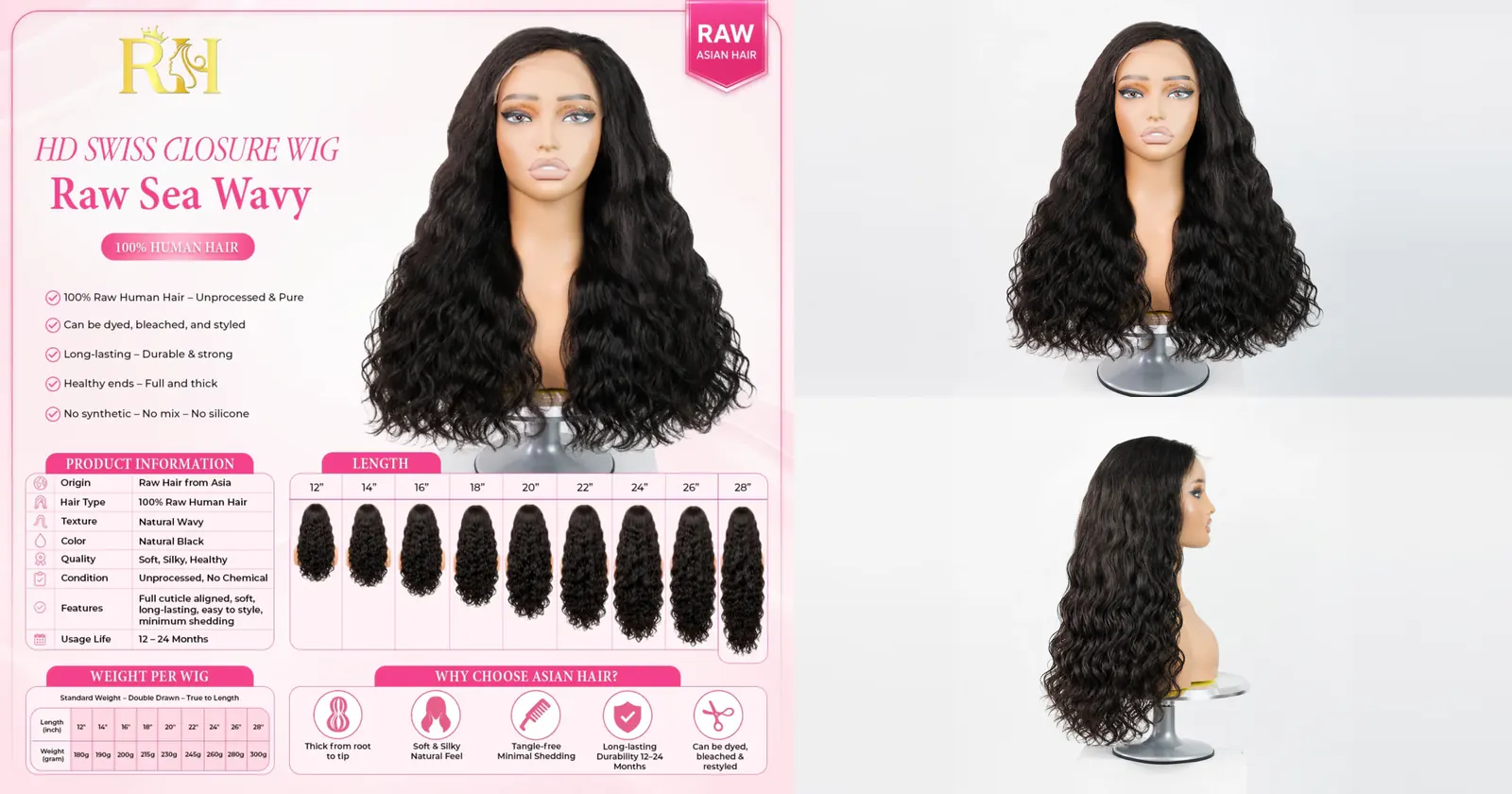
=>> Shop now: Wavy HD Closure Wig, our in-stock wavy unit in raw human hair on an HD closure, at the loosest end of this scale
Curly human hair wigs: where the curl comes from
On a living head, curl is mostly inherited. The U.S. National Library of Medicine says genes play a major role in whether hair grows straight, wavy or curly, and that chemical treatments such as perms and relaxers can change it afterward. A wig factory has the same two routes. It can use hair that grew curly, or it can put the curl in.
Natural curly wigs vs factory-set curls
Most hair collected for wigs grows straight or softly wavy. Donor hair that grew curly exists, but it is scarce, it varies from strand to strand, and it is usually a loose curl. So when a unit shows the same ringlet on every strand, from root to tip, in every length on the menu, a factory set that curl.
That isn’t a flaw. Nearly all curly human hair wigs are made this way. Listings for natural curly wigs, or for a “natural curls wig”, almost always mean the curl looks natural, not that it grew that way.
What matters is how the curl was set:
- Steam. The hair is wound on rods and set with steam, with no chemicals. The curl comes back after washing, softens over the months and can be put back on rods at home.
- Perm solution. Chemicals break the hair’s internal bonds and re-form them around the rod. The curl holds longer, but the hair comes out drier and more porous, so it tangles sooner.
One rule of thumb follows. The tighter and more uniform the curl, the more was done to hair that grew straight. A loose curl asks the least of the fiber and a pencil-tight coil asks the most, so hair quality matters more as the curl gets smaller.
You can’t see the method in a studio photo, so ask for three photos of the same unit: dry, soaking wet, and air-dried with no product.
| Photo | A curl that will last | A curl that won’t |
|---|---|---|
| Dry | An even pattern from the lace to the ends, with a soft sheen | Glassy shine, or curls only at the ends |
| Soaking wet | The hair gathers into defined clumps and still spirals | The hair hangs nearly straight |
| Air-dried, no product | The pattern is back, with some frizz | Fluff with no pattern, or a much looser wave |
Then ask one question in writing: was the curl set with steam only, or with perm solution? A seller who knows the factory can answer in a line.
Curly real hair wigs or synthetic?
Synthetic curls are molded into plastic fiber. They cost less and hold with no work, which suits a wig you’ll wear a few times. The trade-offs show with daily wear. Most synthetic fiber can’t take a wand or a hot diffuser, the curl can’t be reset once it stretches, and friction at the nape tends to frizz the ends within weeks.
Curly real hair wigs ask more of you and give more back. You can wet them, condition them, move the part and put the curl back when it drops. For a wig worn most days, human hair usually costs less per wear.
Shine is the quickest way to tell the two apart in a photo. Curls scatter light in every direction, so healthy human curls have a soft, low sheen. A curly wig that gleams like glass is either synthetic or human hair under a silicone coating, and a coating rinses out within a few washes.
Why hair quality shows faster in a curl
Curls wrap around each other all day, so every strand rubs against its neighbors far more than straight hair does. Hair with a whole cuticle, the outer layer of overlapping scales, slides past the next strand. Hair whose cuticle was stripped in an acid bath, or laid in mixed directions, catches. The catches turn into mats at the nape.
That is why two curly hair wigs that look identical on day one can be a year apart in lifespan, and why raw and virgin hair cost more in curly textures than in straight ones. It’s also why we start every unit, curly ones included, from raw, cuticle-aligned hair.
=>> Read more: Virgin Hair vs Remy Hair: Which one should you take, four checks you can run yourself before you trust a hair label
Choosing your curls: what a curl does to length, density and color
A curl changes three numbers on a wig listing. Adjust each one before you order.
Length: how much shorter a curly hair wig hangs
Sellers measure curly hair pulled straight, from the cap to the tip. Let go, the curl springs back and the wig hangs shorter. The tighter the curl, the bigger the gap.
| Listed length | Loose curls (loose wave, water wave, loose curly) | Defined curls (deep wave, deep curly) | Tight curls (kinky curly) |
|---|---|---|---|
| 14 inches | About 12 in | About 10 in | About 8 in |
| 18 inches | About 16 in | About 13 in | About 11 in |
| 22 inches | About 19 in | About 16 in | About 13 in |
| 26 inches | About 23 in | About 19 in | About 15 in |
A rough guide. Loose curls hang about 13% shorter than listed, defined curls about a quarter shorter and tight curls about 40% shorter. Patterns vary by factory, so ask the seller for a photo of the unit hanging next to a tape measure.
To use the table, hold a tape at your part and let it fall to where you want the ends to sit. That number is your hanging length. Find it in your curl’s column, then read across to the left for the length to order.
Two more things move the number. Curls hang longer when wet and draw up as they dry, so judge length on dry hair. And long curly hair is heavy. The weight stretches the top few inches, so a 26-inch unit looks looser at the crown than a 14-inch one in the same pattern.
For a wig you’ll wear most days, think about the nape too. Curls that reach past your shoulder blades rub against collars and chair backs, and that is where tangles start. A shoulder-length hang is the easiest curly length to live with.
Density: how full should a full curly wig be?
Density is the seller’s estimate of how much hair is on the cap, and the labels differ from shop to shop. What holds everywhere is that curls stand apart from each other, so the same weight of hair fills more space curly than straight. Go one step lower than you would in straight hair.
| Label | How it looks in a curl | Suits |
|---|---|---|
| 130% | Natural, close to the head | Tight curls, short cuts, fine natural hair, hot weather |
| 150% | Full | Most curl patterns at most lengths |
| 180% | Big | Loose curls at 22 inches and longer, where the ends can thin out |
| 200% and up | Statement volume | Photo shoots and events more than daily wear |
A full curly wig doesn’t need the top label. In a tight curl, 150% already reads as a lot of hair, and a short curly bob at 180% can look like a helmet. Ask for the hair weight in grams as well as the percentage. It’s the one figure you can check on a kitchen scale.
Color: black curly lace front wigs, highlights and lighter shades
Most curly wigs come in natural black, coded 1B, a soft off-black that shows brown in sunlight. Jet black, coded 1, is dyed darker and more uniform. For black curly lace front wigs, 1B is the safer match to most brows and roots, and it photographs with more depth.
Dark curls hide their own shape, because the eye reads a curl by the light on its ridges. If you want the pattern to show from across a room, look at a brown shade or at highlights.
Be careful about lifting a curly wig yourself. Bleach dries hair and loosens a set curl, so buy the color from the factory or leave it to a colorist, and read the warranty first. Many sellers, us included, stop covering hair once it has been bleached or dyed.
=>> Read more: How Much Does a Human Hair Wig Cost?, how length, density and lace size move the price of a unit
Curly lace wig options: closure, lace front, 360 and full lace
On a curly lace wig, hair is tied by hand into a sheer lace panel wherever scalp should show, and machine-sewn wefts cover the rest of the cap. The lace decides where you can part and how far back you can pull the hair. Curls change the usual advice in two ways.
Curls forgive lace. They rise at the root and fall over the hairline, so the lace edge, the knots and the grid sit in shadow most of the time. Straight hair puts all three on show. Many people who would need a glued frontal in straight hair look right in a glueless closure once the hair is curly.
Curls need water. You’ll refresh them with water and leave-in conditioner several times a week. Water and conditioner work against adhesive and, over time, against the knots tied into the lace. The more often you plan to wet the hair, the more sense it makes to own a wig you can take off and refresh on a stand.
| Build | Where the lace sits | Parts you can wear | Curly looks it opens up | How it stays on |
|---|---|---|---|---|
| Closure wig (4×4, 5×5, 6×6, or 2×6 for a middle part only) | A panel on top of the head | Middle, or a side part inside the panel | Wash-and-go, middle part, curly bob, low ponytail | Band and combs, no glue |
| Lace front wig (13×4, 13×6) | Ear to ear along the hairline | Anywhere across the front | Deep side part, half-up styles, curls worn off the face | Glue, gel or a firm band |
| 360 lace wig | All the way around the hairline | Across the front | High puff, pineapple, high ponytail | Adhesive or a band |
| Full lace wig | The whole cap | Anywhere | Updos, braided fronts, any part | Adhesive |
| Headband, U-part or V-part wig | No lace | None, or your own hair at the part | Fast everyday curls | Band or clips |
Curly lace front wigs: when your hairline is on show
Curly lace front wigs carry lace across the whole front hairline, 13 inches from ear to ear and 4 or 6 inches deep. Choose one if you wear your curls pulled back, parted deep on one side or pinned half-up. Those looks expose the hairline that a closure keeps under hair.
The price of that freedom is upkeep. The lace edge has to lie flat on your forehead every time, which usually means plucking, tinting and an adhesive or a snug band. That edge sits on skin. The American Academy of Dermatology names the hairline as one of the first places traction hair loss shows. Its advice for weaves is to take them out if they hurt or irritate the scalp, and to prefer sewn-in styles over bonding glue. Hold a glued frontal to the same rule. If it stings, itches or pulls, take it off.
One routine works well for curls. Wear the frontal glueless with a band on ordinary days, when you’ll be misting and scrunching, and save adhesive for events.
On a lace wig, curly hair should also meet the forehead in its own texture. Ask for a pre-plucked hairline with curly or kinky edges. Straight baby hairs on a curly unit give the wig away.
Glueless curly closure wigs: the everyday choice
A closure wig keeps the lace to a panel on top. You part inside the panel, and you can’t pull the hair straight back off your forehead. In return, the wig goes on in minutes with an adjustable band, comes off at night and never puts adhesive on your edges.
Curls make this build look better than it does in straight hair. They fall forward over the temples and cover the edge of the cap, which is the closure wig’s weak spot. For a first curly lace wig, human hair on a glueless 5×5 closure is where most people should start. It covers a middle part and a slight side part, and you can lift it off to refresh the curls on a stand.
HD or transparent lace under curls?
HD lace is the thinnest lace sold for wigs. It disappears on more skin tones with less tinting, and it tears more easily. Transparent lace is thicker and lasts longer.
Because curls shade the lace, the choice matters less than it does on straight hair. Spend on HD lace where the lace will be seen: a sharp middle part, or a frontal worn off the face. If your curls will fall over the part and the hairline, sturdier lace stands up better to frequent wetting.
Either way, ask for a close-up of the part on a skin tone near yours, and check that the knots are bleached so they don’t show as dark dots.
=>> Read more: HD Lace Wigs vs Transparent Lace Wigs: How to Choose, how each lace looks on your skin tone and how to check a “real HD” claim
Curly hair wig styles, starting with the middle part
Curly hair wig styles are set wet. A curl parts cleanly when it is damp and frizzes when you comb it dry, so do your shaping right after a refresh and let the hair dry in place.
Curly wig with middle part: how to set it
A curly wig with middle part is the look most people buy the wig for: flat at the top, curls opening at the cheekbones, both sides even. Photos of human curly wigs show a middle part so often for a practical reason. It works on every lace size, down to a 2×6.
- Put the wig on and secure it. Mist the top with water until the roots are damp.
- Line the tail of a rat-tail comb up with the bridge of your nose. Draw a straight line from the hairline back to where the lace ends.
- Smooth a little mousse or wax stick along both sides of the part and press the roots flat with your fingers.
- Hold them there while they dry. Slide two flat clips in on each side, parallel to the part, or tie a satin scarf across the top for 10 to 15 minutes.
- Scrunch the curls upward from the ears down, and leave them alone until they are dry.
- Take the clips out. If the knots show, dust a powder that matches your scalp along the part.
If your curly wig makes a triangle, flat on top and wide at the bottom, the hair was cut to one length. Curls of one length stack on each other at the ends. Ask for face-framing layers that start at the cheekbone, or have a stylist cut them dry, curl by curl. On the days in between, tucking one side behind your ear breaks the shape.
Lace front wigs: curly styles and what each one needs
| Style | How to do it | Lace it needs |
|---|---|---|
| Wash-and-go | Wet the hair, apply leave-in and mousse, scrunch, dry without touching | Any |
| Deep side part with a swoop | Part from the arch of the brow, sweep the front across, clip until dry | Frontal, or a 5×5 or 6×6 closure for a moderate side part |
| Half-up top knot | Section from temple to temple and tie at the crown | Frontal. On a closure, leave curls out at the temples |
| Pineapple or high puff | Gather everything loosely at the crown with a satin scrunchie | 360 or full lace |
| Curly bob | A 10 to 14 inch unit at 130% to 150%, parted in the middle or on the side | Any |
| Curly fringe | Cut or pin short curls over the forehead | Any. It covers the hairline, so it suits no-lace wigs too |
| Wet look | Water plus gel, raked through and left to set | Any. Best on water wave and deep wave |
| Brushed-out volume | Lift the roots with a pick and leave the ends alone | Any. Best on kinky curly |
| Low ponytail or bun | Gather at the nape and pull a few curls free at the face | Any |
The looks that need a frontal, 360 or full lace share one thing: they show the hairline. If a style pulls the hair up or back, it needs lace where the hair leaves the head. If the curls stay down around the face, a closure does the job.
Which curly wig suits you?
Shops sort womens curly wigs by who they expect to buy them: curly wigs for Black women, curly Caucasian wigs, ladies curly wigs in short, soft cuts. Those labels are a weak guide to the curl itself.
When researchers tested the eight-type curl scale on volunteers for a study in PLOS ONE, self-declared race groups overlapped heavily across curl types. Hair from volunteers who identified as African spread over four of the eight. So choose by the curl’s width, the density and the lace, then check the result against your own hair and your week.
| If this is you | Start here |
|---|---|
| First curly wig, worn most days | Loose curly or water wave on a glueless 5×5 closure, 16 to 18 inches listed, 150% |
| You wear your natural 3C or 4A hair out and want the wig to pass as yours | Kinky curly at 130% to 150%, with curly edges, on a closure or as a U-part |
| Your own hair is fine and straight | Loose wave or loose curly at 130%, so the volume stays believable |
| You wear your hair up | 360 or full lace, in a curl you can gather without strain |
| Your edges are thin or recovering | Glueless closure, no adhesive, a satin liner under the cap |
| Hot climate or gym days | A curly bob on a closure, which you can lift off and rinse |
| You have ten minutes in the morning | Loose curls at shoulder length. Skip long kinky curly units |
| You want straight hair some days | A wavy or loose curly human hair unit. Ask how the curl was set, so you know it comes back after a flat iron |
| Round or wide face | Ends past the collarbone, with layers starting below the chin |
| Long or narrow face | Shoulder-length curls or a curly fringe, with the volume at cheek level |
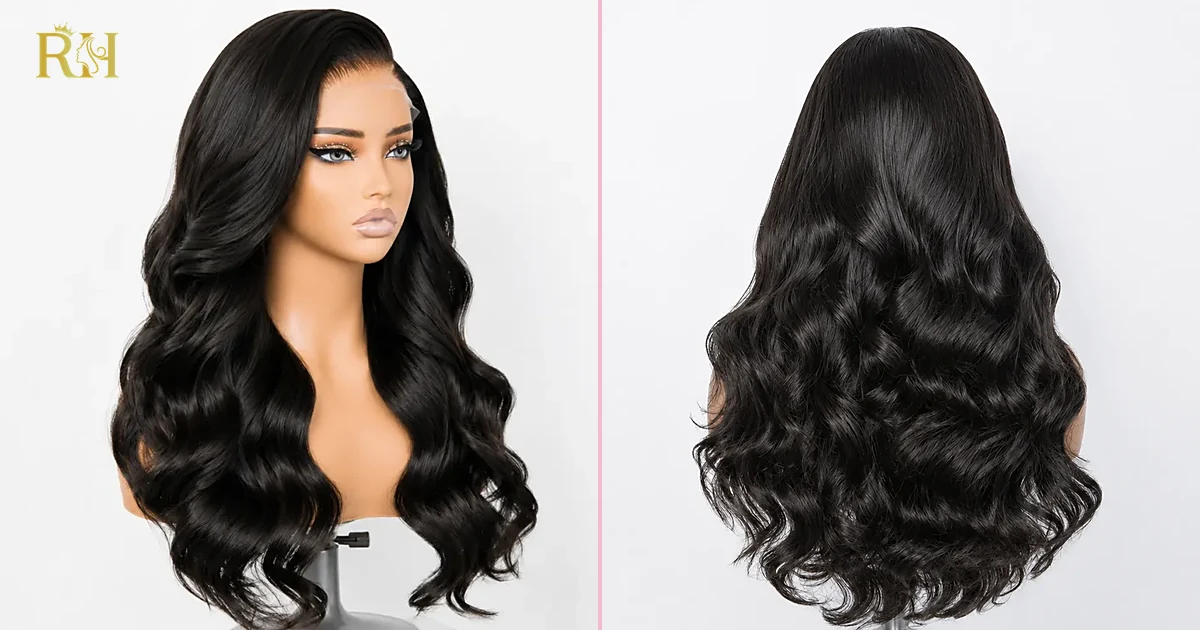
=>> Read more: Best Wigs for Black Women: Natural-Looking Guide, how to match lace, texture and length to your edges, your skin tone and your week
How to care for curly human hair wigs
Curly hair runs dry even on a living head. The PLOS ONE paper above notes that scalp oil spreads unevenly along a curly shaft, and the American Academy of Dermatology describes thick, curly hair as more prone to dryness and breakage than other types. A wig gets no scalp oil at all. So care for curly human hair wigs comes down to two jobs: put moisture back, and keep friction low.
The routine below adapts the AAD’s curly hair care tips to hair that sits on a lace cap.
Wash day, step by step
- Detangle first. Mist the hair with water and a little conditioner, split it into four sections, and work through each with your fingers from the ends up.
- Wet it downward. Run cool to lukewarm water from the cap to the tips. Don’t pile the hair on top of the cap.
- Shampoo gently. Smooth a moisturizing, sulfate-free shampoo down the lengths. Press and stroke. Don’t scrub or twist.
- Condition the full length. The AAD advises conditioning all of curly hair, not only the ends. On a wig, make one exception and keep conditioner off the lace, where it can loosen the knots. Comb it through with a wide-tooth comb, ends first, and leave it for three to five minutes.
- Rinse cool and press dry. Squeeze the water out with a microfiber towel or a cotton T-shirt. Rubbing roughs up the curl.
- Style while it’s soaking wet. Work in leave-in conditioner, then a mousse or light gel. Rake it through with your fingers and scrunch upward. For extra definition at the front, coil a few curls around a finger.
- Dry it on a stand. Let it air dry, or use a diffuser on low heat, cupping the curls from below. Keep your hands off until the hair is fully dry, then scrunch once to soften any stiffness from the gel.
Wash after every 8 to 10 wears, or when the curls look dull and coated. The AAD’s first tip for curly hair is to wash it only when needed, because washing too often leaves curls dry and frizzy.
Between washes
- Refresh with water. Keep a spray bottle of water with a little leave-in conditioner mixed in. Mist, scrunch and give it ten minutes. If the wig is glued, mist from the ears down, or take it off and refresh it on a stand.
- Never brush it dry. The AAD’s advice is to detangle curly hair wet, with leave-in conditioner, using fingers or a wide-tooth comb, since dry brushing causes breakage and frizz. A dry brush also turns defined curls into fluff.
- Protect it at night. Take the wig off and keep it on a stand, or folded loosely in a satin bag. If you sleep in it, gather the curls in a loose “pineapple” on top of your head, as the AAD suggests for natural curls, and cover them with a satin bonnet. Never go to bed with it wet.
- Go easy on heat. Keep hot tools under 400°F and use a heat protectant. That is the limit we give for our own raw hair. Every flat-iron pass relaxes a set curl a little, so save straight days for occasions.
- Keep oil off the lace. Heavy oils and butters make curls limp and work into the knots.
How to bring a curl back
A set curl loosens with months of washing, brushing and heat. Put it back while the hair is damp, because hair keeps the shape it dries in.
| Method | What you need | Time | Best for |
|---|---|---|---|
| Finger coils | Leave-in and gel, each curl wound around a finger | 20 to 30 minutes | The front and top, between washes |
| Flexi rods or perm rods | Damp hair, mousse, rods the width of the original curl | Overnight, or about two hours under a hooded dryer | A curl that has loosened all over |
| Two-strand twists | Damp hair, leave-in, 8 to 12 twists | Overnight | Loose curls that have gone wavy |
| Stylist reset | A salon rod set | One visit | A unit that has gone nearly straight |
Top quality curly human wigs: a seven-day test
Listings for the best curly hair wigs all show the same glossy ringlets, so the photo can’t separate them. The first week can. Before you pay, get five things in writing:
- How the curl was set: steam only, or perm solution.
- The hair weight in grams at your length, and whether that figure includes the cap.
- The lace size and type, and whether the knots are bleached.
- A photo of the unit hanging next to a tape measure.
- The return terms, including whether a wig that has been washed once can still go back.
Then run the test.
| When | What to check | A good sign | A warning |
|---|---|---|---|
| Day 1, out of the box | Smell, shine, weight on a kitchen scale, the lace against your skin | No sharp smell, a soft sheen, weight close to the quote | A chemical smell, glassy shine, grams well short |
| Day 1, dry | Shake the wig, then run your fingers from mid-length to the ends | A few loose hairs, fingers pass through | Hair coming away in pinches, fingers snagging |
| Days 2 to 3, first wash | The rinse water, the wet curl, a comb-through with conditioner in | Clear water, curls that gather into clumps, light shedding | Tinted water, hair hanging straight, shedding along the part |
| Days 3 to 4, air-dried with no product | The pattern from the lace to the tips | The curl is back, and the closure matches the wefts | Fluff with no pattern, or a top that dried looser than the back |
| Days 5 to 7, worn | The nape after a full day, the part, the band | Tangles come out with fingers and water | Mats at the nape after one day under a collar |
Film the unboxing before you touch anything. Many sellers, us included, ask for that video with a warranty claim. And read the return terms before the wash, since some shops treat a washed wig as used.
A unit that passes all five rows has what buyers mean by nice curly wigs: an even curl, full ends, a low sheen and hair that still detangles wet in a few minutes after a week. Hair that fails at the first wash won’t get better with products.
=>> Read more: How to buy best quality human wigs, what a good unit looks like on day one, after the first wash and at month six
Frequently asked questions
What is the difference between a curly wig and a wavy wig? A wavy wig bends in an S and lies fairly flat. A curly wig turns in full spirals, stands away from the head and hangs shorter than its listed length. Curly units look fuller at the same density, need more moisture and hide lace better.
Curly hair wigs: human hair or synthetic? Synthetic curls cost less and hold without work, but most can’t take heat and they frizz with daily friction. Human hair can be wet, conditioned and reset when the curl drops. For a wig worn most days, human hair usually costs less per wear.
Is a wig with curls a good first wig? Yes, in a loose pattern. Curls hide the lace edge and the part, so small mistakes in placement don’t show. Start with loose curly or water wave on a glueless closure, at a shoulder-length hang. Leave long kinky curly units for later.
Do curly lace front wigs need glue? Not always. Curls fall over the hairline and hide the lace edge, so many wearers hold a frontal with an elastic band alone. Glue or gel gives a flatter edge for slicked-back styles. If your hairline stings or itches, take the wig off and go glueless.
How much shorter does a curly wig hang than its listed length? Sellers measure the hair pulled straight. Loose curls hang about 13% shorter, defined curls about a quarter shorter and tight curls about 40% shorter. An 18-inch unit lands near 16, 13 or 11 inches. Ask for a photo next to a tape measure.
Can you straighten curly human hair wigs? Yes. Use a flat iron under 400°F with a heat protectant, on dry hair. A steam-set curl returns after the next wash, a little looser each time, so reset it on rods now and then. Frequent straightening wears the curl out faster.
What density is best for a full curly wig? 150% looks full in most curl patterns, because curls take up more room than straight hair of the same weight. Choose 130% for tight curls, short cuts or fine natural hair, and 180% for loose curls at 22 inches or longer.
Which lace is best for a curly wig with a middle part? A closure. A 2×6 or 4×4 covers a fixed middle part, and a 5×5 adds room for a slight side part. All three can be worn glueless. You need a frontal only if you also want deep side parts or curls pulled off your face.
How long do curly human hair wigs last? With gentle care, a good human hair unit can last a year or more of regular wear, and raw hair tends to outlast processed hair. Tight curls wear faster than loose ones because they tangle more. Expect to reset the curl every few months.
Curly wigs: the short version
Choosing a curly wig comes down to two decisions, made in order. Pick the curl first: its width, how it was set, and the length and density that curl needs to land where you want it. Then pick the lace for the way you’ll wear and refresh the hair: a glueless closure for a middle part and daily wear, a frontal for curls worn off the face, 360 or full lace for updos.
After that the routine is short. Detangle wet, style wet, let the hair dry in shape and keep the heat low. Whichever curly style wigs make your shortlist, run the seven-day test on the one you buy.
Not sure which curl or lace fits you? Send us a photo of the curl you want (your own hair counts), the part you wear and where you’d like the ends to sit, on WhatsApp. We’ll suggest a curl pattern, a lace size and the length to order, tell you how the curl on that unit is set, and send the quote in writing. Our straight and wavy units ship from stock, and curly textures are made to order from the same raw hair.
=>> Shop now: Hair By Texture, our curly, wavy and body wave units in raw human hair
==========
- RAW HAIR LUXURY — MORE THAN JUST HAIR, IT’S CONFIDENCE
- Website: rawhairsglobal.com
- Instagram: @rawhairluxury
- WhatsApp: +1 604 841 9668