
HD Lace Wigs vs Transparent Lace Wigs: How to Choose
The best choice depends on the actual lace, the knots, the cap fit and how you style the hair. Compare those details before paying more for an HD label.
Key takeaways
- HD lace typically offers a finer finish, while standard transparent lace can be easier to handle. Both may need tinting to blend with your skin.
- Choose lace coverage separately: a closure suits parts within a smaller area, while a frontal provides more room across the front hairline.
- Before buying, compare close-up photos, cap measurements and preparation requirements-not just the HD label.
What are HD lace wigs and transparent lace wigs?
HD stands for high definition. High definition lace wigs are marketed for fine mesh that becomes less noticeable when fitted and blended against the skin. Transparent lace refers to a light, sheer lace option, rather than a transparent wig cap from front to back.
In product listings, “transparent wig” is usually shorthand for a wig with transparent lace. Check the construction: most lace front and closure wigs still have a wefted cap behind the lace panel.
Are HD and transparent lace completely different materials?
Not necessarily. “HD” emphasizes a fine, less visible finish, while “transparent” describes a light, sheer appearance. Sellers can combine these descriptions on the same product. The wording alone doesn’t establish a fixed thickness or prove that one wig will blend better than another.
Standard transparent lace is commonly described as more substantial than fine HD lace. Thickness and handling still vary between products. Compare close-ups and the supplier’s material details rather than assuming every transparent lace is stronger or every HD lace is equally delicate.
“Swiss lace” also appears in listings. Treat it as a material description to clarify with the supplier, rather than a ranking that makes every brown lace thicker than every transparent or HD option.
Does HD lace mean human hair?
No. The lace label describes the base, not the hair fiber. An HD-labeled wig can use human hair or synthetic fibers, so check the hair specification separately.
If you want human hair HD lace wigs, confirm the hair material separately. Also check processing history, coloring restrictions and care instructions. Fine lace doesn’t establish whether the hair is raw, virgin, Remy or suitable for bleaching.
HD lace vs transparent lace at a glance
Use this comparison as a starting point, then check the actual unit. Price, handling and appearance vary by supplier and construction.
| Factor | HD lace wigs | Standard transparent lace wigs |
|---|---|---|
| Typical finish | Fine, sheer mesh intended to reduce visible lace | Light, sheer lace that can blend naturally with suitable preparation |
| Handling | Fine versions need particularly gentle handling | More substantial versions may be easier to cut and adjust |
| Skin-tone matching | May still need tinting or makeup | May need tinting if the lace looks pale or ashy against your skin |
| Knots and hairline | Knot size, density and preparation still affect realism | The same details matter; tinting alone won’t hide large dark knots |
| Price | Can carry a premium when other specifications are comparable | Can cost less, but compare the whole wig |
| Good reason to choose it | You prefer its visible finish on your skin and usual styles | You like its finish and handling at the price offered |
| Main caution | A fine finish doesn’t guarantee durability or a good fit | A light lace tone doesn’t automatically match light skin or exclude deep skin |
A natural-looking result comes from the lace and the installation together. A neatly fitted transparent lace wig can look more convincing than an HD wig with a lifted edge, dark knots or a dense, abrupt hairline.
How to choose the lace for your routine
Compare it against your skin in realistic lighting
Start with the area where the lace will sit: your forehead and the visible part. Evaluate whether the mesh looks pale, gray, dark or reflective against that area, rather than relying on a skin-tone category alone.
Compare unfiltered daylight views and, if photos matter to you, a flash or video example. Both lace types can need adjustment. A tint that suits one wearer may be too warm or too dark for another.
For deeper skin tones, pale lace can need tinting. That doesn’t mean transparent lace is unsuitable, or that HD will blend without any preparation. What matters is the specific lace against your skin after the intended installation.
Consider how much lace you want to manage
For a first wig, a correctly fitted, pre-prepared closure can be a manageable option because it has a smaller lace area. Transparent lace may be easier to handle if it is more substantial, but an HD closure can also work when the preparation and removal routine suit your experience.
Avoid treating a frontal as a necessary upgrade. If you wear the same middle part every day, a larger lace area may add work without improving your usual style.
Compare the finish with the total cost
A premium for HD makes sense when you can see a useful improvement in the part or front edge. If bangs or face-framing hair cover most of the edge, cap fit and hair quality may deserve more of your budget.
For a fair price comparison, match the hair material, length, density, lace area and preparation included. A cheaper transparent unit with different hair or a smaller closure isn’t a like-for-like alternative to a larger HD frontal.
For exercise, warm weather or frequent removal, also consider cap comfort and how the wig stays secure. The HD or transparent label alone won’t tell you how an adhesive performs with sweat or whether the cap will fit comfortably.
Choose lace coverage separately from lace material
Lace material affects the finish; lace coverage determines where you can part the hair and expose the hairline.
| Construction | Where the lace sits | What it offers | What to check |
|---|---|---|---|
| Closure wig, such as 2×6 or 5×5 | A limited front/top panel | Parts within that panel, with less front lace to manage | Actual width, depth and usable parting space |
| Lace front or frontal wig, such as 13×4 or 13×6 | Across the front hairline | More front hairline styling and side-part options | Lace depth at your intended part and coverage near the temples |
| Full lace wig | Across the cap | More parting and updo options | Cap fit, perimeter finish and installation requirements |
“Lace front” and “frontal” overlap in product naming. A 13×6 unit can be described with either term; the names don’t create a universal 13×4-versus-13×6 distinction. Check the inside-cap photo to see where the front lace ends and the wefted section begins.
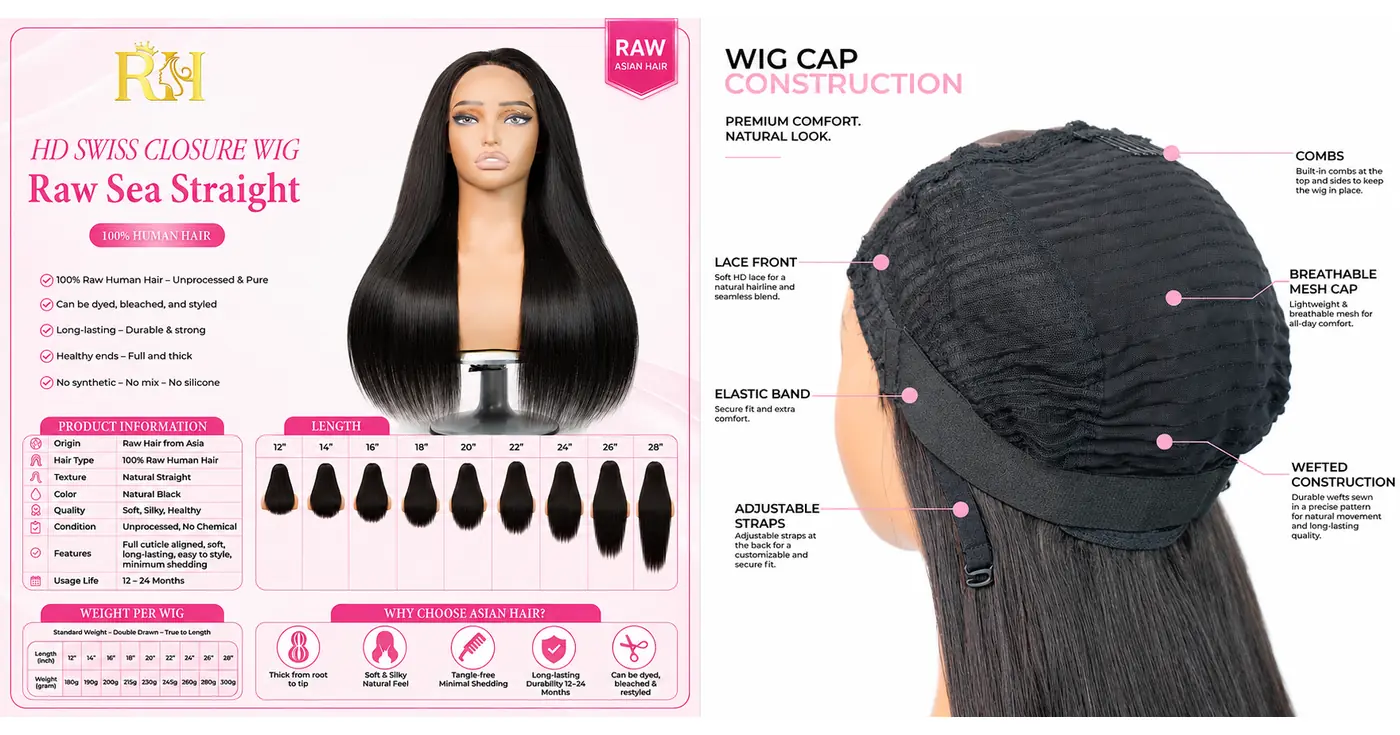
An HD lace closure wig can suit a consistent middle part or a side part that stays within its lace panel. If you’re comparing a sleek option, explore our Straight HD Closure Wig and review the listed cap measurements, lace options and preparation before ordering.
HD lace front wigs and transparent lace frontal wigs offer a wider front lace area. Neither automatically provides lace at the nape, so an exposed high ponytail needs a separate check of the back and sides.
For custom wig making, a closure or frontal sold on its own is a component, not a finished wig. The guide to human hair bundles with closure explains that alternative.
Does hair texture change which lace you need?
The hairstyle matters more than the texture name alone. Hair falling over the front edge can make lace less noticeable; pulling curls back can expose it just as much as a straight style.
| Style you’re considering | What to look at when choosing lace |
|---|---|
| HD lace straight wig | Check the part and edge in the sleek style you intend to wear |
| HD lace body wave wig or body wave HD lace closure wig | Compare the hairline with the waves loose and swept away from the face |
| Loose wave HD lace wig | Look at the front edge after styling; a loose wave doesn’t guarantee coverage |
| Deep wave HD lace wig or water wave HD lace wig | Check the dry pattern and how much hairline shows in your preferred style |
| Kinky curly HD lace wig or other HD lace curly wig | Evaluate both the loose style and any pulled-back look you plan to wear |
| HD lace yaki wig with bangs | Check the visible part and any exposed sides; a fringe can cover much of the front edge |
Texture names vary between sellers. Water wave doesn’t guarantee a wet look when dry, and deep wave isn’t necessarily a spiral curl. A washed-and-dried example is more useful than the label alone. For textured straight options, see what yaki hair is.
If you’re choosing a black frontal wig with HD lace, confirm the shade: “black,” “natural black” and “1B” aren’t enough to assume an exact color match across brands.
For a long HD lace human hair wig, compare density and actual unit weight as well as length. More hair can add weight, but length alone doesn’t establish how much tension a cap or band will put on your head.
How to assess a wig sold as “real HD lace”
There isn’t enough information in a window-light or finger-feel check to authenticate a supplier’s “real HD” claim. Those checks can help you assess appearance and comfort; they don’t establish a material grade or predict lifespan.
Before buying, look for:
- A front-edge close-up against skin. Use normal lighting and check for filters or makeup that could hide the mesh.
- A view of the part and knots. Small knots and appropriate density matter alongside lace fineness. Confirm any bleaching already done.
- An inside-cap photo. Check where lace ends, where wefts begin and whether the construction matches the description.
- Clear preparation details. Establish whether you need to cut lace, tint it, adjust a band or visit a stylist.
- Hair specifications and a dry texture example. Confirm material and processing separately from lace claims.
- Return and repair terms. Check what changes after cutting, washing, coloring or wearing the wig, and whether closure replacement is available.
Don’t pull, scratch or deliberately fray the lace to test it. You could damage the edge before deciding whether to keep the wig.
Products described as “undetectable lace wigs” still need these checks. Treat “undetectable” as the intended finish, rather than a guarantee under every light, distance or hairstyle.
Installing and caring for your lace wig
Check fit and tension first
A glueless wig is designed to stay secure without adhesive, using its cap construction and securing features. The word doesn’t mean it is free of pressure or pulling: bands, combs and tightly braided hair underneath can still cause discomfort.
Keep the fit secure without painful tension. The American Academy of Dermatology advises changing styles that cause pain, stinging or scalp irritation and avoiding repeated pulling on the hair.
Follow the instructions for adhesives and lace preparation
If using adhesive, use a product intended for the purpose and follow its application, testing and removal directions. Don’t apply it to irritated or broken skin. A home product check doesn’t guarantee that you won’t develop a reaction later.
The British Association of Dermatologists’ guidance on Afro-textured hair notes that wig glues and gels can cause irritation or contact dermatitis, and removal can damage edges. Stop using a product that causes a reaction; seek medical advice if symptoms persist or are severe.
For trimming, work gradually and follow the unit’s instructions. Don’t use repeated bleaching or heavy plucking to compensate for dark knots or a poor hairline. A stylist can assess whether the unit needs further customization.
Wash, remove and store gently
- Release adhesive with the recommended remover before lifting the lace. Don’t pull against resistance.
- Detangle from the ends upward, supporting the hair so you don’t tug on the knots.
- Wash without scrubbing or twisting the knotted base. Keep heavy conditioner off that area unless the manufacturer directs otherwise.
- Let the cap dry fully before storing it with the lace protected from folding or snagging.
- Use heat only when the hair material permits it, following the specific care instructions.
There is no universal damage-free heat setting for every wig. For human hair wigs that permit heat styling, follow the supplier’s instructions, use the lowest effective setting and avoid repeated passes. The American Academy of Dermatology’s healthy hair guidance recommends limiting heat and using a heat-protection product. That is general hair-care advice, not a temperature specification for every wig fiber.
Frequently asked questions
Is HD lace better than transparent lace?
HD lace can offer a finer, less visible finish, while a more substantial transparent lace can be easier to handle. Compare the actual lace, knots, fit and price. Neither is automatically the better choice for every skin tone or routine.
Does a transparent lace wig work on dark skin?
Yes. If the lace looks pale against your skin, suitable tinting or makeup can help it blend. HD lace may also need adjustment. Compare unfiltered examples against a similar skin tone instead of assuming either label guarantees a match.
Do HD lace wigs need glue?
Not when the wig is designed for glueless wear and fits securely. HD describes the lace finish, not the securing method. Confirm the band’s adjustability, cap measurements and preparation needed before ordering.
How long does HD lace last?
There is no reliable lifespan or install count based on the label alone. Lace quality, customization, adhesive removal, knot handling and wear frequency all matter. Inspect for tears or thinning, and ask whether a stylist can repair or replace the lace section.
Can you bleach or dye an HD lace human hair wig?
Only if the supplier confirms that the hair is suitable for the intended process. “Human hair” or “raw” doesn’t guarantee even lift to 613 blonde. Check return terms and have a professional assess the unit and carry out a strand test before coloring.
Are HD lace wigs worth the extra cost?
They can be when the actual lace gives a finish you prefer at your visible part or hairline. Compare similarly specified wigs and include customization costs. Paying more for the label without seeing the lace gives you little basis for that decision.
Choose the finish you can see and the care you can manage
Compare the lace against your skin, confirm the parting area and check how much preparation the wig needs. Choose HD when its finer finish makes a useful difference for your style; choose transparent lace when you like its appearance, handling and price.
To compare current options, browse our wig collection or contact Raw Hair Luxury on WhatsApp. Share your preferred part, hairstyle and cap measurements, and ask which lace and construction fit those needs before ordering.
==========
- RAW HAIR LUXURY — MORE THAN JUST HAIR, IT’S CONFIDENCE
- Website: rawhairsglobal.com
- Instagram: @rawhairluxury
- WhatsApp: +1 604 841 9668