
Straight Wigs: Texture and Styling
A straight wig looks like the easy one to buy. There’s no curl to shrink and no wave to drop, and the length on the listing is the length that hangs.
The catch is that straight hair hides nothing. Curls and waves lift off the head and cover the lace edge, the knots at the part and a thin patch of ends. Straight hair lies flat, with every strand pointing the same way and catching the light the same way. Good hair looks expensive like that. Coated hair looks like plastic, and thin ends show from across a room.
So two things decide how straight wigs look on you. The first is texture: which straight you’re buying, from bone straight to natural straight, and how the straightness got into the hair. The second is styling: how you part it, shape it and heat it. A wig can’t grow out a mistake made with a flat iron.
This guide takes texture first. Then it covers the parts of the build that straight hair puts on show: lace, length, density and color. After that come straight wig hairstyles, heat and care. The heat advice comes from dermatologists and from lab studies of flat-ironed hair, and each source is linked where it’s used.
Key takeaways
- “Straight” covers five textures. Bone straight is pressed flat at the factory and stays that way. Natural straight is hair as the donor grew it, with a soft bend that comes back after every wash.
- Wash the wig and let it air dry untouched. What you see when it’s dry tells you which straight you bought.
- Straight hair hides nothing. Spend on the lace at the part, bleached knots and full ends before you spend on extra inches.
- A straight wig hangs at its listed length. Measure with a tape from your part and order that number.
- Start every style at the part. A middle part works on any lace. A deep side part needs a lace front.
- Past about 300°F, heat adds wear and no extra sleekness. Iron dry hair only, in one slow pass, no more often than every other day.
What is a straight wig? Five straight textures compared
A straight wig is a wig whose hair hangs without a repeating wave or curl. The word stops there. Sellers split straight hair wigs into at least five textures, no standard sets the names, and one shop’s “silky” is another shop’s “bone straight”. What separates them is what you can see: how flat the hair lies, how much it shines and how it moves.
| Texture | What you see | Shine | Air-dried after a wash | Holds a curl |
|---|---|---|---|---|
| Bone straight | Flat from root to tip, every strand parallel, blunt ends that swing as one sheet | High | Still pin-straight | Briefly |
| Silky straight | Smooth and straight, a little softer at the ends | Medium to high | Straight, a little fuller | For a day |
| Natural straight | Straight, with lift at the root and a soft bend toward the ends | Low to medium | A loose bend comes back | Well |
| Light yaki and yaki straight | Straight with a fine grain, like relaxed or pressed hair | Low | The grain stays | Well |
| Kinky straight | Coarse and full, like a blowout on natural hair | Matte | Fuller, with some frizz | Well |
The first two rows are factory finishes. The third is hair left alone. The last two are textures set on purpose to match relaxed, pressed or blown-out hair.
Bone straight wig: the sleekest finish
A bone straight wig is the flattest, glossiest straight hair sold. It hangs like a sheet of glass, the ends are cut blunt and the whole length swings as one piece. The name is trade slang. It spread from West African buyers of Vietnamese hair, who made the look famous.
Very little hair grows this flat, so the finish is made. Factories press straight hair with steam and heat until every strand lies the same way. Lower grades get there with chemical straighteners and a silicone coat for gloss. The two look alike in a product photo and age very differently. Pressed hair with a sound cuticle stays sleek for the life of the wig. Coated hair is glassy on day one and dry by the fifth wash.
Bone straight human hair wigs come with trade-offs of their own:
- They are usually sold thick to the ends and at high density, so a long unit is heavy.
- The press works against curls. A bone straight hair wig will take a wand, and the curl tends to drop within hours.
- It is the texture that shows the most. Lace, knots and any gap between wefts are all on view.
Choose it if you want the glass finish every day without touching a flat iron.
Natural straight wig: hair as it grew
A natural straight wig uses hair left the way the donor grew it. It reads as straight, with a little lift at the root and a soft bend toward the ends, and no two strands lie quite the same. It has less shine than bone straight. That lower luster is why it passes more easily for hair growing from your own scalp.
This is how raw hair comes, and it is what we sell as straight. It’s also the most flexible texture in the table. A flat iron takes it to bone straight for a night. A wash brings the soft bend back. And because nothing was pressed or coated, it takes a curl and keeps it until the next wash.
The trade-off is five minutes of work. If you want it pin-straight, you’ll iron it after each wash.
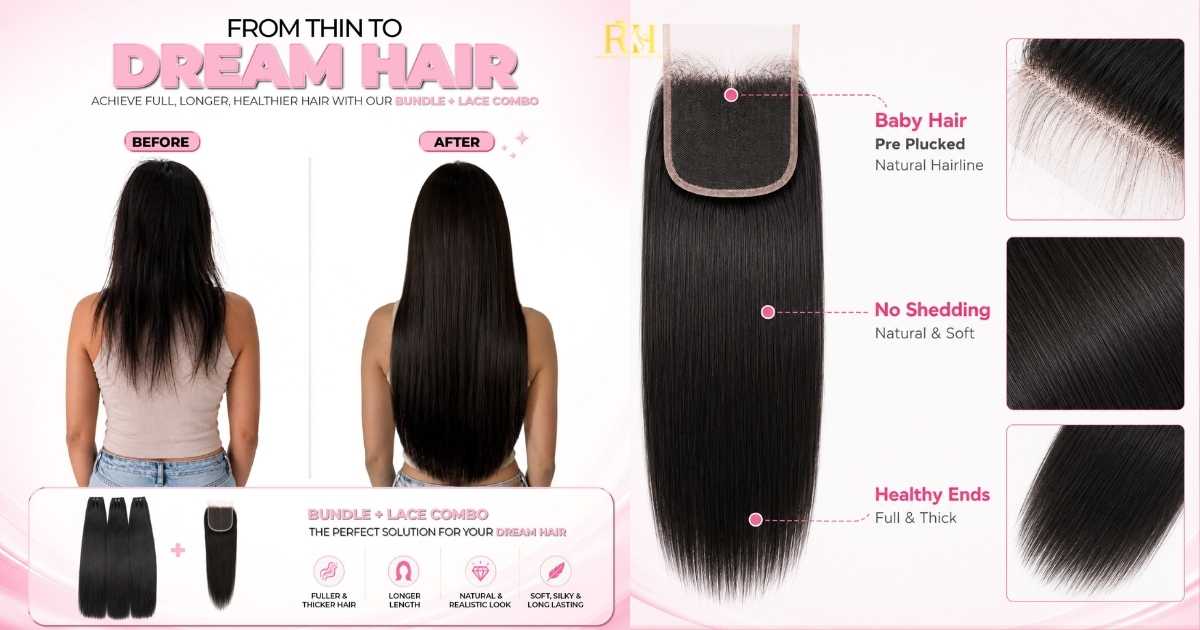
=>> Shop now: Straight HD Closure Wig, our in-stock natural straight unit in raw human hair, on a 2×6 or 5×5 HD closure, 12 to 30 inches
Silky, yaki and kinky straight
Silky straight sits between the two. It is smoothed at the factory, shinier than natural straight and lighter than bone straight, and it is what most listings mean by plain “straight”.
Yaki straight and kinky straight add texture on purpose. They copy relaxed, pressed or blown-out Afro-textured hair, so they sit next to a leave-out or natural edges without a visible seam. If the wig has to match hair you press or relax, look at these two before anything silky.
=>> Read more: What Is Yaki Hair? Meaning, Texture and Yaki Straight Explained, how light yaki, yaki straight and kinky straight differ and which one matches your own hair
The air-dry test: which straight did you buy?
Most straight wigs look bone straight in a listing photo, because a flat iron sets human hair that way until the next wash. Water undoes the set and shows the hair’s resting shape. So the first wash is the test.
- Wet the wig through and press the water out with a towel.
- Hang it on a stand. Don’t brush it and don’t blow-dry it.
- Look at it when it is fully dry.
| When it’s dry you see | What you have |
|---|---|
| Pin-straight hair with the same soft sheen as before | Factory-pressed bone straight on sound hair |
| Straight at the top, with a loose bend from mid-length down | Natural straight. The listing photo was flat-ironed, which is normal |
| A fine grain or crimp along every strand | Yaki |
| Duller, rougher hair that flares at the ends and catches at the nape | Processed hair whose coating has washed off |
| No change at all, with an even, hard gloss | Synthetic fiber |
Run the test inside the return window, and read the terms first, since some shops treat a washed wig as used. Before you buy, you can ask for the same thing in a photo: the hair air-dried, with no heat.
Straight hair wigs: human hair or synthetic?
Straight is the texture where synthetic fiber looks best in a photo and worst in person. The reason is light.
Researchers at TRI/Princeton measured how single hair fibers reflect light. They found that a fiber’s thickness, the shape of its cross-section and its curvature all change its luster, and so does the roughness of its surface. A curved or twisted fiber spreads its reflection out. A straight one keeps it tight. Hang thousands of straight fibers side by side and their reflections join into one bright band across the head.
On human hair with its cuticle in place, that band is soft, because the edges of the cuticle scales break it up. On plastic fiber, and on hair coated in silicone, it is a hard, even glare. Curls would hide the difference. Straight hair puts it on show.
| Synthetic straight wig | Straight human hair wig | |
|---|---|---|
| Out of the box | Styled, glossy, ready to wear | Needs a wash and a press |
| Heat | None, unless the fiber is labeled heat-friendly | Flat iron, hot comb, wand |
| Changing the look | The shape is molded in | Part it, cut it, curl it, color it |
| Where it wears out | Ends frizz where they rub your collar | Slowly, if the cuticle is whole |
| Makes sense for | A look you’ll wear a few times | A wig you’ll wear most weeks |
For regular wear, straight human hair wigs usually cost less per wear. You can wash, press and re-cut the same hair for a year or more.
Raw, virgin or remy: what the grade changes on straight hair
The grade words describe what happened to the hair before it reached the cap. Raw hair has had no chemical processing. Virgin hair has never been colored or permed. Remy hair has its cuticles running one way, root to tip, and may still be colored or textured. Non-remy hair is usually stripped in acid so it can’t tangle, then coated to bring back the shine.
On straight hair, the grade shows in three places:
- At the nape. Hair with a whole, one-way cuticle slides past its neighbors. Stripped hair catches, and long straight hair catches first where it rubs your collar.
- In the shine after the third wash. A coating rinses out. A cuticle doesn’t.
- In the word “raw” next to “bone straight”. Steam pressing is a process, so a strict reading of raw rules it out. Many factories still call pressed hair raw because no chemical touched it. Ask which meaning the seller uses, and get the answer in writing.
=>> Read more: Virgin Hair vs Remy Hair: Which one should you take, four checks you can run yourself before you trust a hair label
Single drawn or double drawn: why the ends matter more on straight hair
A donor’s ponytail holds hairs of many lengths. “Drawn” describes how far the factory sorted them.
| Label | What’s in it | How the ends look hanging straight |
|---|---|---|
| Single drawn | The ponytail as cut, with the shorter hairs left in | Tapered. Natural up to about 18 inches, thin beyond that |
| Double drawn | Most of the short hairs pulled out by hand | Full to the last few inches |
| Super double drawn | Nearly every hair runs the full length | A blunt, heavy line. The bone straight look |
In a curl, short hairs hide inside the pattern. In straight hair they show as ends you can see through. Check with your hands. Gather the hair in your fist at the cap, then slide your fist down to two inches above the ends. If the ponytail there is less than half as thick, the ends will look thin when the hair hangs.
More drawing means more hair, more weight and a higher price, so match it to the length. Single drawn suits a bob or a shoulder-length cut. From 20 inches down, ask for double drawn, and ask for the hair weight in grams.
Straight hair lace wig options: what the lace has to do
On a lace wig, straight hair leaves the lace in plain view. Curls rise at the root and throw a shadow over the hairline and the part. Straight hair lies down beside them. So on a straight hair lace wig, the question is how much lace you want on show and how well it has to be finished.
| Build | What’s on show with straight hair | Parts and styles it allows | How it stays on |
|---|---|---|---|
| Closure wig (2×6, 4×4, 5×5, 6×6) | The part only. Hair falls forward over the front edge | Middle part, a soft side part on a 5×5 or 6×6, low ponytail, bob | Band and combs, no glue |
| Lace front wig (13×4, 13×6) | The whole front hairline | Deep side part, hair tucked behind both ears, half-up styles | Glue, gel or a firm band |
| 360 lace wig | The hairline all the way around | High ponytail, top knot | Adhesive or a band |
| Full lace wig | Everything | Any part, any updo | Adhesive |
| No lace (bang wig, headband wig, U-part) | Nothing, or your own hair at the part | One look. A U-part needs your leave-out pressed to match | Band or clips |
Whichever build you choose, check the three places where a straight wig gets read:
- The part. Each tuft of hair is tied to the lace with a knot, and dark knots on pale lace show as a row of dots. Ask for bleached knots, and for a close-up of the part on a skin tone near yours.
- The hairline. Real hairlines are uneven and thin at the edge. A front edge packed into one dense, straight line reads as a wig, so ask for a pre-plucked hairline.
- The crown. Behind the lace, the hair is sewn on in rows called wefts. Straight hair can fall open between the rows when you bend your head or the wind lifts it. Flex the cap and look for gaps before you wear it out.
Straight hair has one fix of its own: a fringe. Bangs cover the hairline the way curls do on a curly wig, which is why a straight wig with bangs can skip the lace and still pass.
For daily wear, a glueless closure shows the least and asks the least. That is the reasoning behind our own straight unit, which sits on a 2×6 or 5×5 HD closure. A lace front earns its upkeep when you wear a deep side part or your hair off your face.
=>> Read more: HD Lace Wigs vs Transparent Lace Wigs: How to Choose, how each lace looks on your skin tone and how to check a “real HD” claim
Choosing a straight human wig: length, density and color
Three numbers on a listing decide how a straight human wig sits on your frame. Straight hair makes one of them easy and the other two harder.
Length: the tape tells the truth
Sellers measure hair pulled straight, from the cap to the tips. Straight hair hangs that way, so an 18-inch unit hangs at 18 inches. Hold a tape at your part, let it fall to where you want the ends, and order that number.
| Listed length | Where it lands on most women | Worth knowing |
|---|---|---|
| 8 to 10 inches | Jaw to the base of the neck | A blunt bob. The cut line is the whole look, so the ends must be full |
| 12 to 14 inches | Shoulders to collarbone | Light and cool. The easiest first straight wig |
| 16 to 18 inches | Top of the chest to the bra strap | The everyday length, long enough for a low ponytail |
| 20 to 22 inches | Mid-back | Thin ends start to show here. Ask for double drawn |
| 24 to 26 inches | Lower back to waist | Heavy. Collars and chair backs rub the nape |
| 28 to 30 inches | Hip | Event hair. Plan for the weight and the detangling |
Your height moves every row. Twenty inches reaches mid-back on a woman of five foot two and sits just under the shoulder blades at five foot nine.
Long straight hair cut to one length can also hang like a curtain around the face. Layers that start at the chin fix that, and a stylist can cut them in ten minutes.
Density: fuller isn’t more natural
Density is the seller’s estimate of how much hair is on the cap. Straight hair lies flat, so it looks thinner than a wave or a curl at the same number. That tempts buyers toward 200% and up. Too much hair at the crown and the hairline is how a straight wig gets spotted, because scalps don’t grow it that way.
| Label | How it looks in straight hair | Suits |
|---|---|---|
| 130% | Light, close to the head | Bobs, fine natural hair, hot weather |
| 150% | Natural and full | Most lengths up to 18 inches |
| 180% | Full to the ends | 20 to 24 inches |
| 200% and up | Glam volume | 26 inches and longer, and the bone straight look |
Labels differ from shop to shop, so ask for the hair weight in grams too. You can check that figure on a kitchen scale.
=>> Read more: How Much Does a Human Hair Wig Cost?, how length, density and lace size move the price of a unit
Black straight wig: natural black or jet black?
Most straight units come in natural black, coded 1B. It is a soft off-black that shows brown in sunlight, the way undyed hair does. Jet black, coded 1, is dyed darker and more even.
The gap between the two is wider on a black straight hair wig than on any other texture. The Princeton study found that how much light a fiber absorbs plays a major part in its luster, and a flat, dark surface shows its shine as one clean band. Natural black with a low luster looks grown. Jet black with a high gloss is the “glass hair” look, and it is also the finish that most easily reads as synthetic.
Four checks before you order a black straight wig:
- Match your brows and roots, not the color name. Jet black can look painted beside brown-black brows.
- Ask how jet black got that way. Color 1 is dye. Hair sold as raw or virgin in jet black has been colored, so ask what the label means. Rinse water that runs gray is the tell.
- Look at the knots. Black hair on pale lace shows every knot. Bleached knots matter most here.
- Plan ahead for color. If you might go lighter later, start with a black straight human hair wig in undyed 1B and leave the lifting to a colorist. Read the warranty first. Many sellers, us included, stop covering hair once it has been bleached or dyed.
If the wig has to pass beside hair you press or relax, texture matters as much as shade. On a black straight hair wig, a low-luster natural straight or a yaki finish will sit closer to your own hair than anything glossy.
=>> Read more: Best Wigs for Black Women: Natural-Looking Guide, how to match lace, texture and length to your edges, your skin tone and your week
Straight wig hairstyles: start with the part
Straight hair holds a line, and the part is the one line everyone sees. So straight wig hairstyles are built from the part outward. Pick the part, check that your lace covers it, then shape the ends.
Middle part: the bone straight classic
Flat on top, with both sides falling like a curtain: this is the look most straight wigs are photographed in. It works on every lace size, a 2×6 included.
Line the tail of a comb up with the bridge of your nose and draw the part straight back to where the lace ends. Press the roots flat on both sides with a hot comb on low heat, or smooth on a little wax stick and tie a satin scarf across the top for ten minutes. Then tuck one side behind your ear. It breaks the symmetry, and symmetry is what makes a middle part look stiff.
Straight lace front wig, side part: how to set it
A straight lace front wig with a side part is the dressier look: one deep line, a sweep across the forehead and the short side tucked away. It needs more lace than a middle part does. A closure reaches half its width to each side of center, so a 5×5 gives you 2.5 inches. A part that starts above the arch of your brow fits inside that. A deep part from the outer corner of the eye needs a 13×4 or 13×6 lace front.
- Put the wig on and secure it. Choose your side. If you’re not sure, part on the side where your own hair falls open.
- Set the tail of a rat-tail comb on the hairline above the arch of your brow. Draw the line back toward the crown and stop where the lace ends.
- Clip the larger section out of the way. Spray a little heat protectant along the part and let it dry.
- Run a hot comb on low heat along both sides of the part, close to the root. Keep the teeth off the lace.
- Set the sweep. Clamp the front section in a flat iron at the root and turn your wrist a quarter turn away from your face as you glide down. The hair bends across the forehead instead of dropping into your eye.
- Tuck the short side behind your ear and slide a flat clip under it for five minutes while it cools.
- Dust a powder that matches your scalp along the part to soften the knots.
If the hair keeps falling back toward the middle, it was tied to fall that way. Wet the roots, part again and let them dry clipped in place.
More straight wig styles, and what each one needs
| Style | How to do it | Lace it needs | Heat |
|---|---|---|---|
| Sleek and tucked | Middle part, both sides behind the ears, a drop of serum over the surface | Any | None |
| Flipped ends | Turn the flat iron outward over the last two inches | Any | Ends only |
| Bumped-under bob | 8 to 12 inches, ends turned in with the iron or a round brush | Any. A 2×6 is plenty | Ends only |
| Curtain bangs or face-framing layers | Cut by a stylist, from the cheekbone or the chin down | Any. They cover the corners of the hairline | None after the cut |
| Half-up, half-down | Section from temple to temple and tie at the crown | Lace front. On a closure, leave hair down at the temples | None |
| Low ponytail or low bun | Gather at the nape and smooth the top with a soft brush and a little mousse | Any | None |
| High ponytail | Brush everything up to the crown | 360 or full lace | None |
| Wand curls | 1.25-inch barrel, each curl pinned until it is cool | Any | Full length |
| Brushed-out waves | The day after curls, brush through once with a paddle brush | Any | None |
| Braid waves | Braid damp hair loosely overnight and undo it in the morning | Any | None |
Two rules sit behind the lace column. Straight lace wig styles that lift the hair up or back need lace wherever the hair leaves the head, so a high ponytail belongs on 360 or full lace. And of all the wig styles straight hair can wear, the ones worn down and forward ask the least of the lace, which is why they suit a closure.
Texture matters here too. Natural straight hair holds the curled styles in the table best. Bone straight hair does the first three best.
One press, seven days: a week of styles on a heat budget
A straight wig invites a daily pass with the flat iron. The American Academy of Dermatology’s advice for growing hair is to keep flat irons to dry hair and a low or medium setting, and to use them every other day at most. Hair on a wig can’t grow out the damage, so treat that as a ceiling. One full press after wash day can carry a week if you plan the styles around it.
| Day | Style | Heat |
|---|---|---|
| 1 | Wash, dry and press. Sleek middle part | Full length, once |
| 2 | Same part, both sides tucked | None |
| 3 | Side part with a sweep | Roots only |
| 4 | Low ponytail or low bun | None |
| 5 | Flipped or bumped ends | Last two inches only |
| 6 | Half-up, half-down. Braid it damp before bed | None |
| 7 | Braid waves, or wand curls for a night out | None, or curls |
That is four heat days at most, never two in a row, and only the first covers the whole length unless you curl on day seven.
How to flat iron a straight human hair wig: three rules from the lab
1. Hotter isn’t straighter. Researchers at TRI/Princeton ran heat styling across a range of temperatures. They found that higher heat did surprisingly little for how well a style held, while damage climbed with temperature. Their conclusion: for most hair, going above 100°C (212°F) added damage and no benefit. Chemically treated hair gained up to about 150°C (300°F) and nothing beyond that. So start a flat iron at 280 to 300°F, and go up only if one slow pass doesn’t smooth the hair. Stay under 400°F, the limit we give for our own raw hair. The 450°F setting buys a straight wig nothing.
2. Never iron damp hair. In a study in the Journal of Cosmetic Science, straightening irons did more structural damage to wet hair than to dry hair. The authors put it down mainly to water evaporating fast inside the fiber. Even a water-based heat-protection spray added damage, compared with an alcohol-based one. So dry the wig fully first. Then spray the protectant, comb it through and wait a minute or two, until the hair is dry to the touch, before the plates go near it.
3. Use tension, not temperature. The Princeton heat study ties how well a style sets to the time hair spends warm and under tension, not to peak heat. Stylists have a practical version called the comb chase. Take a section no wider than the plates, run a fine-tooth comb through it and follow the comb with the iron in one slow pass. One slow pass does more for the finish than three quick ones, and costs the hair less.
| Job | Tool | Setting | Note |
|---|---|---|---|
| Drying after a wash | Blow dryer and paddle brush, air pointing down the hair | Low to medium | Hair dried pointing down dries flat |
| Flattening the part and roots | Hot comb | 250 to 300°F | Keep it off the lace and the knots |
| Full-length press | Flat iron with 1-inch plates, comb chase | 300 to 350°F | One slow pass per section |
| Coarse hair that won’t smooth | Flat iron | Up to 400°F | The ceiling, and not every week |
| Curls for a night | Wand or iron, 1.25-inch barrel | 300 to 350°F | Let each curl cool in a clip |
| Synthetic fiber | None, unless labeled heat-friendly | The maker’s limit | Regular fiber melts |
Skip smoothing treatments on a wig
If you want hair flatter than an iron gets it, buy it pressed at the factory. Don’t put a salon “smoothing” or keratin treatment on a wig at home.
The FDA warns that many of these products contain formaldehyde and give it off as a gas when they are heated. It tells buyers to read the label for formaldehyde, formalin or methylene glycol, and not to buy a product that has no ingredient list. Health Canada permits formaldehyde as a preservative in cosmetics at no more than 0.2%. In a 2011 advisory it named professional smoothing solutions above that limit, after complaints of burning eyes, nose and throat and of breathing difficulties.
A chemical treatment also ends most hair warranties, ours included.
Caring for straight hair wigs: keeping them sleek between washes
Straight wigs need less wash-day work than any other texture. What they need is a short routine, done often.
After every wear. Comb from the ends up with a wide-tooth comb or a paddle brush. Straight human hair can be brushed dry, which curls can’t. Check the nape for tangles, then hang the wig on a stand so the hair falls free.
Wash day, every 8 to 10 wears. Straight hair shows build-up before it feels dirty. Strands clump into strings and the ends separate. When you see that, wash it.
- Detangle the dry hair from the ends up.
- Wet it under lukewarm water running from the cap to the tips. Don’t bunch or scrub, because straight hair knots the moment it’s piled up.
- Smooth a sulfate-free shampoo down the lengths and rinse.
- Work conditioner from mid-length to the ends and keep it off the lace, where it can loosen the knots. Comb it through and leave it for three to five minutes.
- Rinse cool and press the water out with a towel. Don’t rub.
- Hang the wig on a stand. Let it air dry most of the way, then finish with a dryer on low, the air pointing down the hair, brushing as you go.
Dried that way, natural straight hair often needs only a pass at the roots.
At night. Take the wig off if you can. If you sleep in it, wrap it: brush the hair flat around your head in one direction, pin it and tie a satin scarf over it. A loose braid protects it too, and leaves a bend you’ll have to iron out.
In storage. Hang it or keep it on a stand. For a suitcase, smooth the hair into a hairnet, fold the wig once from ear to ear and slide it into a satin bag. Keep elastic bands off it. An elastic leaves a dent, and on straight hair a dent only comes out with water or heat.
Product. Use less than you think. A pea-sized drop of serum over the ends is enough. Oil near the roots makes straight hair look stringy by lunchtime, and oils and butters loosen the knots in the lace.
In winter. Dry indoor air and wool or synthetic collars charge straight hair with static, so it floats and clings. A light mist of leave-in conditioner, a drop of serum smoothed over the surface and a silk or satin scarf between the hair and your coat settle it.
Wearing a straight lace wig without hurting your hairline
A wig sits on your own hair, and the same AAD page is blunt about styles that pull. Worn continuously, they put hair under tension. Tension leads to breakage and, if it goes on, to hair loss that can be permanent. A wig can pull in three ways.
- The band. It should be snug enough to stay put when you shake your head and loose enough to leave no red line. If it presses at your temples by midday, let it out.
- The weight. A 28-inch straight wig at high density is among the heaviest you can wear, and the front of the cap carries it. Keep the long ones for events and wear 16 to 20 inches day to day.
- The glue. Lay the lace on skin in front of your hairline, never on the hair itself. Test a new adhesive on your inner arm for a day before it goes on your forehead, and take the wig off with remover, not by peeling. If your hairline stings, itches or weeps, take the wig off and see a dermatologist.
Under the wig, keep your own hair in flat, loose braids under a satin or mesh cap. Take the wig off at night, and give your edges a few days off each month.
Straight wig problems and quick fixes
Most trouble with a straight wig shows early, because the texture shows everything.
- Mirror shine out of the box. This is often a coating. Wash the wig once and judge it again. For a first wear, a light dusting of translucent powder or dry shampoo along the part and crown takes the glare down.
- Ends you can see through. Have an inch cut off blunt. If the ends still look thin, the hair is single drawn at a length that needed double. Wear it shorter.
- A dent or crease. Mist it, comb it and blow-dry it pointing down. Use the iron only if the bend survives.
- Stringy by day three. That’s too much product. Wash the wig, then halve what you use.
- Tangles at the nape. The cause is friction from collars and scarves. Comb the nape every night and wear a low braid under a coat. If it mats again after every wash, the cuticle has been stripped and care won’t fix it.
- Dots or a grid along the part. Dust scalp-colored powder along the part and tint the lace. Next time, ask for bleached knots and thinner lace.
- Wefts showing at the crown. The density is too low for the length. Move the part, or ask a stylist to sew in an extra weft.
- Curls that drop by dinner. Pressed hair resists them. Pin each curl until it’s cold and use a light hold spray, or keep curls for a natural straight unit.
- A bend near the roots that keeps coming back. That is natural straight hair returning to its resting shape. A hot comb at the roots after each wash settles it.
=>> Read more: How to buy best quality human wigs, what a good unit looks like on day one, after the first wash and at month six
Frequently asked questions
What is a bone straight wig? A bone straight wig has hair pressed flat from root to tip, with a glossy surface and blunt, heavy ends that swing as one piece. Factories set the finish with steam and heat, so it stays pin-straight after washing. It is the sleekest straight texture, and the one that holds curls least.
Bone straight or natural straight: which should I choose? Choose bone straight if you want a glass finish every day with no flat iron. Choose a natural straight wig if you want hair that passes for your own, takes curls and can still be ironed sleek for a night. Natural straight has less shine and a soft bend after washing.
Are straight human hair wigs better than synthetic? For regular wear, yes. Straight human hair wigs can be washed, flat-ironed, curled, colored and re-cut, and their shine looks like hair in daylight. Synthetic straight wigs cost less and need no styling, but most can’t take heat and the ends frizz with friction. They suit occasional wear.
Can you curl a straight human hair wig? Yes. Use a wand at 300 to 350°F on dry hair with a heat protectant, and pin each curl until it cools. Natural straight hair holds curls until the next wash. Bone straight hair drops them within hours, because the factory press works against the curl.
Which lace do I need for a side part on a straight wig? A soft side part above the arch of the brow fits a 5×5 or 6×6 closure, which reaches 2.5 to 3 inches each side of center. A deep side part, or hair tucked behind both ears, needs a 13×4 or 13×6 lace front. A 2×6 closure is for middle parts only.
What density is best for straight wigs? 150% looks natural at most lengths up to 18 inches. Go to 180% for 20 to 24 inches so the ends stay full, and to 200% or more for very long or bone straight looks. Straight hair lies flat, so it looks thinner than curls at the same density label.
Is a black straight hair wig 1B or 1? It can be either. 1B is natural black, a soft off-black that shows brown in sunlight and matches most brows. Color 1 is jet black, dyed darker and more uniform. On straight hair, jet black shows more shine, so 1B is the safer choice if you want the wig to pass as your own.
How often can I flat iron a straight wig? Give it one full press after each wash and touch up only the roots or ends between washes. Dermatologists advise flat ironing growing hair every other day at most, on dry hair and at low to medium heat. Wig hair can’t repair itself, so use less heat than that if you can.
How long do straight human hair wigs last? With gentle care, a good human hair unit can last a year or more of regular wear, and raw hair tends to outlast processed hair. Straight textures tangle less than curls, so the lace often wears out first. Heat is what ages them. High settings and daily ironing shorten the life of the hair.
Straight wigs: the short version
Straight wigs come down to two choices. Choose the texture for the finish you want to live with: bone straight for a glass surface that never needs an iron, natural straight for hair that looks grown and can be worn sleek or curled. Then build your straight wig hairstyles from the part, and give the lace, the knots and the ends the money you might have spent on extra inches. Straight hair shows all three.
After that, the upkeep is light. Dry the hair pointing down, press it once after each wash, keep the iron near 300°F and off damp hair, and comb the nape every night.
Not sure which straight suits you? Send us a daylight photo of your part and hairline, your head measurement and the length you want on WhatsApp. We’ll suggest a lace size, a density and a length, tell you how the hair was finished and how it looks air-dried, and send the quote in writing before you order.
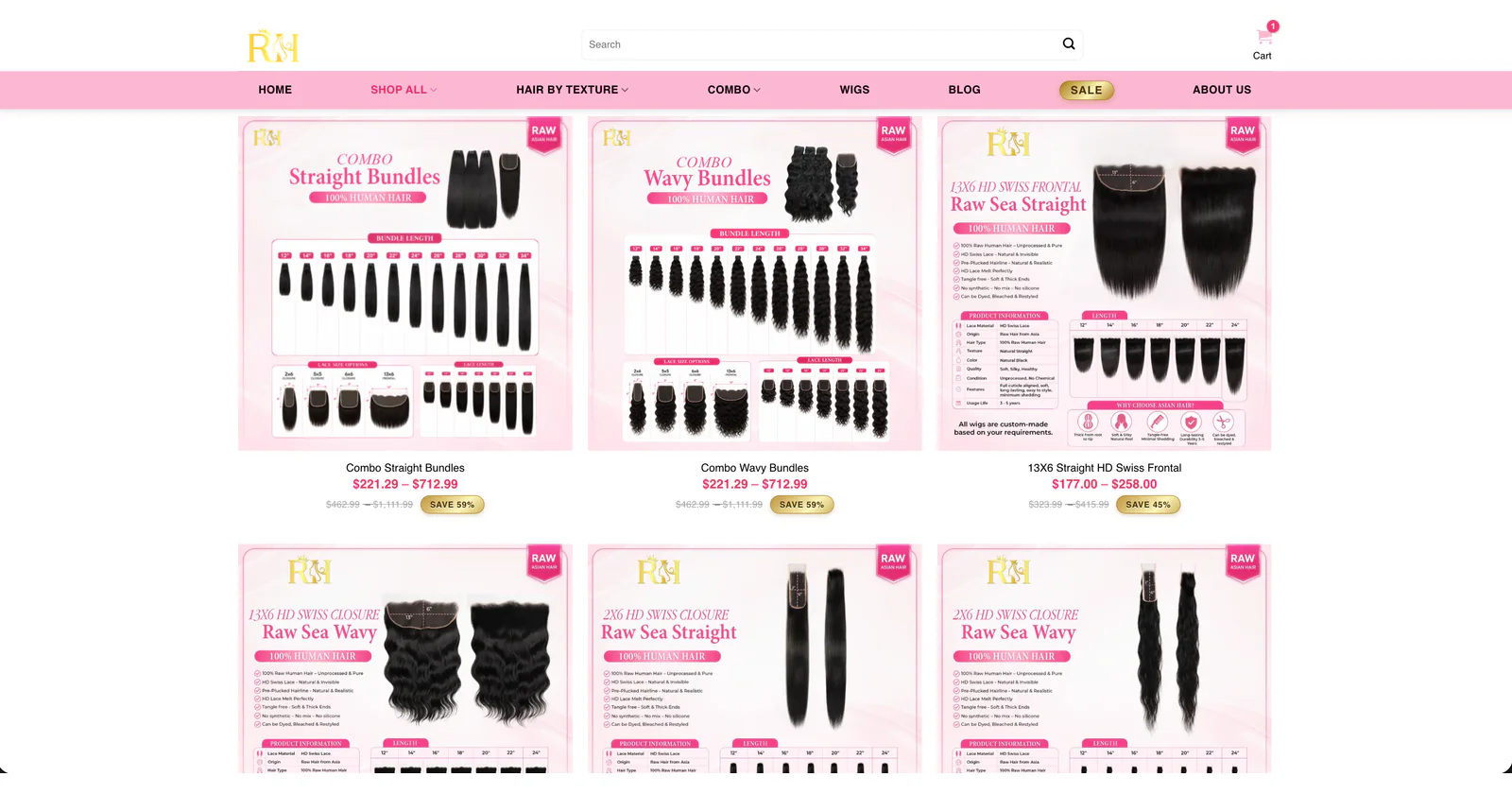
=>> Shop now: Human Hair Wigs Collection, straight, wavy and pre-order HD lace wigs in raw human hair
==========
- RAW HAIR LUXURY — MORE THAN JUST HAIR, IT’S CONFIDENCE
- Website: rawhairsglobal.com
- Instagram: @rawhairluxury
- WhatsApp: +1 604 841 9668