
Body Wave Wig Human Hair: Styles, Lace Types and How to Choose
A body wave wig in human hair gives you the look of a fresh salon blowout: wide, soft S-shaped waves that move when you walk and lie flat enough at the root to pass for your own hair. It is the easiest wave texture to own. It suits most face shapes, softens a part line better than straight hair and asks for far less wash-day work than deep wave or curly units.
Most guides stop at that description. They leave out the fact that decides how the wig behaves after you buy it: a body wave is something done to hair, not a kind of hair. A factory sets the wave, and the way it was set decides how long it lasts, what a wash does to it and how you bring it back when it drops.
They also skip the two choices that shape how you’ll wear the wig every day. The lace decides whether you can wear a side part, a middle part or both. The hair decides whether the wave can be set again in month six.
This guide takes those in order. You’ll see how the wave gets into a body wave wig, which human hair grades hold it best, what the “Brazilian” label means, which lace fits which part, ten body wave wig styles with steps for the two you’ll wear most, how to pick length, density and color, and how to keep the wave for the life of the wig.
Key takeaways
- A body wave is a set. Most units are steam-set, so the wave softens with washing and heat, and you can put it back at home.
- “Brazilian” names a feel, not a country. Judge the cuticle, the way the wave was set, the hair weight in grams and the return terms.
- The lace sets your part. A 5×5 closure covers a middle or side part without glue. A deep side part or hair worn back needs a frontal.
- A body wave hangs an inch or two shorter than its listed length, and looks fuller than straight hair at the same density.
- Hair takes the shape it dries in. Dry the wig in twists, braids or rods and keep hot tools under 400°F.
What is a body wave wig?
A body wave wig is a wig whose hair has been set in a wide, open S-shaped wave. The pattern is the largest and loosest of the named wave textures. The hair lies close to straight for the first few inches from the root, then bends in long, even curves to the ends. Brushed out, it looks like a blowout done with a large round brush. Left alone, it looks like big curls that have relaxed for a day.
The name comes from the salon. A body wave perm is a loose perm that adds fullness, or “body”, to flat hair without making it curly. Wig makers borrowed the term for the same look.
You’ll find the texture on every kind of cap: a body wave lace wig built on a closure or a frontal, a headband wig, a U-part wig and machine-made caps with no lace at all. The wave is the same on all of them. The cap and the lace change how you part and wear it, which comes later in this guide.
Body wave vs loose wave, deep wave and water wave
No standard defines wave names, so one shop’s pattern can differ from the next. In broad terms the textures line up like this, from loosest to tightest:
| Texture | The pattern | Brushed out | Wash-day work | Choose it for |
|---|---|---|---|---|
| Body wave | Wide, even S-waves, fairly flat at the root | Soft bends, like a blowout | Low | Movement that passes for your own styled hair |
| Loose body wave | A body wave set softer and less evenly | Nearly straight, with a bend at the ends | Low | The least “done” wave |
| Loose wave | A narrower S with a curl at the ends | Fluffy and fuller | Medium | More bounce and volume |
| Deep body wave | A seller’s in-between: the body wave shape, set tighter | Full, with visible ridges | Medium | A wave that shows from across a room |
| Deep wave | Tight ridges close together, root to tip | Expands and frizzes | High | A curly look with a defined pattern |
| Water wave | Small, uneven ripples that look wet | Frizzes until you wet it again | High | Wet-and-go styling |
Two names in that table cause most of the confusion. A deep body wave wig is not a standard texture. Most sellers use the term for a body wave set on smaller rods, so the S repeats more often and holds longer. A few use it for what others call loose deep wave. A loose body wave goes the other way, toward hair that looks naturally wavy. Before you order either one, ask for a photo of the hair dry, wet and brushed out, next to a ruler. The photo tells you more than the name.
Body wave is the default wave for good reasons. It blends with the widest range of hair, from relaxed and pressed hair to loose natural waves. It takes a flat iron for a sleek day and a wand for a curly one. And it tangles less than tighter patterns, because the hairs lie side by side instead of coiling around each other.
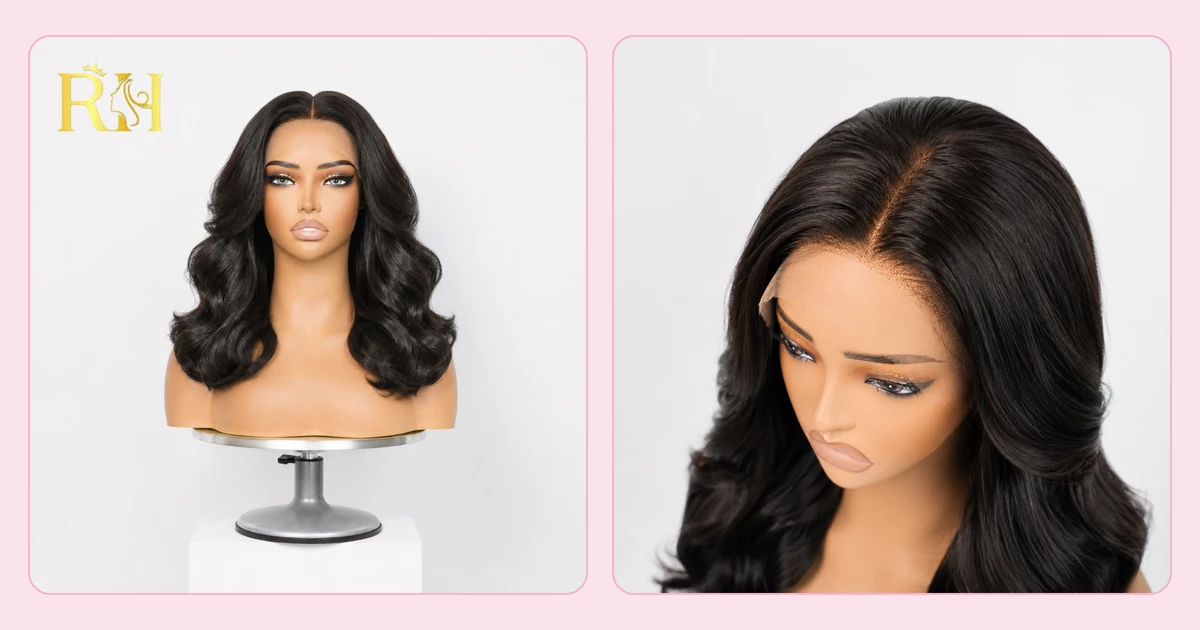
=>> Shop now: Wavy HD Closure Wig, our in-stock wavy unit in raw human hair, on a 2×6 or 5×5 HD closure, 12 to 30 inches
Body wave wig human hair: how the wave gets there
A listing that says “body wave wig human hair” tells you two things, the shape and the fiber. It leaves out a third: how the shape got into the fiber. Very little hair grows in an even body wave from root to tip. In almost every unit, someone put the wave there.
Hair holds a shape with two kinds of bonds. Weak hydrogen bonds let go when hair gets wet and form again as it dries, which is why a roller set lasts only until the next wash. A review in the International Journal of Trichology describes both routes: water breaks the hair’s hydrogen bonds during an ordinary blow-dry, while a perm breaks the fiber’s stronger chemical bonds so they can re-form around a curl.
Wig makers use both routes, and one in between:
| How the wave was made | What happens to the hair | After a wash | After a flat iron | Where you’ll find it |
|---|---|---|---|---|
| Grown by the donor | Nothing. The hair waved on the donor’s head, unevenly from strand to strand | Comes back every time | Comes back with water | Some raw hair, sold as “natural wave” or “wavy” |
| Steam-set | Hair is wound on rods and set with steam, no chemicals | Comes back, a little looser each month | Relaxes until you reset it | Most raw and virgin body wave wigs |
| Permed | Perm solution breaks and re-forms the hair’s chemical bonds | Holds | Holds, but the hair is drier and weaker | Often cheaper, processed hair |
| Molded | Plastic fiber is shaped with heat | Holds until friction frizzes the ends | Melts, unless the fiber is heat-friendly | Synthetic and blended wigs |
A steam-set body wave is the kindest of these to human hair, and it is also the one that fades. Expect it to soften over months of washing, brushing and hot tools. That isn’t a defect. It is the trade you make for hair that has never been through perm solution, and you can put the wave back at home in an evening. The care section below shows how.
So ask one question before you buy: was the wave set with steam only, or with perm solution? A seller who knows the factory can answer in one line.
Body wave wig: human hair or synthetic?
A synthetic body wave wig costs less and holds its wave with no work, because the pattern is molded into the fiber. The catch is that you can’t change it. Most synthetic fiber can’t take a curling wand, and friction at the nape tends to frizz the ends within weeks of daily wear.
Human hair asks more of you and gives more back. You can straighten it, curl it tighter, color it and, when the wave drops, set it again. For a wig you’ll wear a handful of times, synthetic is fine. For one you’ll wear most days, human hair usually costs less per wear.
Raw, virgin or remy: which hair holds a body wave best?
These labels describe what was done to the hair before the wave went in.
- Raw hair has had no chemical processing. Its cuticle, the outer layer of overlapping scales, is whole and runs in one direction.
- Virgin hair has never been colored or permed, though it may be steamed for texture.
- Remy hair has its cuticles aligned from root to tip. It may still be colored or permed.
- Non-remy hair has usually been stripped in acid to stop tangling, then coated in silicone to bring back the shine.
On a body wave, the cuticle matters twice. Waves cross over each other, so hair with a rough or missing cuticle mats faster in a wave than it would straight. And you’ll reset this wave many times with water and heat. The same review notes that once the cuticle is gone, the inner cortex is exposed and the fiber can fracture. Hair that starts with a whole cuticle has more to give before it gets there, which is why raw and virgin body wave wigs cost more and last longer. It’s also why we build ours from raw hair.

=>> Read more: Virgin Hair vs Remy Hair: Which one should you take, four checks you can run yourself before you trust a hair label
Brazilian body wave wig: what the label means
“Brazilian body wave wig” is one of the most searched phrases in this category, and the label rarely means the hair grew in Brazil. In the wig trade, “Brazilian” describes a feel: thick, soft hair with a medium luster that holds a wave well. “Peruvian”, “Malaysian” and “Indian” work the same way on most listings. They are grade and texture names more than places.
Research on the trade says the same. Emma Tarlo, emeritus professor of anthropology at Goldsmiths, University of London, followed human hair through India, Myanmar and China. In a 2019 paper in the Journal of the Royal Anthropological Institute, she describes Chinese factories that make “Brazilian” hair extensions out of hair and labor that cross national lines.
Customs figures point the same way. In 2023 Brazil exported about $1.2 million of unworked human hair, nearly all of it to one country. India exported about $188 million that year, more than nine-tenths of the world total in the same dataset.
None of this makes a Brazilian body wave wig bad. Plenty of them are good hair. It means the word can’t tell you which ones. Judge the unit on four things a seller can put in writing:
- The cuticle. Raw, virgin or remy, and whether the hair was acid-washed or coated.
- The wave. Steam-set or permed.
- The weight. Grams of hair at your length, not only a density percentage.
- The return terms. Read them before the first wash, because many sellers treat a washed wig as used.
For what it’s worth, we label our own hair as what it is: raw Asian hair. If one of our body wave wigs suits you, it will be because of the hair and the lace, not the name of a country.
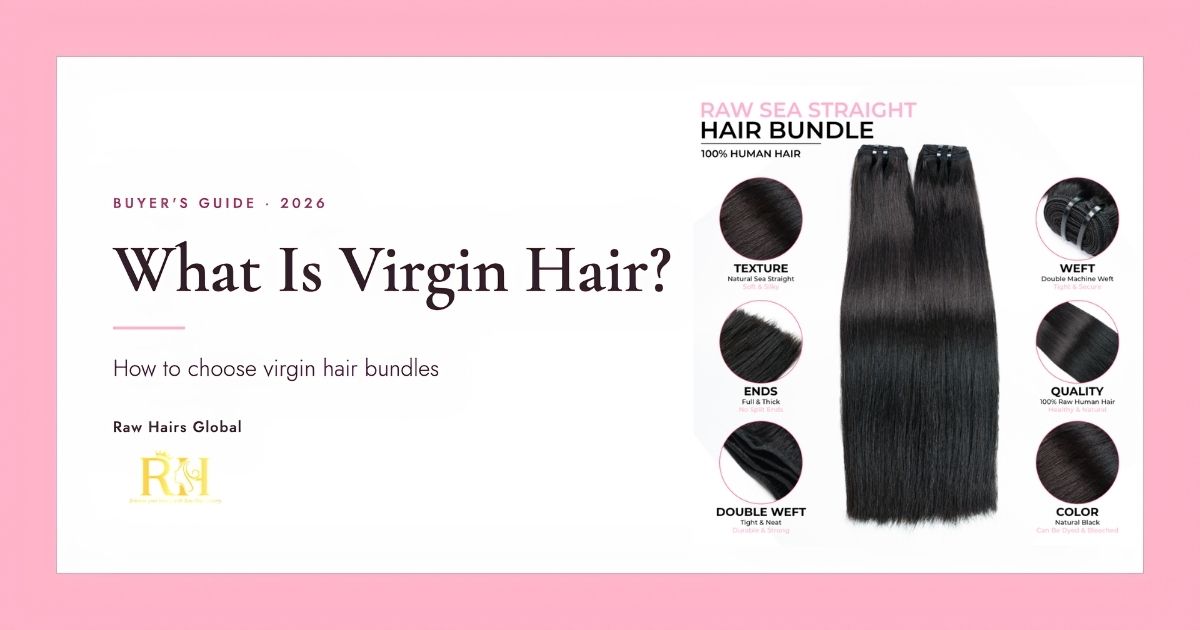
=>> Read more: What Is Virgin Hair? How to Choose Virgin Hair Bundles, what virgin, raw and origin labels can and can’t tell you
Body wave lace wig types: closure, lace front, HD and full lace
The lace decides where the hair can part and how far back you can pull it. On a body wave lace wig, human hair is tied into the lace by hand, a few strands per knot, so the part looks like scalp. Machine-sewn wefts cover the rest of the cap.
| Build | Where the lace sits | Where you can part | Glue? | Suits |
|---|---|---|---|---|
| Closure wig (2×6, 4×4, 5×5, 6×6) | A panel on top of the head | Inside the panel | No, a band and combs hold it | Daily wear, first wigs, fragile edges |
| Lace front wig (13×4, 13×6) | Ear to ear along the hairline | Anywhere across the front | Often glue, gel or a firm band | Deep side parts, hair worn off the face |
| 360 lace wig | All around the hairline | Across the front, plus a high ponytail | Yes | Ponytails and updos |
| Full lace wig | The whole cap | Anywhere | Yes | Braids, updos, full styling freedom |
| T-part or fixed-part wig | A narrow strip | One fixed line | No | One look on a lower budget |
Body wave lace front wigs: human hair on a 13×4 or 13×6 frontal
Lace front body wave wigs carry lace along the whole front hairline, 13 inches from ear to ear and 4 or 6 inches deep. That gives the texture its most glamorous looks: a deep side part with a swoop, waves pulled back off the face, a half-up style with the hairline on show. The cost is upkeep. The lace edge has to lie flat on your forehead every time you wear it, which usually means plucking, tinting and an adhesive or a firm elastic band.
That edge sits on skin. The American Academy of Dermatology names the hairline as one of the first places traction hair loss shows. Its advice for weaves is to take them out if they hurt or irritate the scalp, and to choose sewn-in styles over bonding glue. Hold a glued frontal to the same rule. If it stings, itches or pulls, take it off. For daily wear, wear the frontal glueless with a band, or have a stylist install and remove it.
Body wave closure wigs: the glueless option
A closure wig keeps the lace to a panel on top of the head. You can part only inside that panel, and you can’t pull the hair straight back off your forehead. In return you get a wig that goes on in minutes with an adjustable band, comes off at night and puts no adhesive on your hairline. For a first body wave wig, or one you’ll wear most days, a 5×5 closure gives the best mix of parting room and ease.
HD body wave wig: does the lace matter on a wave?
An HD body wave wig uses HD lace, the thinnest lace sold for wigs. It disappears on more skin tones with less tinting, and it tears more easily. Transparent lace is thicker, lasts longer and needs tinting on deeper skin.
On a body wave the hair lies fairly flat at the root, so the part is on show almost as much as on a straight unit. That makes the lace and the knots worth a close look. Ask for a close-up of the part on a skin tone near yours, and check that the knots are bleached so they don’t show as dark dots. No standard defines “HD”, so the photo counts for more than the label.
=>> Read more: HD Lace Wigs vs Transparent Lace Wigs: How to Choose, how each lace looks on your skin tone and how to check a “real HD” claim
Body wave wig styles: side part, middle part and eight more
Body wave wig styles start with the part. The part sets where the first wave falls against your face, and the lace sets which parts you can wear. So choose the part you wear most, then check that the lace allows it.
Which lace does your part need?
Measure from the center of your front hairline to the spot where you want the part to start. Then compare:
| The part you wear | Distance from center | Lace that covers it |
|---|---|---|
| Middle part, always | 0 | 2×6 or 4×4 closure, or anything larger |
| Middle part, with a slight side part some days | Up to 1 inch | 4×4 or 5×5 closure |
| Side part above the arch of your brow | About 1.5 inches on most faces | 5×5 or 6×6 closure, or a frontal |
| Deep side part from the outer end of the brow | 2 inches or more | 13×4 or 13×6 frontal |
| A part that changes daily, or hair worn back | Anywhere | 13×6 frontal, 360 or full lace |
The rule behind the table is simple. A closure sits centered, so it reaches half its width to each side: 2 inches on a 4×4, 2.5 inches on a 5×5. Keep your part at least half an inch inside that edge, so the knots end under hair and not in plain view. For a side part body wave wig on a closure, that makes a 5×5 the smallest lace worth considering.
Side part body wave wig: how to set it
A side part body wave wig is the texture’s signature look. The deep side sweeps across the forehead in one long wave, and the other side tucks behind the ear. You can get there two ways. Some wigs come pre-parted, with a fixed side part and little or no lace. They cost less and lock you into one look. A free-part lace wig lets you set the part yourself and move it later.
To set a side part on a lace unit:
- Put the wig on and secure it. Find the arch of your eyebrow on the side you want. That is where the part starts at the hairline.
- With the tail of a rat-tail comb, draw a straight line from that point back toward the crown. Stop where the lace ends.
- Flip the larger section over and clip it. Mist the roots along the part with a little water.
- Press the part flat. Use a hot comb on low heat, or smooth a little wax stick over the roots and tie a satin scarf across them for ten minutes.
- Dust a powder that matches your scalp along the part to soften the knots.
- Shape the swoop. Brush the front section forward and across, pin the first wave with a flat clip while you do your makeup, then let it go.
If the part keeps closing up, the hair on top was tied to fall the other way. Wet the roots, part again and let them dry clipped in place. Hair takes the shape it dries in.
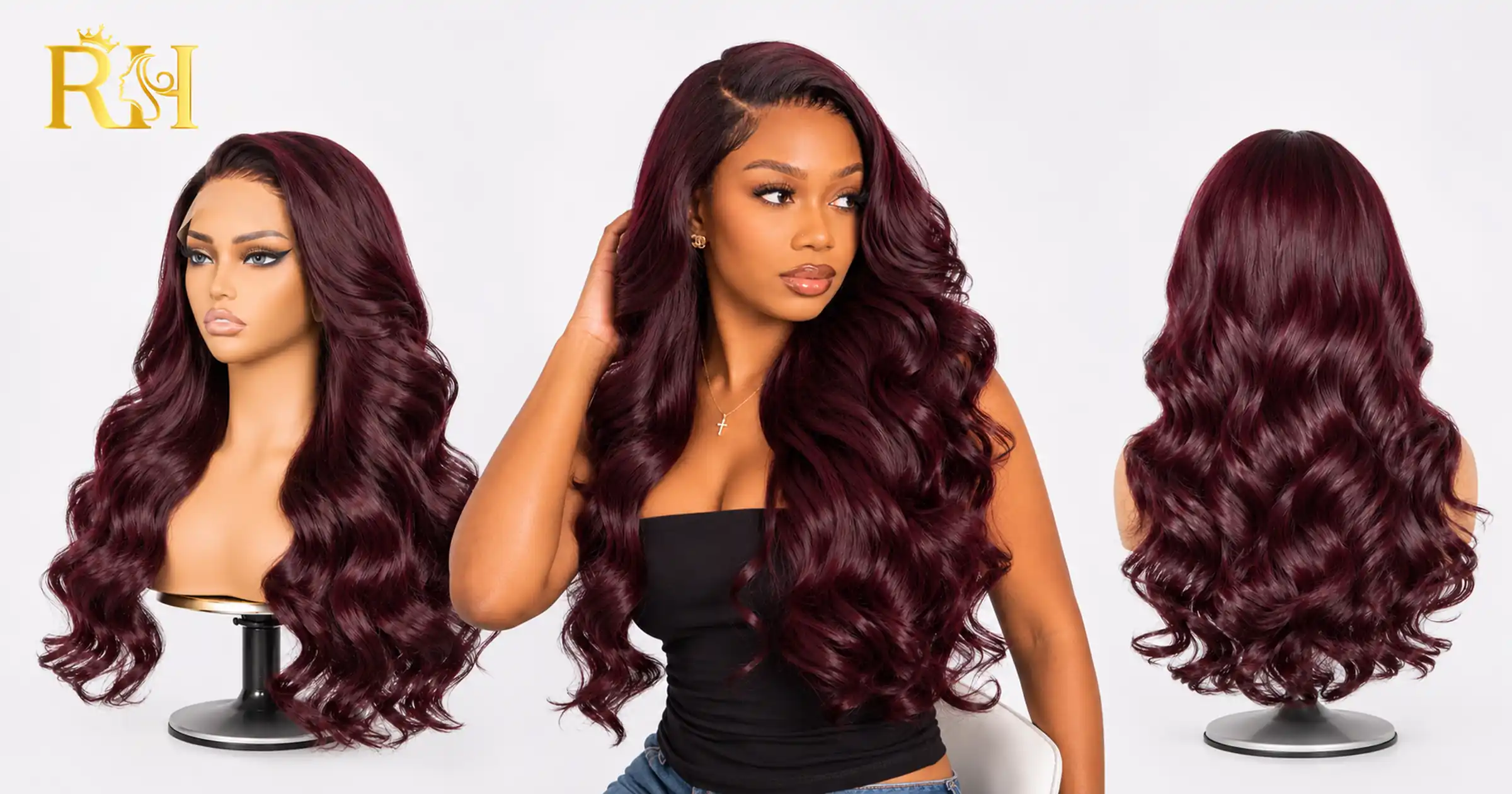
=>> Shop now: Rich Dark Plum Body Wave 5×5 HD Lace Closure Human Hair Wig, a glueless raw hair unit with room for a middle or side part
Body wave wig middle part
A body wave wig middle part is the cleanest version of the texture: flat on top, waves opening at the cheekbones, both sides even. It works on every lace size, a 2×6 included. Line the part up with the bridge of your nose, press both sides flat as above and tuck one or both sides behind your ears. If the waves start too high and widen your face, run a flat iron through the first two or three inches at the root, so the wave begins at cheekbone level.
More body wave wig hairstyles to try
| Style | How to do it | Lace it needs | Looks best at |
|---|---|---|---|
| Brushed-out glam waves | Brush through with a paddle brush, then smooth a drop of serum over the surface | Any | 18 to 26 inches |
| Defined wet-look waves | Mist with water, scrunch in mousse, air dry without touching | Any | 14 to 22 inches |
| Old Hollywood side sweep | Deep side part, brush every wave in one direction, clip the ridges for ten minutes | 5×5 closure or a frontal | 16 to 22 inches |
| Half-up, half-down | Section from temple to temple and tie at the crown | Frontal. On a closure, leave hair down at the temples | 18 inches and up |
| Low ponytail or low bun | Gather at the nape and leave loose waves at the temples | Any | 16 inches and up |
| High ponytail | Brush everything up to the crown | 360 or full lace | 20 inches and up |
| Body wave bob | Shoulder length, side part, ends turned under | Any, a 2×6 or 5×5 is plenty | 10 to 14 inches |
| Sleek straight day | Flat iron on low heat with protectant, then reset the wave after the next wash | Any | Any length |
Two of these depend on the lace more than on your skill. Body wave lace front wig styles such as a high half-up or a swept-back look need lace along the hairline, so they belong on a frontal. On a closure wig, keep some hair down around the face and the edge of the cap stays hidden.
=>> Shop now: Shoulder Length Body Wave Cuticle Aligned Parting HD Lace Wig, a body wave bob in raw hair, available on pre-order
How to choose a body wave wig: length, density, color and fit
Once the hair and the lace are settled, four choices are left. Each one changes how a body wave wig looks on you and how much work it takes to wear.
Length: where a body wave lands
Sellers measure wavy hair pulled straight. Once the hair springs back into its S, a body wave hangs about an inch or two shorter than the number on the listing, and a little more on a tighter set. If you’re between two lengths, take the longer one.
| Listed length | Where it lands on most women | Worth knowing |
|---|---|---|
| 10 to 14 inches | Chin to collarbone | Lightest and coolest. Reads as a wavy bob |
| 16 to 18 inches | Past the shoulders to the top of the chest | The easiest length to live with, and a good first wig |
| 20 to 22 inches | Mid-back | The classic body wave look. More detangling at the nape |
| 24 to 26 inches | Lower back to waist | Heavier. Ask for more density so the ends stay full |
| 28 to 30 inches | Waist to hip | A statement length. The weight pulls the wave looser |
Length changes the wave as well as the look. Long hair is heavy, and the weight stretches the top of the pattern, so a 28-inch body wave looks straighter at the crown than a 16-inch one from the same batch. Shorter units show the wave more clearly.
Density: how full the wave looks
Density is the seller’s estimate of how much hair is on the cap, and labels vary. Most shops use 130% for a light look, 150% for natural and full, and 180% or more for glam volume. Waves stand slightly apart from each other, so a body wave looks fuller than straight hair at the same density. For most wearers, 150% suits lengths up to 20 inches, and 180% keeps the ends from looking thin at 22 inches and beyond. Ask for the hair weight in grams as well. It is the one number you can check on a kitchen scale.
Black body wave wig: natural black, jet black or color
Most body wave wigs are sold in natural black, coded 1B. A black body wave wig in 1B is a soft off-black that shows brown in sunlight, the way undyed hair does. Jet black, coded 1, is dyed darker and looks more uniform. Match the wig to your brows and roots. 1B suits most people, and jet black can look flat next to brown-black brows.
Dark hair hides the wave a little, because the ridges catch less light. If you want the pattern to show from across a room, look at color with contrast: highlights, sometimes sold as “piano” color, or a deep tone such as plum or burgundy. If you plan to lighten the wig yourself, start with raw hair in its natural color and leave the lifting to a colorist. Read the warranty first. Many sellers, us included, stop covering hair once it has been bleached or dyed.
=>> Read more: Best Wigs for Black Women: Natural-Looking Guide, how to match lace, texture and length to your edges, your skin tone and your week
Cap size and fit
Measure around your head along the hairline, behind the ears and across the nape, with your own hair flat. Compare the number with the seller’s cap chart. Most ready-made caps are built for a head of about 22 to 22.5 inches. A glueless wig should stay put when you shake your head and leave no red line when you take it off. If the band presses at your temples by midday, it is too tight, and that pressure lands on your edges.
A quick way to decide
| If this is you | Start here |
|---|---|
| First wig, worn most days | Glueless 5×5 closure, 16 to 18 inches, 150% |
| You wear a deep side part | 13×4 or 13×6 frontal, 18 to 22 inches |
| Hot climate or gym days | Shoulder-length bob on a 2×6 or 5×5 closure |
| Your edges are thin or recovering | Glueless closure, no adhesive, a satin liner under the cap |
| You want the wave to show in photos | 20 to 24 inches, 180%, highlights or a deep color |
| You’ll color it later | Raw hair in natural black |
| You switch between wavy and straight | Raw or virgin hair with a steam-set wave, plus a set of flexi rods |
=>> Read more: How Much Does a Human Hair Wig Cost?, what moves the price of a human hair wig, from length to lace size
How to care for a body wave wig and keep the wave
A body wave wig needs two kinds of care: the care any human hair wig needs, and the care that keeps a set in place. The second kind comes down to one rule. Hair takes the shape it dries in. Every wash is a chance to put the wave back, or to lose it.
Wash day, step by step
- Detangle the dry hair from the ends up, with a wide-tooth comb or your fingers.
- Wet the hair with cool to lukewarm water, running it from root to tip. Don’t pile the hair on top of the cap.
- Smooth a sulfate-free shampoo down the lengths. Press and stroke. Don’t rub or twist.
- Rinse, then work conditioner from mid-length to the ends. Keep it off the lace, where it can loosen the knots. Comb it through and leave it for a few minutes.
- Rinse with cool water and press the water out with a microfiber towel.
- While the hair is damp, set the wave. Scrunch in a light mousse, or split the hair into four to six loose twists or braids. For a firmer set, use flexi rods.
- Dry it, as described below.
Wash after every 7 to 10 wears, or sooner if the hair feels coated or heavy.
Drying: don’t leave it wet for hours
Air drying sounds like the gentle choice, and it isn’t always. In a study in the Annals of Dermatology, researchers washed and dried hair tresses 30 times under different conditions. Hotter air did more harm to the hair’s surface. Yet a dryer held 15 cm away and kept moving did less damage than leaving hair to dry on its own, and only the air-dried hair showed damage to the cell membrane complex, the material that binds the fiber’s cells together.
For a wig, that means you shouldn’t leave a thick body wave wig soaking wet overnight. Put it on a stand and dry it on low heat, with the dryer about 15 cm (6 inches) from the hair and always moving, until it is mostly dry. Then let the twists or rods finish in the air before you take them out.
Heat: how hot is too hot?
Human hair takes heat, within limits. In a 2019 lab study of virgin Asian and Caucasian hair, heat damaged the cuticle, and the keratin lost its structure at about 237°C, or 459°F. The Asian hair in the test lost more protein, and most wig hair is Asian hair.
So keep wands and flat irons under 400°F. A body wave rarely needs more than 300 to 350°F for a refresh. Use a heat protectant every time, on dry hair only. The trichology review cited earlier recommends silicone-based protectants because they spread the heat along the fiber.
How to bring the wave back
| Method | What you need | Time | Best for |
|---|---|---|---|
| Braid or twist set | Damp hair, four to six loose braids, a satin bonnet | Overnight | A wave that has only softened |
| Flexi rods or large rollers | Damp hair, setting mousse, 8 to 12 rods | About 2 hours under a hooded dryer, or overnight | An even S close to the factory pattern |
| Curling wand | Dry hair, heat protectant, a 1.25 to 1.5 inch barrel | 20 to 30 minutes | A quick refresh between washes |
| Stylist reset | A salon roller or steam set | One visit | A unit that has gone almost straight |
With a wand, wrap each section away from your face, hold it for a few seconds, then let the curl cool in your palm or pinned in a clip before you drop it. Curls set as they cool. When every curl is cool, brush through once with a paddle brush and the curls open into a body wave.
Night care and storage
Take the wig off at night when you can and keep it on a stand, out of direct sun. If you sleep in it, put the hair in two loose braids under a satin bonnet, and never go to bed with it wet. Before coats and scarves, a loose braid protects the nape, where collars rub waves into tangles. Keep oils and heavy creams off the lace.
What sits under the wig matters as well. The AAD’s advice on head coverings applies here: silk or satin is gentler on hair than rougher fabric. Wear a satin liner, and keep your own hair braided loosely underneath.
Body wave wig problems and how to fix them
Most problems with a body wave wig have a fix that takes one wash day. Find yours in the table.
| Problem | Likely cause | What to do |
|---|---|---|
| The wave went almost straight after the first wash | A light steam set, or the hair dried hanging straight | Reset on rods while damp. If it drops again within days, tell the seller |
| Flat on top, puffy at the ends | Product build-up at the root, or the ends were brushed dry | Clarify once, then brush only damp hair or use a little serum |
| Frizz over the surface | Dry brushing, rough towel-drying or humid air | Detangle damp, press dry with microfiber, finish with a light serum |
| Tangles at the nape | Friction from collars, dry ends | Braid before coats, condition the ends, detangle from the bottom up |
| Matting that comes back after every wash | A stripped cuticle, showing once the coating has washed off | Deep condition. If it keeps matting, the hair is the problem, not your care |
| Shedding along the part | Knots loosened by oil, scrubbing or extra bleaching | Keep oil off the lace and wash the part with your fingertips |
| Lace lifting, or a sore or itchy hairline | A reaction to adhesive, or too much tension | Take the wig off and go glueless. See a dermatologist if it doesn’t settle |
| Closure waves looser than the rest | The closure and the wefts were set in separate batches | Reset the whole unit together on the same rods |
| Mirror shine that turns dry and rough | A silicone coating washing out | Nothing brings the coating back. Judge the hair after wash one |
Most of these trace back to one thing. The wave is a set, the set lives in the hair, and the hair is only as strong as its cuticle. Good hair forgives a bad wash day. Coated hair doesn’t.
=>> Read more: How to buy best quality human wigs, what a good unit looks like on day one, after the first wash and at month six
Frequently asked questions
What is a body wave wig? A body wave wig has hair set in wide, soft S-shaped waves, the loosest of the wave textures. It lies fairly flat at the root and bends from about cheekbone level down, so it looks like a blowout more than curls. You can get it on closure, lace front, full lace and non-lace caps.
Are body wave lace front wigs human hair? Some are, and some are synthetic or a blend. Listings often use similar photos for all three, so read the fiber line. Human hair can be colored, heat-styled and reset when the wave drops. If a long, full lace front is priced like a synthetic, expect synthetic fiber or heavily processed hair.
Does a Brazilian body wave wig come from Brazil? Usually not. In the wig trade, “Brazilian” describes thick, soft hair that holds a wave, and most of that hair is collected and processed in Asia. Judge the wig on its cuticle, how the wave was set, the hair weight in grams and the return terms.
Can I wear a side part on a body wave closure wig? Yes, if the closure is wide enough. A 5×5 reaches 2.5 inches to each side of center, which covers a side part above the arch of the brow. A 4×4 allows a slight side part, and a 2×6 is for middle parts. For a deep side part body wave wig, choose a frontal.
Does a body wave wig stay wavy after washing? A steam-set wave comes back after a wash if the hair dries in shape, and it loosens a little over the months. Set it in loose twists, braids or flexi rods while damp. A wave that falls flat after one wash was set too lightly.
Can you straighten a body wave wig? Yes, if it is human hair. Use a flat iron under 400°F with a heat protectant, on dry hair. Part of the wave returns after the next wash, and all of it after a reset on rods. Straightening often wears out a steam-set wave faster.
Body wave or deep body wave wig: which should I choose? Body wave is softer, easier to keep and closer to a blowout. A deep body wave wig is set tighter, so the pattern shows more and holds longer, with more work on wash day. Choose body wave for daily wear and deep body wave for volume.
How long does a human hair body wave wig last? With gentle care, a good human hair unit can last a year or more of regular wear, and raw hair tends to outlast processed hair. The lace usually wears out before the hair does. The wave needs a reset every few weeks to a few months, depending on how often you wash and heat-style.
Body wave wig human hair: the short version
The right body wave wig comes down to three choices. Choose the hair for its cuticle and for how the wave was set, not for the country on the label. Choose the lace for the part and the body wave wig styles you plan to wear: a 5×5 closure for a middle or side part with no glue, a frontal for a deep side part or hair worn back. Then choose length, density and color for your frame and your week.
After that, the wave is yours to keep. Let it dry in shape, keep the heat under 400°F and reset it when it softens.
Not sure which lace, length or density fits you? Send us a photo of the part you wear, your head measurement and the length you want on WhatsApp. We’ll suggest a lace size and density, tell you how the wave on that unit is set, and send the quote in writing before you order.
=>> Shop now: Body Wave Collection, pre-order body wave HD lace wigs in raw human hair
==========
- RAW HAIR LUXURY — MORE THAN JUST HAIR, IT’S CONFIDENCE
- Website: rawhairsglobal.com
- Instagram: @rawhairluxury
- WhatsApp: +1 604 841 9668